24時間365日サポート — いつでもお客様をサポートいたします。
お問い合わせ
Aerogel Blanket Market – Overview and Outlook by Potential Growth
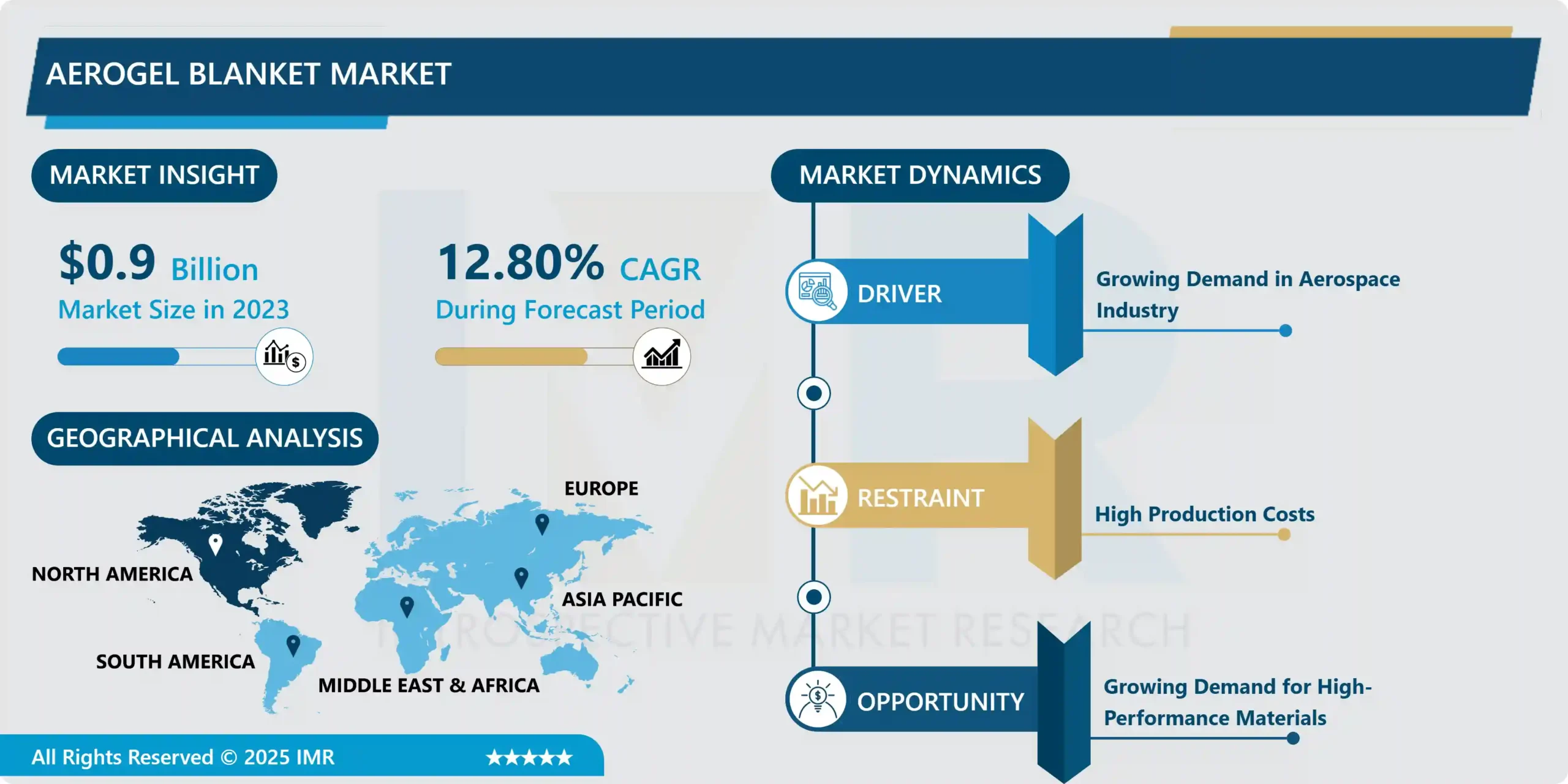
Aerogel Blanket Market Size Was Valued at USD 0.90 Billion in 2023, and is Projected to Reach USD 2.66 Billion by 2032, Growing at a CAGR of 12.80% From 2024-2032.An aerogel blanket is an insulating material produced from aerogel – a material characterized by significant thermal conductivity. Aerogel blankets are flexible, royal upholstery, thin and lightweight insulators that lower the rate of heat transfer. They find many uses in various areas where superior thermal insulation is demanded such as aerospace industries, construction industry and industry at large.

IMR
Description
Aerogel Blanket Market Synopsis
Aerogel Blanket Market Size Was Valued at USD 0.90 Billion in 2023, and is Projected to Reach USD 2.66 Billion by 2032, Growing at a CAGR of 12.80% From 2024-2032.
An aerogel blanket is an insulating material produced from aerogel – a material characterized by significant thermal conductivity. Aerogel blankets are flexible, royal upholstery, thin and lightweight insulators that lower the rate of heat transfer. They find many uses in various areas where superior thermal insulation is demanded such as aerospace industries, construction industry and industry at large.
The Aerogel blanket market has become one of the key segments of the advanced material market thanks to its specific characteristics such as high thermal insulation co-efficiency, low density and versatility of product applications. These blankets are widely being applied in the field of constructions for insulation purposes, aerospace industries, oil & gas industry and automobile industry where aspect of energy control and non-stranded lighter weight products plays a significant role. Increased consciousness towards energy-saving and a variety of Asian regulatory policies concerning energy efficiency in structures has propelled the need for aerogel blankets as the best insulator. Similarly, improvements in the technology used to produce aerogel and overall cost reduction has also contributed to the progress of the market. China and India are experiencing higher growth because of industrialization and urbanization, and the firm persistently targets North America and Europe due to the durable aerospace and automotive industries. Due to the growing demand for sustainable buildings and infrastructure, the aerogel blanket market is expected to grow further, with potential new uses and enhancement in the characteristics of the aerogel blanket products playing the key role here.
Aerogel Blanket Market Trend Analysis
Energy Efficiency and Sustainability
Presently, the primary driver of the aerogel blanket market is the rising R&D on eco-friendly products particularly in construction and automobile industries. As the regulations increase and codes being implemented on buildings being developed become even stricter, there is definitely lots of demand for building materials that not only meet these codes but also those that can help in meeting environmental objectives. Aerogel blankets have gradually become a prominent solution since these products possess great thermal insulating characteristics that reduce energy loss in certain structures. Due to their low mass and nearly zero effect on the environment they should be used for energy conserving structures like passive houses as well as green roofs where it is essential to sustain optimal thermal properties.
Besides the home use, more manufactures of aerogel blankets are incorporating them into commercial structures, thus significantly propelling the market. The use of these materials fits the objectives of minimizing energy, and thus carbon, utilization to complement worldwide conservation measures. Given the emerging shift toward sustainability in the construction industry, aerogel technology is poised to receiving wider acceptance and implementation surrounding sustainable designs for energy efficiency while not compromising on Stylistic and Structural considerations. This tendency proves not only people increased consciousness of environment problems, but also the progress of material science, and ingeniously, have to use the aerogel blankets for the modern construction issues.
Expanding Applications of Aerogel Blankets in Aerospace and Oil & Gas Industries
The industries that are most concerned with insulation, such as aerospace industry and oil and gas industries, are more and more often exploiting the possibilities of aerogel blankets, based on these properties. Advanced composites are widely applicable in aerospace industries and their primary need for materials with a lightweight and high-temperature stability is crucial. Of all the types of thermal insulations, which are commonly used in packaging and other applications, aerogel blankets are outstanding because of their high-performance to weight ratio for use in aerospace applications. This not only benefits fuel economy but it also positively affects safety as crucial parts of a plane do not get in contact with high or low temperatures during the flight. With the advancement in aerospace industry, introduce of aerogel in products are believed in future will enhance the aerospace industry and new designs of aircraft.
Similarly, the oil and gas industry uses aerogel blankets for insulation of pipelines and equipment in the hope of increasing efficiency and safety in extremely conditions. The stability offered by aerogel in terms of insulation minimizes heat exchange between the building and the external environment to enable regulation of energy and control against problems resulting from temperature changes. Furthermore, manufacturing technology is improving and costs for aerogel products, which causes increasing usage of the aerogel in different fields. Current work includes optimization of the mechanical properties of the aerogel blankets themselves and improving their overall flexibility so they can be applied to a variety of industries that have not yet embraced this technology. It is for this reason that this continued evolution not only consolidates aerogel blankets in the market but also orients them as the material of future insulation.
Aerogel Blanket Market Segment Analysis:
Aerogel Blanket Market Segmented based on By Material Type, By Form, By Layer,By Application, By End-user.
By Material Type, Silica segment is expected to dominate the market during the forecast period.
Mortar is a blend of silica or siliceous material, which is used extensively due to its superior thermal conductivity and is prized for its usefulness in many industries. It has a high melting point and thus to withstand high temperatures without deforming, and it has very low coefficient of thermal conductivity; thus good insulating property against heat. These characteristics render silica profound for applications that require sound thermal stability in high temperatures. For example, silica is employed to isolate the pipelines; tanks and the likes in the oil and gas industry to minimize the heat loss in the extraction of oil and gas. This not only improves efficiency of the energy used but also helps to preserve the material in harsh operating parameters.
Apart from Oil and gas sector, silica finds uses in other commercial uses in industries like construction and aerospace where the stability of thermal conductivity is essential. In construction, silica-based insulation materials are used in building envelopes so as to minimize on energy utilization for heating and cooling. In the same manner, in aerospace industry the silica is used as a thermal protection shield for operational aircraft parts in order to endure the extreme conditions of flying at high altitudes, without compromising the performance of those parts at optimal temperatures conditions. Silica is a versatile material, and its thermal performance characteristics put it in forefront league of niche applications which need reliable insulation solutions where high temperature is involved.
By End-user, Refining Industry segment held the largest share in 2023
The refining industry is exposed to highly pressurized conditions, some of the processes taking place at temperatures above 1000degrees F. For optimum operational performance, it becomes compulsory to quality insulating material. These materials assist in reducing heat transfer hence all times promoting energy use and cutting expenses. Insulation is also important for achieving the required temperature in the process equipment including the reactors and distillation columns, the requirements are important to secure high yield of the product and also the quality of the product. Through controlling heat transfer, insulation material plays a vital role of improving the working conditions as there will be little chances of overheating and subsequently breakdowns of equipments.
However, the refining industry has some problems in their production due to the fact that the products that undergo refining are often corrosive substances. Therefore, film thickness is not the only property of insulation materials that it has to exhibit high temperature and chemical stability. Modern prefabricated insulation materials are based on silica and ceramics and are used for achieving maximum heat shield while operating in extreme conditions for a long time. These materials can be fashioned for particular uses, for achieving the required thermal conductivity as well as sturdiness for distinct operating processes in the refining industry. In making the decision to improve insulation quality, refining companies can improve efficiency, safety and sustainability of their facility, in addition to meeting regulatory expectations and minimizing their carbon footprint.
Aerogel Blanket Market Regional Insights:
North America is Expected to Dominate the Market Over the Forecast period
The growth of the aerogel blanket market in North America depends on various innovative technologies across some critical industries such as aerospace and automotive ones as well as construction. Such industries make use of aerogel blankets because of the outstanding thermal resistances, lightweight nature, and insulation superiority of aerogel blankets to normal insulators. In aerospace programs, such as for instance, the strength that is low of is crucial for increasing Points of passion and effectiveness. In the same manner, aerogel blankets are used in car manufacturing to enhance the thermal performance of vehicles boosting the efficiency rates of energy friendly cars as well as comfort of their occupants. Construction industry is also growing rapidly due to increase in demand from builders for efficient usage of energy to prevent rising legal requirements on environmental control and people’s desire for guaranteed comfortable living in comfortable ecological environment.
Furthermore, the aerogel innovation and sustainability in the North American market are remarkable and essential to create a demand for the aerogel. Both government and industries are currently working hard to inject more resources into Research and Development so as to bring better and cheaper aerogel products in to the market. This synergy has helped in creating a suitable platform for new application introduction and growth of aerogel blankets for different uses in diverse industries. With sustainability being incorporated into construction and manufacturing processes in developed countries and increasing consumer awareness of aerogel blankets as high-performance insulation products, the opportunity for growth is vast and ever-growing in the North American aerogel blanket market.
Active Key Players in the Aerogel Blanket Market
Active Aerogels (Portugal)
Aerogel Technologies, LLC (U.S.)
Aspen Aerogels, Inc. (U.S.)
BASF SE (Germany)
Cabot Corporation (U.S.)
Green Earth Aerogel Technologies (Spain)
DuPont (U.S.)
HUATAO GROUP LTD. (China)
ENERSENS (France)
Svenska Aerogel Holding AB (Sweden)
Dow (U.S.)
JIOS Aerogel Corporation (South Korea)
PBM Insulations Pvt. Ltd. (India)
Acoustiblok UK Limited (U.K.)
ARMACELL (Luxembourg)
Thermablok Aerogels Limited (U.K.) and Other Active Players
Chapter 1: Introduction
1.1 Scope and Coverage
Chapter 2:Executive Summary
Chapter 3: Market Landscape
3.1 Market Dynamics
3.1.1 Drivers
3.1.2 Restraints
3.1.3 Opportunities
3.1.4 Challenges
3.2 Market Trend Analysis
3.3 PESTLE Analysis
3.4 Porter’s Five Forces Analysis
3.5 Industry Value Chain Analysis
3.6 Ecosystem
3.7 Regulatory Landscape
3.8 Price Trend Analysis
3.9 Patent Analysis
3.10 Technology Evolution
3.11 Investment Pockets
3.12 Import-Export Analysis
Chapter 4: Aerogel Blanket Market by Material Type (2018-2032)
4.1 Aerogel Blanket Market Snapshot and Growth Engine
4.2 Market Overview
4.3 Silica
4.3.1 Introduction and Market Overview
4.3.2 Historic and Forecasted Market Size in Value USD and Volume Units
4.3.3 Key Market Trends, Growth Factors, and Opportunities
4.3.4 Geographic Segmentation Analysis
4.4 Polymers
4.5 Carbon
Chapter 5: Aerogel Blanket Market by Form (2018-2032)
5.1 Aerogel Blanket Market Snapshot and Growth Engine
5.2 Market Overview
5.3 Blanket
5.3.1 Introduction and Market Overview
5.3.2 Historic and Forecasted Market Size in Value USD and Volume Units
5.3.3 Key Market Trends, Growth Factors, and Opportunities
5.3.4 Geographic Segmentation Analysis
5.4 Particle
5.5 Panel
5.6 Monolith
Chapter 6: Aerogel Blanket Market by Layer (2018-2032)
6.1 Aerogel Blanket Market Snapshot and Growth Engine
6.2 Market Overview
6.3 Mono-Layer
6.3.1 Introduction and Market Overview
6.3.2 Historic and Forecasted Market Size in Value USD and Volume Units
6.3.3 Key Market Trends, Growth Factors, and Opportunities
6.3.4 Geographic Segmentation Analysis
6.4 Multi-Layer
Chapter 7: Aerogel Blanket Market by Application (2018-2032)
7.1 Aerogel Blanket Market Snapshot and Growth Engine
7.2 Market Overview
7.3 Oil and Gas
7.3.1 Introduction and Market Overview
7.3.2 Historic and Forecasted Market Size in Value USD and Volume Units
7.3.3 Key Market Trends, Growth Factors, and Opportunities
7.3.4 Geographic Segmentation Analysis
7.4 Automotive
7.5 Cryogenic
7.6 Performance Coatings
7.7 Aerospace
Chapter 8: Aerogel Blanket Market by End-user (2018-2032)
8.1 Aerogel Blanket Market Snapshot and Growth Engine
8.2 Market Overview
8.3 Refining Industry
8.3.1 Introduction and Market Overview
8.3.2 Historic and Forecasted Market Size in Value USD and Volume Units
8.3.3 Key Market Trends, Growth Factors, and Opportunities
8.3.4 Geographic Segmentation Analysis
8.4 Building and Construction
8.5 Households
8.6 Pharmaceuticals
8.7 Transportation
Chapter 9: Company Profiles and Competitive Analysis
9.1 Competitive Landscape
9.1.1 Competitive Benchmarking
9.1.2 Aerogel Blanket Market Share by Manufacturer (2024)
9.1.3 Industry BCG Matrix
9.1.4 Heat Map Analysis
9.1.5 Mergers and Acquisitions
9.2 ACTIVE AEROGELS (PORTUGAL)
9.2.1 Company Overview
9.2.2 Key Executives
9.2.3 Company Snapshot
9.2.4 Role of the Company in the Market
9.2.5 Sustainability and Social Responsibility
9.2.6 Operating Business Segments
9.2.7 Product Portfolio
9.2.8 Business Performance
9.2.9 Key Strategic Moves and Recent Developments
9.2.10 SWOT Analysis
9.3 AEROGEL TECHNOLOGIES
9.4 LLC (U.S.)
9.5 ASPEN AEROGELS INC. (U.S.)
9.6 BASF SE (GERMANY)
9.7 CABOT CORPORATION (U.S.)
9.8 GREEN EARTH AEROGEL TECHNOLOGIES (SPAIN)
9.9 DUPONT (U.S.)
9.10 HUATAO GROUP LTD. (CHINA)
9.11 ENERSENS (FRANCE)
9.12 SVENSKA AEROGEL HOLDING AB (SWEDEN)
9.13 DOW (U.S.)
9.14 JIOS AEROGEL CORPORATION (SOUTH KOREA)
9.15 PBM INSULATIONS PVT. LTD. (INDIA)
9.16 ACOUSTIBLOK UK LIMITED (U.K.)
9.17 ARMACELL (LUXEMBOURG)
9.18 THERMABLOK AEROGELS LIMITED (U.K.)
Chapter 10: Global Aerogel Blanket Market By Region
10.1 Overview
10.2. North America Aerogel Blanket Market
10.2.1 Key Market Trends, Growth Factors and Opportunities
10.2.2 Top Key Companies
10.2.3 Historic and Forecasted Market Size by Segments
10.2.4 Historic and Forecasted Market Size by Material Type
10.2.4.1 Silica
10.2.4.2 Polymers
10.2.4.3 Carbon
10.2.5 Historic and Forecasted Market Size by Form
10.2.5.1 Blanket
10.2.5.2 Particle
10.2.5.3 Panel
10.2.5.4 Monolith
10.2.6 Historic and Forecasted Market Size by Layer
10.2.6.1 Mono-Layer
10.2.6.2 Multi-Layer
10.2.7 Historic and Forecasted Market Size by Application
10.2.7.1 Oil and Gas
10.2.7.2 Automotive
10.2.7.3 Cryogenic
10.2.7.4 Performance Coatings
10.2.7.5 Aerospace
10.2.8 Historic and Forecasted Market Size by End-user
10.2.8.1 Refining Industry
10.2.8.2 Building and Construction
10.2.8.3 Households
10.2.8.4 Pharmaceuticals
10.2.8.5 Transportation
10.2.9 Historic and Forecast Market Size by Country
10.2.9.1 US
10.2.9.2 Canada
10.2.9.3 Mexico
10.3. Eastern Europe Aerogel Blanket Market
10.3.1 Key Market Trends, Growth Factors and Opportunities
10.3.2 Top Key Companies
10.3.3 Historic and Forecasted Market Size by Segments
10.3.4 Historic and Forecasted Market Size by Material Type
10.3.4.1 Silica
10.3.4.2 Polymers
10.3.4.3 Carbon
10.3.5 Historic and Forecasted Market Size by Form
10.3.5.1 Blanket
10.3.5.2 Particle
10.3.5.3 Panel
10.3.5.4 Monolith
10.3.6 Historic and Forecasted Market Size by Layer
10.3.6.1 Mono-Layer
10.3.6.2 Multi-Layer
10.3.7 Historic and Forecasted Market Size by Application
10.3.7.1 Oil and Gas
10.3.7.2 Automotive
10.3.7.3 Cryogenic
10.3.7.4 Performance Coatings
10.3.7.5 Aerospace
10.3.8 Historic and Forecasted Market Size by End-user
10.3.8.1 Refining Industry
10.3.8.2 Building and Construction
10.3.8.3 Households
10.3.8.4 Pharmaceuticals
10.3.8.5 Transportation
10.3.9 Historic and Forecast Market Size by Country
10.3.9.1 Russia
10.3.9.2 Bulgaria
10.3.9.3 The Czech Republic
10.3.9.4 Hungary
10.3.9.5 Poland
10.3.9.6 Romania
10.3.9.7 Rest of Eastern Europe
10.4. Western Europe Aerogel Blanket Market
10.4.1 Key Market Trends, Growth Factors and Opportunities
10.4.2 Top Key Companies
10.4.3 Historic and Forecasted Market Size by Segments
10.4.4 Historic and Forecasted Market Size by Material Type
10.4.4.1 Silica
10.4.4.2 Polymers
10.4.4.3 Carbon
10.4.5 Historic and Forecasted Market Size by Form
10.4.5.1 Blanket
10.4.5.2 Particle
10.4.5.3 Panel
10.4.5.4 Monolith
10.4.6 Historic and Forecasted Market Size by Layer
10.4.6.1 Mono-Layer
10.4.6.2 Multi-Layer
10.4.7 Historic and Forecasted Market Size by Application
10.4.7.1 Oil and Gas
10.4.7.2 Automotive
10.4.7.3 Cryogenic
10.4.7.4 Performance Coatings
10.4.7.5 Aerospace
10.4.8 Historic and Forecasted Market Size by End-user
10.4.8.1 Refining Industry
10.4.8.2 Building and Construction
10.4.8.3 Households
10.4.8.4 Pharmaceuticals
10.4.8.5 Transportation
10.4.9 Historic and Forecast Market Size by Country
10.4.9.1 Germany
10.4.9.2 UK
10.4.9.3 France
10.4.9.4 The Netherlands
10.4.9.5 Italy
10.4.9.6 Spain
10.4.9.7 Rest of Western Europe
10.5. Asia Pacific Aerogel Blanket Market
10.5.1 Key Market Trends, Growth Factors and Opportunities
10.5.2 Top Key Companies
10.5.3 Historic and Forecasted Market Size by Segments
10.5.4 Historic and Forecasted Market Size by Material Type
10.5.4.1 Silica
10.5.4.2 Polymers
10.5.4.3 Carbon
10.5.5 Historic and Forecasted Market Size by Form
10.5.5.1 Blanket
10.5.5.2 Particle
10.5.5.3 Panel
10.5.5.4 Monolith
10.5.6 Historic and Forecasted Market Size by Layer
10.5.6.1 Mono-Layer
10.5.6.2 Multi-Layer
10.5.7 Historic and Forecasted Market Size by Application
10.5.7.1 Oil and Gas
10.5.7.2 Automotive
10.5.7.3 Cryogenic
10.5.7.4 Performance Coatings
10.5.7.5 Aerospace
10.5.8 Historic and Forecasted Market Size by End-user
10.5.8.1 Refining Industry
10.5.8.2 Building and Construction
10.5.8.3 Households
10.5.8.4 Pharmaceuticals
10.5.8.5 Transportation
10.5.9 Historic and Forecast Market Size by Country
10.5.9.1 China
10.5.9.2 India
10.5.9.3 Japan
10.5.9.4 South Korea
10.5.9.5 Malaysia
10.5.9.6 Thailand
10.5.9.7 Vietnam
10.5.9.8 The Philippines
10.5.9.9 Australia
10.5.9.10 New Zealand
10.5.9.11 Rest of APAC
10.6. Middle East & Africa Aerogel Blanket Market
10.6.1 Key Market Trends, Growth Factors and Opportunities
10.6.2 Top Key Companies
10.6.3 Historic and Forecasted Market Size by Segments
10.6.4 Historic and Forecasted Market Size by Material Type
10.6.4.1 Silica
10.6.4.2 Polymers
10.6.4.3 Carbon
10.6.5 Historic and Forecasted Market Size by Form
10.6.5.1 Blanket
10.6.5.2 Particle
10.6.5.3 Panel
10.6.5.4 Monolith
10.6.6 Historic and Forecasted Market Size by Layer
10.6.6.1 Mono-Layer
10.6.6.2 Multi-Layer
10.6.7 Historic and Forecasted Market Size by Application
10.6.7.1 Oil and Gas
10.6.7.2 Automotive
10.6.7.3 Cryogenic
10.6.7.4 Performance Coatings
10.6.7.5 Aerospace
10.6.8 Historic and Forecasted Market Size by End-user
10.6.8.1 Refining Industry
10.6.8.2 Building and Construction
10.6.8.3 Households
10.6.8.4 Pharmaceuticals
10.6.8.5 Transportation
10.6.9 Historic and Forecast Market Size by Country
10.6.9.1 Turkiye
10.6.9.2 Bahrain
10.6.9.3 Kuwait
10.6.9.4 Saudi Arabia
10.6.9.5 Qatar
10.6.9.6 UAE
10.6.9.7 Israel
10.6.9.8 South Africa
10.7. South America Aerogel Blanket Market
10.7.1 Key Market Trends, Growth Factors and Opportunities
10.7.2 Top Key Companies
10.7.3 Historic and Forecasted Market Size by Segments
10.7.4 Historic and Forecasted Market Size by Material Type
10.7.4.1 Silica
10.7.4.2 Polymers
10.7.4.3 Carbon
10.7.5 Historic and Forecasted Market Size by Form
10.7.5.1 Blanket
10.7.5.2 Particle
10.7.5.3 Panel
10.7.5.4 Monolith
10.7.6 Historic and Forecasted Market Size by Layer
10.7.6.1 Mono-Layer
10.7.6.2 Multi-Layer
10.7.7 Historic and Forecasted Market Size by Application
10.7.7.1 Oil and Gas
10.7.7.2 Automotive
10.7.7.3 Cryogenic
10.7.7.4 Performance Coatings
10.7.7.5 Aerospace
10.7.8 Historic and Forecasted Market Size by End-user
10.7.8.1 Refining Industry
10.7.8.2 Building and Construction
10.7.8.3 Households
10.7.8.4 Pharmaceuticals
10.7.8.5 Transportation
10.7.9 Historic and Forecast Market Size by Country
10.7.9.1 Brazil
10.7.9.2 Argentina
10.7.9.3 Rest of SA
Chapter 11 Analyst Viewpoint and Conclusion
11.1 Recommendations and Concluding Analysis
11.2 Potential Market Strategies
Chapter 12 Research Methodology
12.1 Research Process
12.2 Primary Research
12.3 Secondary Research
Q1: What would be the forecast period in the Aerogel Blanket Market research report?
A1: The forecast period in the Market research report is 2024-2032.
Q2: Who are the key players in the Aerogel Blanket Market?
A2: Active Aerogels (Portugal), Aerogel Technologies, LLC (U.S.), Aspen Aerogels, Inc. (U.S.), BASF SE (Germany), Cabot Corporation (U.S.), Green Earth Aerogel Technologies (Spain), DuPont (U.S.), HUATAO GROUP LTD. (China), ENERSENS (France), Svenska Aerogel Holding AB (Sweden), Dow (U.S.), JIOS Aerogel Corporation (South Korea), PBM Insulations Pvt. Ltd. (India), Acoustiblok UK Limited (U.K.), ARMACELL (Luxembourg), and Thermablok Aerogels Limited (U.K.) and among others
Q3: What are the segments of the Aerogel Blanket Market?
A3: The Aerogel Blanket Market is segmented into By Material Type, By Form, By Layer,By Application, By End-user and region. By Material Type, the market is categorized into Silica, Polymers, and Carbon, Layer: Mono-Layer and Multi-Layer.By Form, the market is categorized into Blanket, Particle, Panel, and Monolith.ByApplication, the market is categorized into Oil and Gas, Automotive, Cryogenic, Performance Coatings, and Aerospace.By End-user, the market is categorized into Refining Industry, Building and Construction, Households, Pharmaceuticals, and Transportation.By region, it is analyzed across North America (U.S.; Canada; Mexico), Europe (Germany; U.K.; France; Italy; Russia; Spain, etc.), Asia-Pacific (China; India; Japan; Southeast Asia, etc.), South America (Brazil; Argentina, etc.), Middle East & Africa (Saudi Arabia; South Africa, etc.).
Q4: What is the Aerogel Blanket Market?
A4: An aerogel blanket is a type of thermal insulator, which is manufactured from aerogel – a highly porous material with some of the highest possible level of insulation. The aerogel blankets created by this company are slim, portable and possess low thermal conductance thus slowing down heat convection. They are employed where high performance insulation is needed for example in aerospace or building construction field plus in industries.
Q5: How big is the Aerogel Blanket Market Market Name Market?
A5: Aerogel Blanket Market Size Was Valued at USD 0.90 Billion in 2023, and is Projected to Reach USD 2.66 Billion by 2032, Growing at a CAGR of 12.80% From 2024-2032.
How to buy a report from Megatrends.jp
On the product page, select the license you want: Single User License or Enterprise License.
Select the report language:
- English Report
- English Report + Japanese Translation
Click the Buy Now button.
You’ll be redirected to the checkout page. Enter your company and payment details.
Click Place Order to complete your purchase.
Confirmation: You’ll receive an order confirmation email. Our team will then follow up with your report delivery.
If you have questions, fill out the contact form below or email us at sales1@megatrends.jp.
Thank you for choosing Megatrends.jp!