24時間365日サポート — いつでもお客様をサポートいたします。
お問い合わせ
Applicant Tracking Systems Software Market 2024-2032
The universal demand for efficient recruiting procedures is primarily driving the substantial expansion of the market for applicant tracking systems (ATS) software. By facilitating the administration of recruitment workflows, including candidate selection and job posting, ATS solutions reduce time-to-hire and enhance hire quality.

IMR
Description
Applicant Tracking Systems Software Market Synopsis
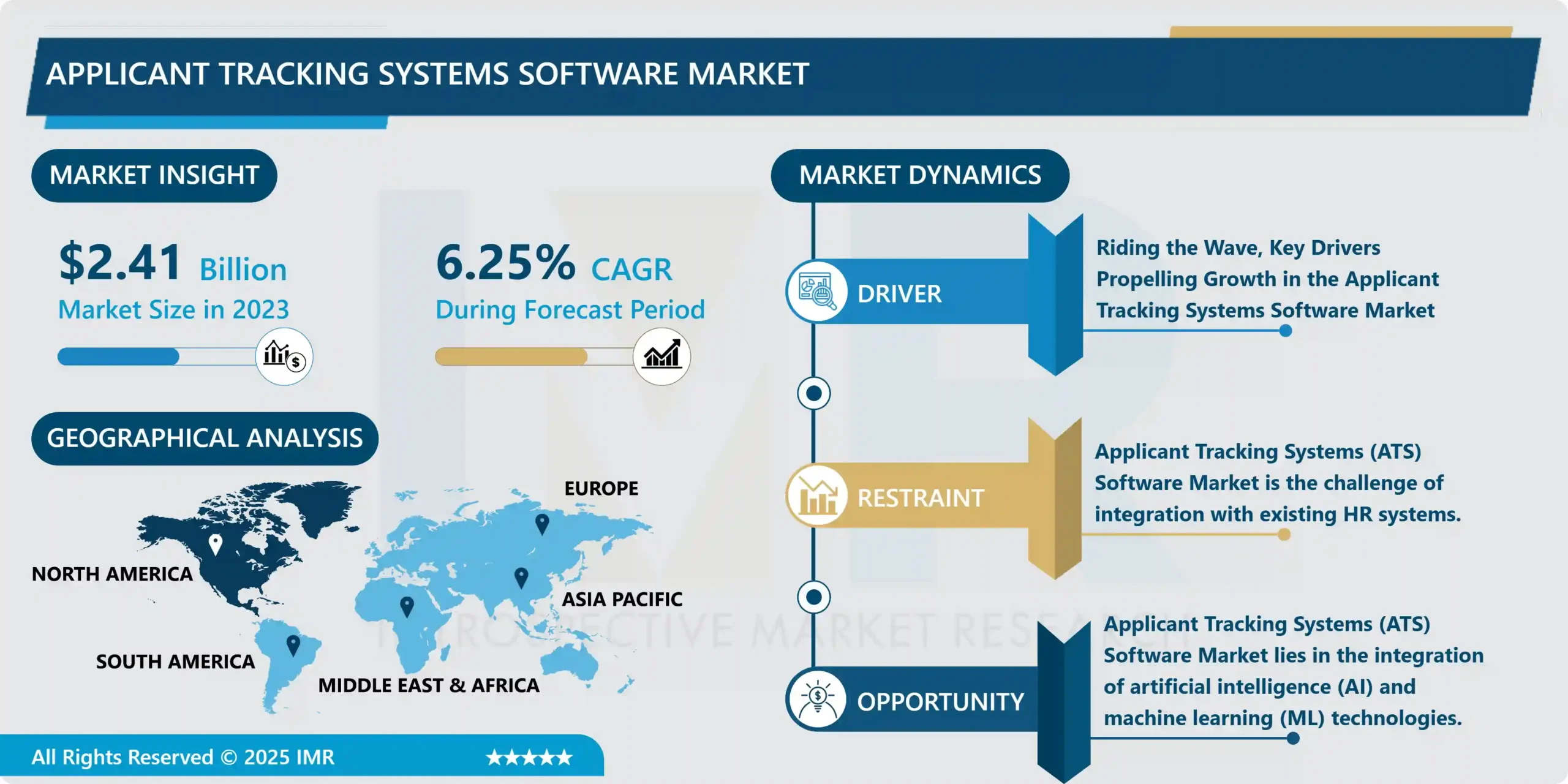
Applicant Tracking Systems Software Market Size Was Valued at USD 2.41 Billion in 2023, and is Projected to Reach USD 4.16 Billion by 2032, Growing at a CAGR of 6.25 % From 2024-2032.
The largest force behind the explosive growth in the applicant tracking systems (ATS) software market is the universal necessity for efficient recruitment methods. By automating recruitment process frameworks, candidate screening, and job postings, ATS systems accelerate time-to-hire and improve hire quality. Top players in the market are struggling to develop adaptable platforms that integrate with other human resources tools and utilize AI to enhance the sourcing and vetting of candidates.
Major market factors are related to the need to face strict employment regulations and the growing demand for talent solutions, especially in highly competitive labor markets. Small to medium-sized enterprises (SMEs) are slowly embracing ATS software as a way to optimize the process of recruitment. Yet, integration complications and questions of data privacy remain a barrier. The ATS software market is expected to keep growing, and North American and European countries will be at the forefront due to their developed HR technology environment and focus on workforce optimization.
The recruitment software market has been steadily developing due to the increased necessity of an efficient hiring process across many industries. With the recognition of the significance of the companies to automate recruitment, the ATS software market is growing. It is reported that the total ATS market around the world was in several billions of dollars and is predicted to go on constantly growing at a healthy pace.
Modern ATS software provides a wide range of features and functionality that are aimed at simplifying the recruitment process. Common characteristics encompass resume parsing, job posting, candidate tracking, interview scheduling, collaboration tools, analytics and reporting, and integration with other HR systems. A lot of the ATS systems involve AI and ML algorithms to improve candidate sourcing, screening, and matching.
Integration of other HR and business systems is an important factor that organisations think about when they are assessing ATS software. Main ATS providers provide advanced integration capacities. They enable the smooth linking of HRIS (Human Resource Information Systems), CRM (Customer Relationship Management) software, job boards, social media, and other third-party applications. Furthermore, ATS systems usually offer customization settings that allow the adaptation to the particular needs and processes used by various companies.
Multiple factors are driving change in the ATS software market. These trends include the increasing use of cloud-based ATS solutions, the advent of mobile recruiting apps for on-the-spot candidate outreach and interaction, the attention paid to candidate experience and employer branding, the rise of AI-powered recruiting tools, and the concentration on diversity, equity, and inclusion in hiring. Undoubtedly, as companies endeavor to remain competitive in the employee search field, they are going to devote more resources to ATS systems that offer ease, scale, and creativity
Applicant Tracking Systems Software Market Trend Analysis
AI and Automation Integration is one of the major trends in Applicant Tracking Systems Software Market
The Applicant Tracking Systems (ATS) software market is witnessing a rapid integration of artificial intelligence and automation technologies, being one of the noticeable trends. This integration is revolutionizing traditional recruitment processes through workflow simplification, enhanced candidate screening, and talent acquisition optimization.
AI-based ATS systems utilize machine learning algorithms to analyze applicant data and can help recruiters in finding the most suitable candidates more quickly. Not only this, but the systems can also automate the repetitive tasks such as resume parsing, candidate scoring, and interview scheduling, allowing the recruiters to focus on strategic activities which are of high value.
Additionally, AI-powered ATS systems are good at predictive analytics which can be used by organizations to forecast hiring needs, discover talent gaps and use data to make decisions. AI and automation are capable of eliminating human error, which will lead to more accurate and faster recruitment processes. Moreover, the usage of these technologies will reduce the bias during candidate selection and improve the overall efficiency.
On the other hand, automation integration within ATS platforms is far more comprehensive than just recruitment processes as it also covers onboarding, employee engagement, and workforce management. This complete strategy not only upgrades the candidate experience but also increases the employee retention rate and organizational effectiveness.
Essentially, AI and automation integration is a revolutionary trend reshaping the ATS software market in such a way that employers are able to stay competitive in the present-day fast-paced job market while driving innovations and efficiency in the recruitment processes.
Enhanced Candidate Experience is one of the major trends of the Applicant Tracking Systems Software Market
The enhancement of candidate experience is becoming a more popular and important trend in the ATS software market. This move highlights the importance of enabling job candidates to have an exciting and smooth journey throughout the recruitment process.
Present-day ATSs are paying more attention to improving the candidate experience, from the appplication stage and continuing through onboarding, with a target of generating favorable attitudes and solidifying strong employer-candidate linkages.
One of the key factors in optimizing the candidate experience involves the incorporation of mobile-friendly applications and user-friendly interfaces that allow applicants to easily explore job opportunities and submit resumes from their preferred devices.
Moreover, the recruiter is also able to set up personalized communication channels to ensure transparency of the recruitment process and candidates are updated regularly on status of their applications.
On top of that, the introduction of self-service portals to ATS tools allow candidates to proactively track the progress of their applications, update information and whether their accounts are active or not. Moreover, the higher the level of autonomy, the more candidates are happy as well as it reduces the job of recruiters.
Moreover, many upgraded ATS (applicant tracking systems) use interactive components such as introductory videos, gamified selection, and virtual organizational visits; the interactive features definitely build a striking and exhilarating encounter for job seekers.
Organizations can create an employer brand that projects a positive image, get the right people that are the best fit, and stand out among competitors by making candidate experience the most important priority.
In essence, applicant tracking system (ATS) platforms that implement candidate-centric design and functionality are more effectively positioned to satisfy the ever-changing demands of recruiting organizations and candidates.
Applicant Tracking Systems Software Market Segment Analysis:
Applicant Tracking Systems Software Market Segmented based on By Type and By Application
By Type, On-Premise segment is expected to dominate the market during the forecast period
The demand for the global applicant tracking software (ATS) market is set to skyrocket due to the requirement for a lot of sectors to realign recruitment procedures. Via functions like tracking candidates, resume parsing, and communication, the ATS technology cuts the red tape out of the hiring process and saves the organization time and money.
The two form of the deployment which divide the ATS market are on-premise and cloud-based solutions. A further extension of this is on-premise ATS software that is set up and maintained on company infrastructure, resulting in extensive customization and control at the cost of a significant initial investment and periodic maintenance.
By contrast, external vendors host and run ATS services in the cloud. This solutions point out the benefits such as scalability, flexibility, and accessibility from any place with the internet connection. SaaS models are multiplying, leading to a gradual change to cloud solutions as they bring simplicity and efficiency to the implementation process.
The deployment of ATS technologies across the globe is being driven by an increase in demand for both the traditional and cloud-based models. The cloud-based applications in ATS are gaining popularity because of the benefits of cost effectiveness, scalability, and remote access. Additionally, with enterprises rapidly adopting remote work arrangement and digital transformations, the COVID-19 pandemic has accelerated the cloud-based technology adoption.
SAP SE, Oracle Corporation, Workday Inc., IBM Corporation, Cornerstone OnDemand Inc. – these companies make up the top five players in the global Applicant Tracking System (ATS) market. These organizations emphasize on the fact that they have AI integration, mobile optimization and advanced analytics that integrate with decision-making in the process of recruitment to stay competitive through constant innovation.
The importance of talent acquisition automation increases, as well as cloud-based solutions that give businesses regardless of their sizes the opportunity to be scalable and adaptable, therefore, the global ATS market is anticipated to keep growing as it has done recently.
By Application, Retail and Consumer Goods segment held the largest share in 2023
The ATS Software Market is segmented by application into various industries namely BFSI (Banking, Financial Services, and Insurance), IT and Telecommunications, Government and Public Sector, Retail and Consumer Goods, Manufacturing, Healthcare and Life Sciences, as well as Others.
In the banking, financial services, and insurance sector (BFSI), ATS software automates and simplifies the recruitment process by ensuring compliance with industry regulations and enhancing candidate experience. ATS tools help IT and telecom industry to handle large volumes of applications for technical roles effectively and capture candidates with niche skill sets.
In the government and public sector, they make use of ATS software to optimize recruitment, increase transparency, and bring about diverse hiring. Just the same, the Retail and Consumer Goods industry also uses ATS technologies to fill positions in multiple locations, to maintain talent pipelines, and enhance workforce planning.
Manufacturing companies use ATS software in their recruitment procedures to remedy skills deficits, increase productivity, and make sure that they are compliant with regulations. ATS solutions in Healthcare and Life Sciences ensure faster and more efficient recruitment for specialized roles, improve candidates’ engagement, and remain compliant with the industry requirements.
The ATS industry is increasingly becoming a market which is highly customized to meet the various needs of these sectors, including AI-driven candidate matching, mobile recruiting, and analytics to support data-driven decision-making..
Applicant Tracking Systems Software Market Regional Insights:
North America acquired the largest revenue share of the applicant tracking system market in 2023.
Leading the revenue share, North America held the dominant position in the applicant tracking systems (ATS) software market. Many factors rank it first.
First of all, North America is famous for its robust economic system that is technology-driven and integrates various industries. The presence of a developed technological ecosystem that’s highly sophisticated and a mature IT infrastructure creates a perfect environment for the implementation of ATS software solutions.
Moreover, highly competitive talent market in North America especially in IT, health care, and financial industries drive companies to devote resources to efficient talent acquisition and administration systems such as ATS software. Those tools provide the possibility for the businesses to simplify the recruiting process, attract first class candidates, and be leaders on the job market.
Moreover, strict regulatory norms in industries such as BFSI and healthcare require the execution of safe and compliant ATS software solutions, thus causing the growth of market share in that region.
Further, the existence of a myriad of ATS software vendors and key market players in the area highly plays a role in the market’s expansion in North America. These businesses continuously bring out new versions that are equipped with the latest features and functions to keep abreast of the evolving organizational needs.
In general, the North American region’s supremacy in the ATS software market in 2023 emphasizes the region’s significance as a key center for talent management solutions and technological innovations.
Active Key Players in the Applicant Tracking Systems Software Market
ADP (USA)
BambooHR (USA)
Bullhorn (USA)
Cornerstone OnDemand (USA)
Greenhouse Software (USA)
IBM (USA)
iCIMS (USA)
JazzHR (USA)
Jobvite (USA)
Oracle (USA)
Paycor (USA)
PeopleFluent (USA)
Racarie Software (Canada)
Recruiterbox (USA)
SAP (Germany)
SilkRoad Technology (USA)
Ultimate Software (USA)
Zoho Corp. (India)
Other Key Players
Key Industry Developments in the Applicant Tracking Systems Software Market:
In April 2023, HiBob unveils Bob Hiring, a fully integrated Applicant Tracking System (ATS) that connects candidate, employee, and business data for smarter hiring strategies. Bob Hiring seamlessly integrates with Bob Workforce Planning, aligning recruitment processes with dynamic business goals. This powerful, all-in-one HCM platform enables better decision-making and optimized hiring plans, enhancing business performance. Bob Hiring ensures a streamlined talent acquisition process, making it easier to attract and retain top talent while driving organizational success.
Chapter 1: Introduction
1.1 Scope and Coverage
Chapter 2:Executive Summary
Chapter 3: Market Landscape
3.1 Market Dynamics
3.1.1 Drivers
3.1.2 Restraints
3.1.3 Opportunities
3.1.4 Challenges
3.2 Market Trend Analysis
3.3 PESTLE Analysis
3.4 Porter’s Five Forces Analysis
3.5 Industry Value Chain Analysis
3.6 Ecosystem
3.7 Regulatory Landscape
3.8 Price Trend Analysis
3.9 Patent Analysis
3.10 Technology Evolution
3.11 Investment Pockets
3.12 Import-Export Analysis
Chapter 4: Applicant Tracking Systems Software Market by Type (2018-2032)
4.1 Applicant Tracking Systems Software Market Snapshot and Growth Engine
4.2 Market Overview
4.3 On-Premise
4.3.1 Introduction and Market Overview
4.3.2 Historic and Forecasted Market Size in Value USD and Volume Units
4.3.3 Key Market Trends, Growth Factors, and Opportunities
4.3.4 Geographic Segmentation Analysis
4.4 Cloud-Based
Chapter 5: Applicant Tracking Systems Software Market by Application (2018-2032)
5.1 Applicant Tracking Systems Software Market Snapshot and Growth Engine
5.2 Market Overview
5.3 BFSI
5.3.1 Introduction and Market Overview
5.3.2 Historic and Forecasted Market Size in Value USD and Volume Units
5.3.3 Key Market Trends, Growth Factors, and Opportunities
5.3.4 Geographic Segmentation Analysis
5.4 IT and Telecommunications
5.5 Government and Public Sector
5.6 Retail and Consumer Goods
5.7 Manufacturing
5.8 Healthcare and Life Sciences
5.9 Others
Chapter 6: Company Profiles and Competitive Analysis
6.1 Competitive Landscape
6.1.1 Competitive Benchmarking
6.1.2 Applicant Tracking Systems Software Market Share by Manufacturer (2024)
6.1.3 Industry BCG Matrix
6.1.4 Heat Map Analysis
6.1.5 Mergers and Acquisitions
6.2 VWR INTERNATIONAL
6.2.1 Company Overview
6.2.2 Key Executives
6.2.3 Company Snapshot
6.2.4 Role of the Company in the Market
6.2.5 Sustainability and Social Responsibility
6.2.6 Operating Business Segments
6.2.7 Product Portfolio
6.2.8 Business Performance
6.2.9 Key Strategic Moves and Recent Developments
6.2.10 SWOT Analysis
6.3 LLC (U.S.)
6.4 CHEVRON PHILLIPS CHEMICAL COMPANY LLC. (U.S.)
6.5 THERMO FISHER SCIENTIFIC INC. (U.S.)
6.6 TOSOH USA INC. (U.S.)
6.7 BASF SE (GERMANY)
6.8 LANXESS (GERMANY)
6.9 HPC STANDARDS GMBH (GERMANY)
6.10 ROYAL SOCIETY OF CHEMISTRY (UK)
6.11 TORAY INDUSTRIES INC. (JAPAN)
6.12 KUMIAI CHEMICAL INDUSTRY COLTD (JAPAN)
6.13 MITSUBISHI CHEMICAL GROUP CORPORATION (JAPAN)
6.14 HONGXING CHEMICAL CO. LTD. (CHINA)
6.15 BENZO CHEM INDUSTRIES PVT. LTD. (INDIA)
6.16 SIMSON PHARMA LIMITED (INDIA)
6.17 TCI CHEMICALS (INDIA) PVT. LTD. (INDIA)
6.18
Chapter 7: Global Applicant Tracking Systems Software Market By Region
7.1 Overview
7.2. North America Applicant Tracking Systems Software Market
7.2.1 Key Market Trends, Growth Factors and Opportunities
7.2.2 Top Key Companies
7.2.3 Historic and Forecasted Market Size by Segments
7.2.4 Historic and Forecasted Market Size by Type
7.2.4.1 On-Premise
7.2.4.2 Cloud-Based
7.2.5 Historic and Forecasted Market Size by Application
7.2.5.1 BFSI
7.2.5.2 IT and Telecommunications
7.2.5.3 Government and Public Sector
7.2.5.4 Retail and Consumer Goods
7.2.5.5 Manufacturing
7.2.5.6 Healthcare and Life Sciences
7.2.5.7 Others
7.2.6 Historic and Forecast Market Size by Country
7.2.6.1 US
7.2.6.2 Canada
7.2.6.3 Mexico
7.3. Eastern Europe Applicant Tracking Systems Software Market
7.3.1 Key Market Trends, Growth Factors and Opportunities
7.3.2 Top Key Companies
7.3.3 Historic and Forecasted Market Size by Segments
7.3.4 Historic and Forecasted Market Size by Type
7.3.4.1 On-Premise
7.3.4.2 Cloud-Based
7.3.5 Historic and Forecasted Market Size by Application
7.3.5.1 BFSI
7.3.5.2 IT and Telecommunications
7.3.5.3 Government and Public Sector
7.3.5.4 Retail and Consumer Goods
7.3.5.5 Manufacturing
7.3.5.6 Healthcare and Life Sciences
7.3.5.7 Others
7.3.6 Historic and Forecast Market Size by Country
7.3.6.1 Russia
7.3.6.2 Bulgaria
7.3.6.3 The Czech Republic
7.3.6.4 Hungary
7.3.6.5 Poland
7.3.6.6 Romania
7.3.6.7 Rest of Eastern Europe
7.4. Western Europe Applicant Tracking Systems Software Market
7.4.1 Key Market Trends, Growth Factors and Opportunities
7.4.2 Top Key Companies
7.4.3 Historic and Forecasted Market Size by Segments
7.4.4 Historic and Forecasted Market Size by Type
7.4.4.1 On-Premise
7.4.4.2 Cloud-Based
7.4.5 Historic and Forecasted Market Size by Application
7.4.5.1 BFSI
7.4.5.2 IT and Telecommunications
7.4.5.3 Government and Public Sector
7.4.5.4 Retail and Consumer Goods
7.4.5.5 Manufacturing
7.4.5.6 Healthcare and Life Sciences
7.4.5.7 Others
7.4.6 Historic and Forecast Market Size by Country
7.4.6.1 Germany
7.4.6.2 UK
7.4.6.3 France
7.4.6.4 The Netherlands
7.4.6.5 Italy
7.4.6.6 Spain
7.4.6.7 Rest of Western Europe
7.5. Asia Pacific Applicant Tracking Systems Software Market
7.5.1 Key Market Trends, Growth Factors and Opportunities
7.5.2 Top Key Companies
7.5.3 Historic and Forecasted Market Size by Segments
7.5.4 Historic and Forecasted Market Size by Type
7.5.4.1 On-Premise
7.5.4.2 Cloud-Based
7.5.5 Historic and Forecasted Market Size by Application
7.5.5.1 BFSI
7.5.5.2 IT and Telecommunications
7.5.5.3 Government and Public Sector
7.5.5.4 Retail and Consumer Goods
7.5.5.5 Manufacturing
7.5.5.6 Healthcare and Life Sciences
7.5.5.7 Others
7.5.6 Historic and Forecast Market Size by Country
7.5.6.1 China
7.5.6.2 India
7.5.6.3 Japan
7.5.6.4 South Korea
7.5.6.5 Malaysia
7.5.6.6 Thailand
7.5.6.7 Vietnam
7.5.6.8 The Philippines
7.5.6.9 Australia
7.5.6.10 New Zealand
7.5.6.11 Rest of APAC
7.6. Middle East & Africa Applicant Tracking Systems Software Market
7.6.1 Key Market Trends, Growth Factors and Opportunities
7.6.2 Top Key Companies
7.6.3 Historic and Forecasted Market Size by Segments
7.6.4 Historic and Forecasted Market Size by Type
7.6.4.1 On-Premise
7.6.4.2 Cloud-Based
7.6.5 Historic and Forecasted Market Size by Application
7.6.5.1 BFSI
7.6.5.2 IT and Telecommunications
7.6.5.3 Government and Public Sector
7.6.5.4 Retail and Consumer Goods
7.6.5.5 Manufacturing
7.6.5.6 Healthcare and Life Sciences
7.6.5.7 Others
7.6.6 Historic and Forecast Market Size by Country
7.6.6.1 Turkiye
7.6.6.2 Bahrain
7.6.6.3 Kuwait
7.6.6.4 Saudi Arabia
7.6.6.5 Qatar
7.6.6.6 UAE
7.6.6.7 Israel
7.6.6.8 South Africa
7.7. South America Applicant Tracking Systems Software Market
7.7.1 Key Market Trends, Growth Factors and Opportunities
7.7.2 Top Key Companies
7.7.3 Historic and Forecasted Market Size by Segments
7.7.4 Historic and Forecasted Market Size by Type
7.7.4.1 On-Premise
7.7.4.2 Cloud-Based
7.7.5 Historic and Forecasted Market Size by Application
7.7.5.1 BFSI
7.7.5.2 IT and Telecommunications
7.7.5.3 Government and Public Sector
7.7.5.4 Retail and Consumer Goods
7.7.5.5 Manufacturing
7.7.5.6 Healthcare and Life Sciences
7.7.5.7 Others
7.7.6 Historic and Forecast Market Size by Country
7.7.6.1 Brazil
7.7.6.2 Argentina
7.7.6.3 Rest of SA
Chapter 8 Analyst Viewpoint and Conclusion
8.1 Recommendations and Concluding Analysis
8.2 Potential Market Strategies
Chapter 9 Research Methodology
9.1 Research Process
9.2 Primary Research
9.3 Secondary Research
Q1: What would be forecast period in the Applicant Tracking Systems Software market research report?
A1: The forecast period in the Applicant Tracking Systems Software market research report is 2024-2032.
Q2: Who are the key players in Applicant Tracking Systems Software market ?
A2: ADP (USA), BambooHR (USA), Bullhorn (USA), Cornerstone OnDemand (USA), Greenhouse Software (USA), IBM (USA),iCIMS (USA), JazzHR (USA), Jobvite (USA), Oracle (USA), Paycor (USA), PeopleFluent (USA), Racarie Software (Canada),Recruiterbox (USA), SAP (Germany), SilkRoad Technology (USA), Ultimate Software (USA), Zoho Corp. (India) and Other Key Players
Q3: What are the segments of Applicant Tracking Systems Software market ?
A3: The market is segmented by type, application, and region. By type, it includes On-Premise and Cloud-Based solutions. In terms of application, it serves sectors such as BFSI, IT and Telecommunications, Government and Public Sector, Retail and Consumer Goods, Manufacturing, Healthcare and Life Sciences, and Others. Regionally, the market spans North America (U.S., Canada, Mexico), Eastern Europe (Bulgaria, The Czech Republic, Hungary, Poland, Romania, Rest of Eastern Europe), Western Europe (Germany, UK, France, Netherlands, Italy, Russia, Spain, Rest of Western Europe), Asia Pacific (China, India, Japan, South Korea, Malaysia, Thailand, Vietnam, The Philippines, Australia, New Zealand, Rest of APAC), Middle East & Africa (Turkey, Bahrain, Kuwait, Saudi Arabia, Qatar, UAE, Israel, South Africa), and South America (Brazil, Argentina, Rest of SA).
Q4: What is the Applicant Tracking Systems Software market ?
A4: The largest force behind the explosive growth in the applicant tracking systems (ATS) software market is the universal necessity for efficient recruitment methods. By automating recruitment process frameworks, candidate screening, and job postings, ATS systems accelerate time-to-hire and improve hire quality. Top players in the market are struggling to develop adaptable platforms that integrate with other human resources tools and utilize AI to enhance the sourcing and vetting of candidates.
Q5: How big is the Applicant Tracking Systems Software market ?
A5: Applicant Tracking Systems Software Market Size Was Valued at USD 2.41 Billion in 2023, and is Projected to Reach USD 4.16 Billion by 2032, Growing at a CAGR of 6.25 % From 2024-2032.
How to buy a report from Megatrends.jp
On the product page, select the license you want: Single User License or Enterprise License.
Select the report language:
- English Report
- English Report + Japanese Translation
Click the Buy Now button.
You’ll be redirected to the checkout page. Enter your company and payment details.
Click Place Order to complete your purchase.
Confirmation: You’ll receive an order confirmation email. Our team will then follow up with your report delivery.
If you have questions, fill out the contact form below or email us at sales1@megatrends.jp.
Thank you for choosing Megatrends.jp!