24時間365日サポート — いつでもお客様をサポートいたします。
お問い合わせ
Carbon Footprint Management Market Size, Share, Growth & Forecast (2024-2032)
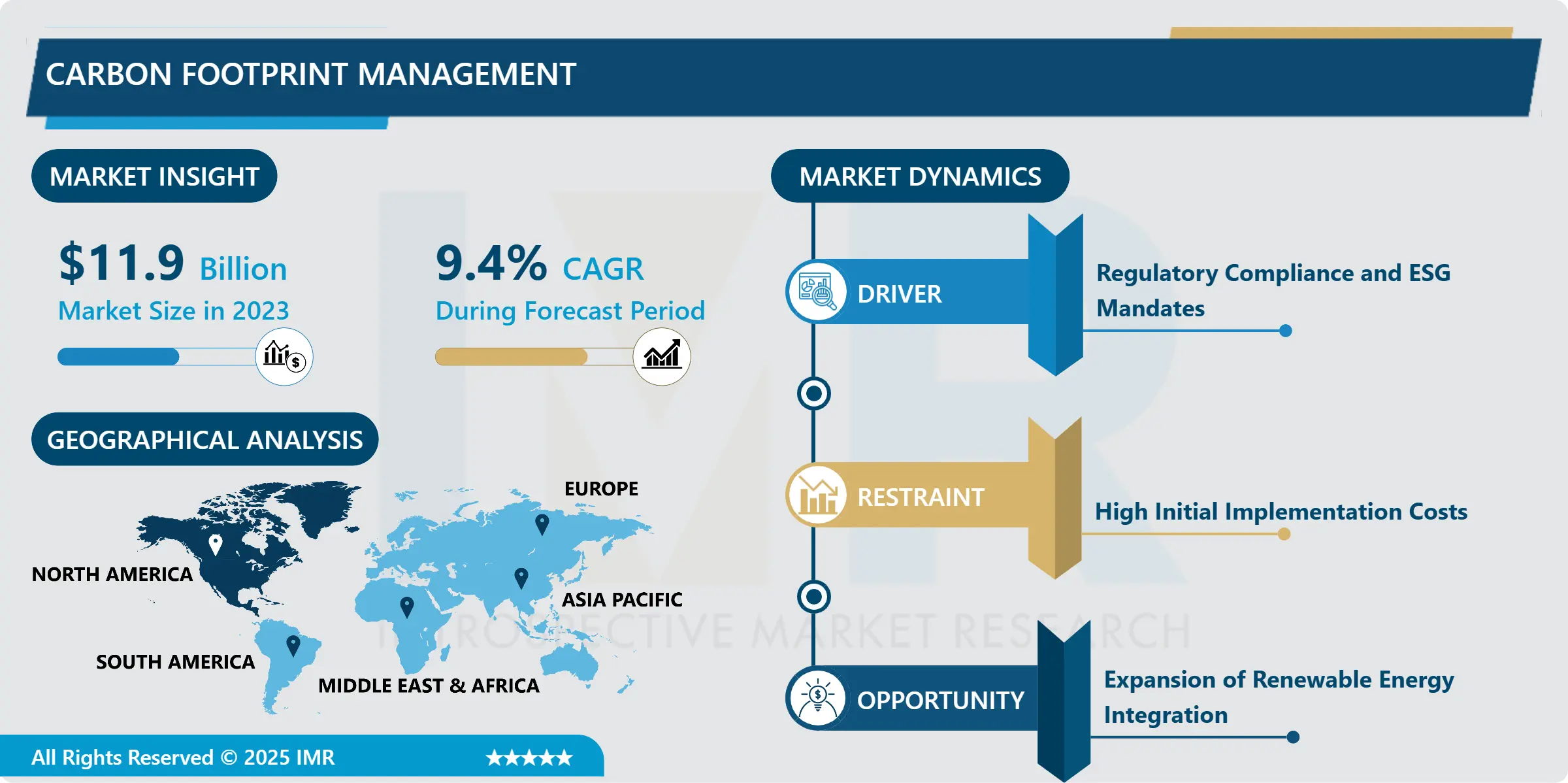
Carbon Footprint Management Market Size Was Valued at USD 11.9 Billion in 2023, and is Projected to Reach USD 26.7 Billion by 2032, Growing at a CAGR of 9.4% From 2024-2032.

IMR
Description
Carbon Footprint Management Market Synopsis:
Carbon Footprint Management Market Size Was Valued at USD 11.9 Billion in 2023, and is Projected to Reach USD 26.7 Billion by 2032, Growing at a CAGR of 9.4% From 2024-2032.
Carbon Footprint Management Market is the solution and service related market for managing the carbon emissions of the organizations and helping them in terms of sustainability, compliance, and other aspects. These are software solutions for recording emission information, as well as services for preparation of emissions strategies and such services as emissions management and reporting.
The Carbon Footprint Management is a rapidly expanding market because of the rising environmental concern and the pressuring world laws and regulations. Companies of all forms see increasing social pressure to lower their carbon footprint and in response adopt techniques to assess and minimize it. National and global governments, Non-Governmental Organizations, and international organizations pioneer the Paris Agreement that compels corporations to implement aggressive emissions management technologies.
Software solutions in this market have features such as emission monitoring, carbon recording, and forecasting tools. Together with professional services, these allow business organization to work in tandem with environmental objectives and the requirements of the law. Manufacturing, transportation and energy consumption industries are major consumers of electricity, but other industries like retail, Information technology also have intentions of reducing carbon footprint due to pressure from customer and investors.
As organizations start to shift towards net-zero strategies, the market gains from innovations in artificial intelligence used to optimize AI for energy matters, blockchain in reporting, and IoT to track consumption patterns. The Carbon Footprint Management Market will continue to grow as sustainability is integrated within many companies’ business model and marketing plan.
Carbon Footprint Management Market Trend Analysis:
Integration of AI and IoT for Real-Time Monitoring
Carbon footprint monitoring has been made easier by AI and IoT that offer details on carbon emissions occurring at any one time. Machine learning tools and deep learning patterns to process big data to learn about such inefficiencies and even forecast future emissions along with suggesting measures to minimize carbon use. IoT comes in handy in this process by feeding the system with real time data collected by sensors from production lines, transport fleets or buildings. This trend is especially so for industries that have extensive supply chain links or those that consume much energy.
The integration of real-time data and predictive analytics enables organizations to take instant corrective actions, making the best use of available resources to address a variety of sustainable outcomes and objectives. Together, both AI and IoT enable accurate and authentic reporting to stakeholders while also meeting the standards of legal compliance.
Expansion of Renewable Energy Integration
Increasing emphasis placed on renewable power types in the carbon impact control process remains a colossal chance for the market participants. Companies are now sourcing for solar and wind and many other renewable energy so that to cut on on emissions and usage of fossil fuel. The carbon management platforms can be improved to capture use of renewable energy, carbon emission savings, and the achievement of sustainable objectives.
Another way that service providers can increase the benefits from this opportunity is by providing organizational advisory services that assist firms in their move to embrace renewable energy for use, energy consumption, and annual carbon footprint calculations. The expansion of such a service is in line with the global commitment towards developing a low carbon economy and the need to meet the corporate world’s needs for green solutions.
Carbon Footprint Management Market Segment Analysis:
Carbon Footprint Management Market is Segmented on the basis of Component, Deployment Mode, Industry Vertical, Application, and Region.
By Component, Software segment is expected to dominate the market during the forecast period
Software: Currently software solutions are leading the market owing to their potential to support automated data capture, processing, and analysis of carbon. Such solutions have things like live monitoring, predictive analysis, and conformity summary that help organizations manage carbon effectively. AI implementation has improved accuracy and decision making making software essential for embarking on any emission reduction planning.
Services complete packages since they provide personalized consultation, training, and practical application on existing software systems. Professional services safeguard that organisations execute software flawlessly and integrate it in house systems while fulfilling particular necessities in sustainability strategies. Specifically, the services segment is useful for organizations that have limited knowledge regarding carbon management within their organization.
By Application, Carbon Footprint Reduction segment expected to held the largest share
Carbon Footprint Reduction: This segment looks at efforts to curb emission directly. These tools help businesses in detecting the activities with high emission and then the appropriate ways to manage them and integrate sustainable procedures.
Energy Consumption Monitoring: Core consumers of energy in industries for instance, use monitoring devices to measure and course their energy consumption rates. This application is already playing a very crucial role in carbon reduction by both highlighting possible inefficiencies and encouraging the use of renewable power.
Reporting and Compliance: Legal requirement from the international as well as the local markets is also a factor that fuels this segment. Reporting tools make it easy to scale compliance, and not deviating from the guidelines provided by standards such as the GHG Protocol, while preventing organizations from incurring penalties.
Carbon Footprint Management Market Regional Insights:
North America is Expected to Dominate the Market Over the Forecast period
North America holds the largest market share in the Carbon Footprint Management Market due to the stringent regulation standards and increased corporate social responsibility. The US and Canada have adopted a carbon price policies, tax and fund program encouraging business to consider carbon management technologies.
Moreover, the existing technological environment of the region supports the refinement of AI and IoT solutions, as well as data analysis. The same increased awareness also puts pressure on businesses to fund sustainability, which strengthens North America’s position as the leading segment in this market.
Active Key Players in the Carbon Footprint Management Market:
SAP SE (Germany)
IBM Corporation (United States)
Schneider Electric (France)
Salesforce, Inc. (United States)
Accenture plc (Ireland)
Enablon (France)
Wolters Kluwer N.V. (Netherlands)
Dakota Software (United States)
Carbon Trust (United Kingdom)
ProcessMAP Corporation (United States)
VelocityEHS (United States)
Intelex Technologies (Canada), and Other Active Players
Key Industry Developments in the Carbon Footprint Management Market:
In June 2024, China plans to launch a carbon footprint management system by 2027 to track and reduce emissions across industries, aiming for carbon neutrality by 2060. This system will include standards for calculating carbon footprints for 100 major products by 2027 and expand to 200 by 2030. The initiative emphasizes data accuracy and transparency to support sustainability goals.
In March 2024, Matsumoto Precision Inc. has adopted SAP Sustainability Footprint Management to track and report CO2 emissions per product. Partnering with Accenture, the company aims to enhance environmental and economic value through this system. This move supports Matsumoto’s vision of a sustainable factory, contributing to greater transparency and reduced carbon footprints in manufacturing.
In May 2023, the U.S. government announced to invest USD 251 million for carbon capture and storage projects in seven states, aiming to reducing reduce planet-warming pollution from power plants and other industrial facilities. The investment was made on an effort to commercial lift off in the carbon management industry in the country.
Chapter 1: Introduction
1.1 Scope and Coverage
Chapter 2:Executive Summary
Chapter 3: Market Landscape
3.1 Market Dynamics
3.1.1 Drivers
3.1.2 Restraints
3.1.3 Opportunities
3.1.4 Challenges
3.2 Market Trend Analysis
3.3 PESTLE Analysis
3.4 Porter’s Five Forces Analysis
3.5 Industry Value Chain Analysis
3.6 Ecosystem
3.7 Regulatory Landscape
3.8 Price Trend Analysis
3.9 Patent Analysis
3.10 Technology Evolution
3.11 Investment Pockets
3.12 Import-Export Analysis
Chapter 4: Carbon Footprint Management Market by Component
4.1 Carbon Footprint Management Market Snapshot and Growth Engine
4.2 Carbon Footprint Management Market Overview
4.3 Software
4.3.1 Introduction and Market Overview
4.3.2 Historic and Forecasted Market Size in Value USD and Volume Units (2017-2032F)
4.3.3 Key Market Trends, Growth Factors and Opportunities
4.3.4 Software: Geographic Segmentation Analysis
4.4 Services
4.4.1 Introduction and Market Overview
4.4.2 Historic and Forecasted Market Size in Value USD and Volume Units (2017-2032F)
4.4.3 Key Market Trends, Growth Factors and Opportunities
4.4.4 Services: Geographic Segmentation Analysis
Chapter 5: Carbon Footprint Management Market by Deployment Mode
5.1 Carbon Footprint Management Market Snapshot and Growth Engine
5.2 Carbon Footprint Management Market Overview
5.3 Cloud
5.3.1 Introduction and Market Overview
5.3.2 Historic and Forecasted Market Size in Value USD and Volume Units (2017-2032F)
5.3.3 Key Market Trends, Growth Factors and Opportunities
5.3.4 Cloud: Geographic Segmentation Analysis
5.4 On-Premises
5.4.1 Introduction and Market Overview
5.4.2 Historic and Forecasted Market Size in Value USD and Volume Units (2017-2032F)
5.4.3 Key Market Trends, Growth Factors and Opportunities
5.4.4 On-Premises: Geographic Segmentation Analysis
Chapter 6: Carbon Footprint Management Market by Industry Vertical
6.1 Carbon Footprint Management Market Snapshot and Growth Engine
6.2 Carbon Footprint Management Market Overview
6.3 Energy and Utilities
6.3.1 Introduction and Market Overview
6.3.2 Historic and Forecasted Market Size in Value USD and Volume Units (2017-2032F)
6.3.3 Key Market Trends, Growth Factors and Opportunities
6.3.4 Energy and Utilities: Geographic Segmentation Analysis
6.4 Manufacturing
6.4.1 Introduction and Market Overview
6.4.2 Historic and Forecasted Market Size in Value USD and Volume Units (2017-2032F)
6.4.3 Key Market Trends, Growth Factors and Opportunities
6.4.4 Manufacturing: Geographic Segmentation Analysis
6.5 Transportation and Logistics
6.5.1 Introduction and Market Overview
6.5.2 Historic and Forecasted Market Size in Value USD and Volume Units (2017-2032F)
6.5.3 Key Market Trends, Growth Factors and Opportunities
6.5.4 Transportation and Logistics: Geographic Segmentation Analysis
6.6 Residential and Commercial Buildings
6.6.1 Introduction and Market Overview
6.6.2 Historic and Forecasted Market Size in Value USD and Volume Units (2017-2032F)
6.6.3 Key Market Trends, Growth Factors and Opportunities
6.6.4 Residential and Commercial Buildings: Geographic Segmentation Analysis
6.7 IT and Telecom
6.7.1 Introduction and Market Overview
6.7.2 Historic and Forecasted Market Size in Value USD and Volume Units (2017-2032F)
6.7.3 Key Market Trends, Growth Factors and Opportunities
6.7.4 IT and Telecom: Geographic Segmentation Analysis
6.8 Others
6.8.1 Introduction and Market Overview
6.8.2 Historic and Forecasted Market Size in Value USD and Volume Units (2017-2032F)
6.8.3 Key Market Trends, Growth Factors and Opportunities
6.8.4 Others: Geographic Segmentation Analysis
Chapter 7: Carbon Footprint Management Market by Application
7.1 Carbon Footprint Management Market Snapshot and Growth Engine
7.2 Carbon Footprint Management Market Overview
7.3 Carbon Footprint Reduction
7.3.1 Introduction and Market Overview
7.3.2 Historic and Forecasted Market Size in Value USD and Volume Units (2017-2032F)
7.3.3 Key Market Trends, Growth Factors and Opportunities
7.3.4 Carbon Footprint Reduction: Geographic Segmentation Analysis
7.4 Energy Consumption Monitoring
7.4.1 Introduction and Market Overview
7.4.2 Historic and Forecasted Market Size in Value USD and Volume Units (2017-2032F)
7.4.3 Key Market Trends, Growth Factors and Opportunities
7.4.4 Energy Consumption Monitoring: Geographic Segmentation Analysis
7.5 Reporting and Compliance
7.5.1 Introduction and Market Overview
7.5.2 Historic and Forecasted Market Size in Value USD and Volume Units (2017-2032F)
7.5.3 Key Market Trends, Growth Factors and Opportunities
7.5.4 Reporting and Compliance: Geographic Segmentation Analysis
Chapter 8: Company Profiles and Competitive Analysis
8.1 Competitive Landscape
8.1.1 Competitive Benchmarking
8.1.2 Carbon Footprint Management Market Share by Manufacturer (2023)
8.1.3 Industry BCG Matrix
8.1.4 Heat Map Analysis
8.1.5 Mergers and Acquisitions
8.2 SAP SE (GERMANY)
8.2.1 Company Overview
8.2.2 Key Executives
8.2.3 Company Snapshot
8.2.4 Role of the Company in the Market
8.2.5 Sustainability and Social Responsibility
8.2.6 Operating Business Segments
8.2.7 Product Portfolio
8.2.8 Business Performance
8.2.9 Key Strategic Moves and Recent Developments
8.2.10 SWOT Analysis
8.3 IBM CORPORATION (UNITED STATES)
8.4 SCHNEIDER ELECTRIC (FRANCE)
8.5 SALESFORCE INC. (UNITED STATES)
8.6 ACCENTURE PLC (IRELAND)
8.7 ENABLON (FRANCE)
8.8 WOLTERS KLUWER N.V. (NETHERLANDS)
8.9 DAKOTA SOFTWARE (UNITED STATES)
8.10 CARBON TRUST (UNITED KINGDOM)
8.11 PROCESSMAP CORPORATION (UNITED STATES)
8.12 VELOCITYEHS (UNITED STATES)
8.13 INTELEX TECHNOLOGIES (CANADA)
8.14
8.15 OTHER ACTIVE PLAYERS
Chapter 9: Global Carbon Footprint Management Market By Region
9.1 Overview
9.2. North America Carbon Footprint Management Market
9.2.1 Key Market Trends, Growth Factors and Opportunities
9.2.2 Top Key Companies
9.2.3 Historic and Forecasted Market Size by Segments
9.2.4 Historic and Forecasted Market Size By Component
9.2.4.1 Software
9.2.4.2 Services
9.2.5 Historic and Forecasted Market Size By Deployment Mode
9.2.5.1 Cloud
9.2.5.2 On-Premises
9.2.6 Historic and Forecasted Market Size By Industry Vertical
9.2.6.1 Energy and Utilities
9.2.6.2 Manufacturing
9.2.6.3 Transportation and Logistics
9.2.6.4 Residential and Commercial Buildings
9.2.6.5 IT and Telecom
9.2.6.6 Others
9.2.7 Historic and Forecasted Market Size By Application
9.2.7.1 Carbon Footprint Reduction
9.2.7.2 Energy Consumption Monitoring
9.2.7.3 Reporting and Compliance
9.2.8 Historic and Forecast Market Size by Country
9.2.8.1 US
9.2.8.2 Canada
9.2.8.3 Mexico
9.3. Eastern Europe Carbon Footprint Management Market
9.3.1 Key Market Trends, Growth Factors and Opportunities
9.3.2 Top Key Companies
9.3.3 Historic and Forecasted Market Size by Segments
9.3.4 Historic and Forecasted Market Size By Component
9.3.4.1 Software
9.3.4.2 Services
9.3.5 Historic and Forecasted Market Size By Deployment Mode
9.3.5.1 Cloud
9.3.5.2 On-Premises
9.3.6 Historic and Forecasted Market Size By Industry Vertical
9.3.6.1 Energy and Utilities
9.3.6.2 Manufacturing
9.3.6.3 Transportation and Logistics
9.3.6.4 Residential and Commercial Buildings
9.3.6.5 IT and Telecom
9.3.6.6 Others
9.3.7 Historic and Forecasted Market Size By Application
9.3.7.1 Carbon Footprint Reduction
9.3.7.2 Energy Consumption Monitoring
9.3.7.3 Reporting and Compliance
9.3.8 Historic and Forecast Market Size by Country
9.3.8.1 Russia
9.3.8.2 Bulgaria
9.3.8.3 The Czech Republic
9.3.8.4 Hungary
9.3.8.5 Poland
9.3.8.6 Romania
9.3.8.7 Rest of Eastern Europe
9.4. Western Europe Carbon Footprint Management Market
9.4.1 Key Market Trends, Growth Factors and Opportunities
9.4.2 Top Key Companies
9.4.3 Historic and Forecasted Market Size by Segments
9.4.4 Historic and Forecasted Market Size By Component
9.4.4.1 Software
9.4.4.2 Services
9.4.5 Historic and Forecasted Market Size By Deployment Mode
9.4.5.1 Cloud
9.4.5.2 On-Premises
9.4.6 Historic and Forecasted Market Size By Industry Vertical
9.4.6.1 Energy and Utilities
9.4.6.2 Manufacturing
9.4.6.3 Transportation and Logistics
9.4.6.4 Residential and Commercial Buildings
9.4.6.5 IT and Telecom
9.4.6.6 Others
9.4.7 Historic and Forecasted Market Size By Application
9.4.7.1 Carbon Footprint Reduction
9.4.7.2 Energy Consumption Monitoring
9.4.7.3 Reporting and Compliance
9.4.8 Historic and Forecast Market Size by Country
9.4.8.1 Germany
9.4.8.2 UK
9.4.8.3 France
9.4.8.4 The Netherlands
9.4.8.5 Italy
9.4.8.6 Spain
9.4.8.7 Rest of Western Europe
9.5. Asia Pacific Carbon Footprint Management Market
9.5.1 Key Market Trends, Growth Factors and Opportunities
9.5.2 Top Key Companies
9.5.3 Historic and Forecasted Market Size by Segments
9.5.4 Historic and Forecasted Market Size By Component
9.5.4.1 Software
9.5.4.2 Services
9.5.5 Historic and Forecasted Market Size By Deployment Mode
9.5.5.1 Cloud
9.5.5.2 On-Premises
9.5.6 Historic and Forecasted Market Size By Industry Vertical
9.5.6.1 Energy and Utilities
9.5.6.2 Manufacturing
9.5.6.3 Transportation and Logistics
9.5.6.4 Residential and Commercial Buildings
9.5.6.5 IT and Telecom
9.5.6.6 Others
9.5.7 Historic and Forecasted Market Size By Application
9.5.7.1 Carbon Footprint Reduction
9.5.7.2 Energy Consumption Monitoring
9.5.7.3 Reporting and Compliance
9.5.8 Historic and Forecast Market Size by Country
9.5.8.1 China
9.5.8.2 India
9.5.8.3 Japan
9.5.8.4 South Korea
9.5.8.5 Malaysia
9.5.8.6 Thailand
9.5.8.7 Vietnam
9.5.8.8 The Philippines
9.5.8.9 Australia
9.5.8.10 New Zealand
9.5.8.11 Rest of APAC
9.6. Middle East & Africa Carbon Footprint Management Market
9.6.1 Key Market Trends, Growth Factors and Opportunities
9.6.2 Top Key Companies
9.6.3 Historic and Forecasted Market Size by Segments
9.6.4 Historic and Forecasted Market Size By Component
9.6.4.1 Software
9.6.4.2 Services
9.6.5 Historic and Forecasted Market Size By Deployment Mode
9.6.5.1 Cloud
9.6.5.2 On-Premises
9.6.6 Historic and Forecasted Market Size By Industry Vertical
9.6.6.1 Energy and Utilities
9.6.6.2 Manufacturing
9.6.6.3 Transportation and Logistics
9.6.6.4 Residential and Commercial Buildings
9.6.6.5 IT and Telecom
9.6.6.6 Others
9.6.7 Historic and Forecasted Market Size By Application
9.6.7.1 Carbon Footprint Reduction
9.6.7.2 Energy Consumption Monitoring
9.6.7.3 Reporting and Compliance
9.6.8 Historic and Forecast Market Size by Country
9.6.8.1 Turkiye
9.6.8.2 Bahrain
9.6.8.3 Kuwait
9.6.8.4 Saudi Arabia
9.6.8.5 Qatar
9.6.8.6 UAE
9.6.8.7 Israel
9.6.8.8 South Africa
9.7. South America Carbon Footprint Management Market
9.7.1 Key Market Trends, Growth Factors and Opportunities
9.7.2 Top Key Companies
9.7.3 Historic and Forecasted Market Size by Segments
9.7.4 Historic and Forecasted Market Size By Component
9.7.4.1 Software
9.7.4.2 Services
9.7.5 Historic and Forecasted Market Size By Deployment Mode
9.7.5.1 Cloud
9.7.5.2 On-Premises
9.7.6 Historic and Forecasted Market Size By Industry Vertical
9.7.6.1 Energy and Utilities
9.7.6.2 Manufacturing
9.7.6.3 Transportation and Logistics
9.7.6.4 Residential and Commercial Buildings
9.7.6.5 IT and Telecom
9.7.6.6 Others
9.7.7 Historic and Forecasted Market Size By Application
9.7.7.1 Carbon Footprint Reduction
9.7.7.2 Energy Consumption Monitoring
9.7.7.3 Reporting and Compliance
9.7.8 Historic and Forecast Market Size by Country
9.7.8.1 Brazil
9.7.8.2 Argentina
9.7.8.3 Rest of SA
Chapter 10 Analyst Viewpoint and Conclusion
10.1 Recommendations and Concluding Analysis
10.2 Potential Market Strategies
Chapter 11 Research Methodology
11.1 Research Process
11.2 Primary Research
11.3 Secondary Research
Q1: What would be the forecast period in the Carbon Footprint Management Market research report?
A1: The forecast period in the Carbon Footprint Management Market research report is 2024-2032.
Q2: Who are the key players in the Carbon Footprint Management Market?
A2: SAP SE (Germany), IBM Corporation (United States), Schneider Electric (France), Salesforce, Inc. (United States), Accenture plc (Ireland), Enablon (France), Wolters Kluwer N.V. (Netherlands), Dakota Software (United States), Carbon Trust (United Kingdom), ProcessMAP Corporation (United States), VelocityEHS (United States), Intelex Technologies (Canada), and Other Active Players.
Q3: What are the segments of the Carbon Footprint Management Market?
A3: The Carbon Footprint Management Market is segmented into Component, Deployment Mode, Industry Vertical, Application, and Region. By Component, the market is categorized into Software, Services. By Deployment Mode, the market is categorized into Cloud, On-Premises. By Industry Vertical, the market is categorized into Energy and Utilities, Manufacturing, Transportation and Logistics, Residential and Commercial Buildings, IT and Telecom, and Others. By Application, the market is categorized into Carbon Footprint Reduction, Energy Consumption Monitoring, Reporting, and Compliance. By region, it is analyzed across North America (U.S., Canada, Mexico), Eastern Europe (Russia, Bulgaria, The Czech Republic, Hungary, Poland, Romania, Rest of Eastern Europe), Western Europe (Germany, UK, France, Netherlands, Italy, Spain, Rest of Western Europe), Asia Pacific (China, India, Japan, South Korea, Malaysia, Thailand, Vietnam, The Philippines, Australia, New Zealand, Rest of APAC), Middle East & Africa (Turkiye, Bahrain, Kuwait, Saudi Arabia, Qatar, UAE, Israel, South Africa), South America (Brazil, Argentina, Rest of SA).
Q4: What is the Carbon Footprint Management Market?
A4: Carbon Footprint Management Market is the solution and service related market for managing the carbon emissions of the organizations and helping them in terms of sustainability, compliance, and other aspects. These are software solutions for recording emission information, as well as services for preparation of emissions strategies and such services as emissions management and reporting.
Q5: How big is the Carbon Footprint Management Market?
A5: Carbon Footprint Management Market Size Was Valued at USD 11.9 Billion in 2023, and is Projected to Reach USD 26.7 Billion by 2032, Growing at a CAGR of 9.4% From 2024-2032.
How to buy a report from Megatrends.jp
On the product page, select the license you want: Single User License or Enterprise License.
Select the report language:
- English Report
- English Report + Japanese Translation
Click the Buy Now button.
You’ll be redirected to the checkout page. Enter your company and payment details.
Click Place Order to complete your purchase.
Confirmation: You’ll receive an order confirmation email. Our team will then follow up with your report delivery.
If you have questions, fill out the contact form below or email us at sales1@megatrends.jp.
Thank you for choosing Megatrends.jp!
Related products