24時間365日サポート — いつでもお客様をサポートいたします。
お問い合わせ

Cloud Based Language Learning Market Size, Share, Growth & Forecast (2024-2032)
The Cloud-Based Language Learning Market defines as web-based language teaching and learning platforms, services, and applications run on cloud technology. These solutions employ feature like artificial intelligence-based personalization, virtual class, cross-device functionality and deliver interactivity, renowned scalability and affordable language training in individual, institutional and corporate fields.

IMR
Description
Cloud Based Language Learning Market Synopsis:
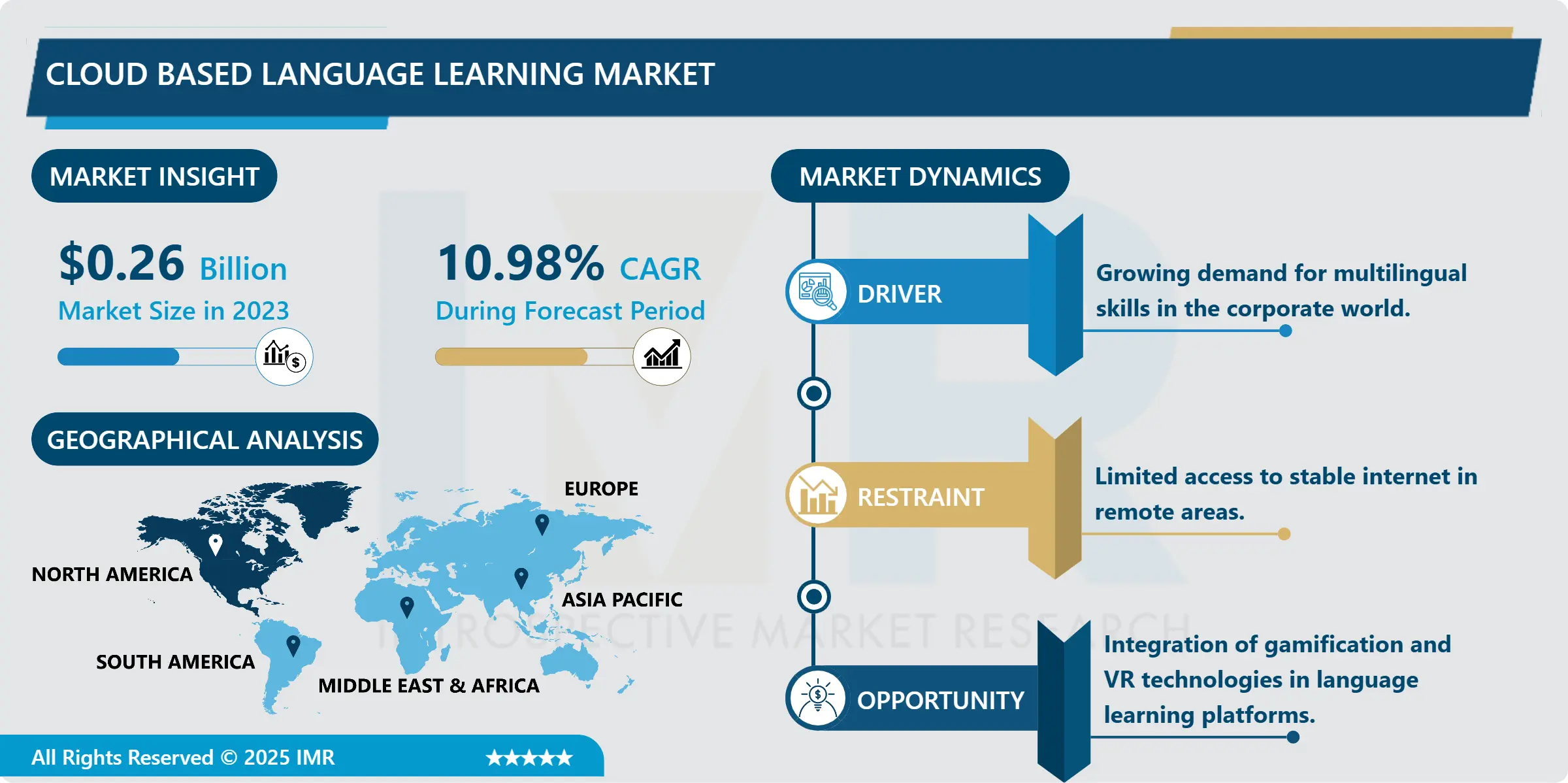
Cloud Based Language Learning Market Size Was Valued at USD 0.26 Billion in 2023, and is Projected to Reach USD 0.68 Billion by 2032, Growing at a CAGR of 10.98% From 2024-2032.
The Cloud-Based Language Learning Market defines as web-based language teaching and learning platforms, services, and applications run on cloud technology. These solutions employ feature like artificial intelligence-based personalization, virtual class, cross-device functionality and deliver interactivity, renowned scalability and affordable language training in individual, institutional and corporate fields.
The Cloud-Based Language Learning Market has grown tremendously over the past years due to globalisation and more organisations shifting to multilingualism. The education sector also felt the influence of the digital transformation journey where schools and universities started using cloud technologies improving the language curricula. This change has offered an environment for new language learning applications that are suitable and accommodate different ways of learning. The pandemic caused this acceptance even further as learning went online and with that, helped establish these platforms as not only indispensable for individual learners, but for institutions as well.
The primary forces that are contributing to the growth of the market are corporate training and cross border communications. The general trend of employing more diverse employees and serving diverse customer demographic has led enterprises to focus on training employees for being versatile in different languages pushing the language learning tools adoption forward. Also, data obtained from numerous governmental institutions and NGOs indicate that learning and teaching languages integrated into various initiating immigrant support activities and filling gaps in multicultural societies increasingly involve the use of cloud-based instruments. For this reason, the market has extended its capabilities by incorporating features like real-time translation, gamification, and AI-based assessments, to fit the variety of user demands.
Cloud Based Language Learning Market Trend Analysis:
AI Integration Revolutionizing Language Learning
With the integration of Artificial Intelligence (AI) into the cloud-based language learning market, the next step or the way learners’ interface with learning platforms has been set. This is an advantage because tools such as speech recognition, and virtual tutors enhance interactive and more effective language learning. These tools are self-adjustable depending on individual user’s progress while providing lessons according to user’s needs and ability levels. This type of approach means that learners are able to spend much of their time on areas of strength in order to make learning process more effective and entertaining.
NLP advanced technologies are also engaged in providing improvements to the real-time interaction experience. Things like pronunciation check and grammar help allow learners to fix errors as soon as possible making their language practice more effective. It also helps platforms to conduct large-scale analysis, as well as enhancing algorithms to optimize the result step by step. Creating cloud-based language learning solutions for overcoming common learning difficulties with the help of artificial intelligence this industry is changing the educational processes as for accessibility and learners’ satisfaction.
Rise of Mobile and Remote Learning
An always-connected smartphone-wielding audience and the increasing prevalence of the World Wide Web as the repository of educational content is a compelling proposition for the market, especially where learners rely on portable devices. Therefore, due to the prevailing mobile-first strategies, language learning platforms are beginning to create applications that ensure easy access to content on-the-go. This shift is a crucial one in developing countries, where through a smartphone, one can get an access to quality education that they could never had any way. The adaptation of the platforms for mobile devices allow the providers meet the rising demand of the language learning that is sensitive to the time-constrained global society.
The recent use of distance learning, which had been enjoyed before the emergence of COVID-19, has become a new trend in the globalization process. This is because employers, institutions and individual learners are providing more resources to support efficient, flexible, and inexpensive cloud-based language learning platforms. As organizations require to train or promote their employees and as educational institution extended online classes, the demand for language learning platforms remains steadily high. This has created an excellent chance for most companies who can now penetrate deeper into the market with an aim of reaching out to those unseen or ignored population groups. These development hence foster a perfect storm for market growth and new market opportunities because of the increasing demand for multilingual communication.
Cloud Based Language Learning Market Segment Analysis:
Cloud Based Language Learning Market is Segmented on the basis of Product Type, Application, Technology, End User, and Region.
By Product Type, Web-Based Learning Platforms segment is expected to dominate the market during the forecast period
The Cloud-Based Language Learning Market is available in several applications such as; Language Proficiency Testing and the latter has been showing great growth. The availability of multilingual knowledge is gradually becoming vital in several sectors; therefore, English proficiency assessment like TOEFL, IELTS, and others are taken through cloud computing environments. The special feature of these platforms is real-time testing, immediate grading, and individual feedback; language tests are easier to take and more accessible for a global audience. The administration of these tests is possible in the digital format which has enriched their application in the spheres of education and work, as well as offered a number of opportunities for fair assessment of the language abilities.
Corporate Training is another significant segment contributing to the demand for proficiency testing that forms another primary market segment. This has been the case since as organizations continue to grow internationally the need for language training for staff has grown. Language acquisition solutions delivered through cloud is today one of the most cherished solutions across organizations as it helps them equip their employees with communication skills necessary for international operations. These platforms provide ease and convenience, for employees are able to learn independently either through mobile application or even through the internet. Additionally, Personal Language Learning still prevails in solving the problem of language learning, whereby people use facilities in clouds at their own preferred time. These platforms also contain rewards systems or elements of games, increased possibilities of artificial intelligence and, indeed, the opportunity to learn in several languages, all of which makes language learning more fun and versatile.
By Application, Language Proficiency Tests segment expected to held the largest share
The Cloud Based Language Learning market is categorized into several applications including Language Proficiency Tests for the cloud market exhibiting growth. With the growing requirement for people who are intelligent in more than one difficult, common tests like TOEFL, IELTS, and more are being provided through cloud service. These allow testing as it is conducted online, grading also is done automatically and feedback is given making test therefore more convenient for a global audience. This kind of tests has been made highly versatile coupled with easy administration because of the digital form that has been adopted across learning institutions and workplaces.
Another genuine market driving force is Corporate Training, in addition to proficiency testing. When companies go international, there has been a substantial need to for language training for staff personnel. It is used as an online language learning technology solution by organizations to train their employees in effective communication across different global locations. They provide convenience in that learners can study on their own time and via both applications and websites. Moreover, Personal Language Learning maintains its operation in a digital environment as each person can find a cloud-based solution, which allows the continuous learning of languages whenever it is convenient for them. These platforms include, gamification, artificial intelligence and language translations, which help to make the process of learning languages more fun and for a wider customer base.
Cloud Based Language Learning Market Regional Insights:
North America is Expected to Dominate the Market Over the Forecast period
Therefore, the position of the four categories in the market changed over the period and in 2023, the dominance of regions of cloud-based language learning market shifted towards North America. This leadership can be attributed to the fact that most of the area has enhanced technological system that embraces cloud based language learning. Among those, the U.S. is most significant due to its approach in striving to merge those technologies like AI and machine learning into new generation language learning products to improve user satisfaction and effectiveness of coursework. Increasingly therefore, demand for language skills is apparent in almost every industry, with North America being a focal point of development in the area.
Besides, several key language learning firms have their base in North America such as Duolingo, Rosetta Stone and Coursera. They are some of the players in this market that have empowered its growth through providing different and easily scalable solutions for individual and corporate learners. At the same time, the ever-expanding usage of online learning platforms in educational institutions and the business environment of the United States and Canada consolidates the region’s leadership in the market. Since language skills remain a key focus for business communications across the world North America is set to maintain its dominance of the cloud-based language learning market.
Active Key Players in the Cloud Based Language Learning Market:
Babbel (Germany)
Busuu (Spain)
Cambridge University Press & Assessment (UK)
Coursera (USA)
Duolingo (USA)
EF Education First (Switzerland)
Italki (Hong Kong)
Memrise (UK)
Mondly (Romania)
Open English (USA)
Pimsleur (USA)
Preply (Ukraine)
Rosetta Stone (USA)
SANS Inc. (USA), and Other Active Players
Chapter 1: Introduction
1.1 Scope and Coverage
Chapter 2:Executive Summary
Chapter 3: Market Landscape
3.1 Market Dynamics
3.1.1 Drivers
3.1.2 Restraints
3.1.3 Opportunities
3.1.4 Challenges
3.2 Market Trend Analysis
3.3 PESTLE Analysis
3.4 Porter’s Five Forces Analysis
3.5 Industry Value Chain Analysis
3.6 Ecosystem
3.7 Regulatory Landscape
3.8 Price Trend Analysis
3.9 Patent Analysis
3.10 Technology Evolution
3.11 Investment Pockets
3.12 Import-Export Analysis
Chapter 4: Cloud Based Language Learning Market by Product Type
4.1 Cloud Based Language Learning Market Snapshot and Growth Engine
4.2 Cloud Based Language Learning Market Overview
4.3 Web-Based Learning Platforms
4.3.1 Introduction and Market Overview
4.3.2 Historic and Forecasted Market Size in Value USD and Volume Units (2017-2032F)
4.3.3 Key Market Trends, Growth Factors and Opportunities
4.3.4 Web-Based Learning Platforms: Geographic Segmentation Analysis
4.4 Mobile-Based Learning Applications
4.4.1 Introduction and Market Overview
4.4.2 Historic and Forecasted Market Size in Value USD and Volume Units (2017-2032F)
4.4.3 Key Market Trends, Growth Factors and Opportunities
4.4.4 Mobile-Based Learning Applications: Geographic Segmentation Analysis
Chapter 5: Cloud Based Language Learning Market by Application
5.1 Cloud Based Language Learning Market Snapshot and Growth Engine
5.2 Cloud Based Language Learning Market Overview
5.3 Language Proficiency Tests
5.3.1 Introduction and Market Overview
5.3.2 Historic and Forecasted Market Size in Value USD and Volume Units (2017-2032F)
5.3.3 Key Market Trends, Growth Factors and Opportunities
5.3.4 Language Proficiency Tests: Geographic Segmentation Analysis
5.4 Corporate Training
5.4.1 Introduction and Market Overview
5.4.2 Historic and Forecasted Market Size in Value USD and Volume Units (2017-2032F)
5.4.3 Key Market Trends, Growth Factors and Opportunities
5.4.4 Corporate Training: Geographic Segmentation Analysis
5.5 Personal Language Learning
5.5.1 Introduction and Market Overview
5.5.2 Historic and Forecasted Market Size in Value USD and Volume Units (2017-2032F)
5.5.3 Key Market Trends, Growth Factors and Opportunities
5.5.4 Personal Language Learning: Geographic Segmentation Analysis
Chapter 6: Cloud Based Language Learning Market by End User
6.1 Cloud Based Language Learning Market Snapshot and Growth Engine
6.2 Cloud Based Language Learning Market Overview
6.3 Individual Learners
6.3.1 Introduction and Market Overview
6.3.2 Historic and Forecasted Market Size in Value USD and Volume Units (2017-2032F)
6.3.3 Key Market Trends, Growth Factors and Opportunities
6.3.4 Individual Learners: Geographic Segmentation Analysis
6.4 Corporate Learners
6.4.1 Introduction and Market Overview
6.4.2 Historic and Forecasted Market Size in Value USD and Volume Units (2017-2032F)
6.4.3 Key Market Trends, Growth Factors and Opportunities
6.4.4 Corporate Learners: Geographic Segmentation Analysis
6.5 Educational Institutions
6.5.1 Introduction and Market Overview
6.5.2 Historic and Forecasted Market Size in Value USD and Volume Units (2017-2032F)
6.5.3 Key Market Trends, Growth Factors and Opportunities
6.5.4 Educational Institutions: Geographic Segmentation Analysis
Chapter 7: Company Profiles and Competitive Analysis
7.1 Competitive Landscape
7.1.1 Competitive Benchmarking
7.1.2 Cloud Based Language Learning Market Share by Manufacturer (2023)
7.1.3 Industry BCG Matrix
7.1.4 Heat Map Analysis
7.1.5 Mergers and Acquisitions
7.2 BABBEL (GERMANY)
7.2.1 Company Overview
7.2.2 Key Executives
7.2.3 Company Snapshot
7.2.4 Role of the Company in the Market
7.2.5 Sustainability and Social Responsibility
7.2.6 Operating Business Segments
7.2.7 Product Portfolio
7.2.8 Business Performance
7.2.9 Key Strategic Moves and Recent Developments
7.2.10 SWOT Analysis
7.3 BUSUU (SPAIN)
7.4 CAMBRIDGE UNIVERSITY PRESS & ASSESSMENT (UK)
7.5 COURSERA (USA)
7.6 DUOLINGO (USA)
7.7 EF EDUCATION FIRST (SWITZERLAND)
7.8 ITALKI (HONG KONG)
7.9 MEMRISE (UK)
7.10 MONDLY (ROMANIA)
7.11 OPEN ENGLISH (USA)
7.12 PIMSLEUR (USA)
7.13 PREPLY (UKRAINE)
7.14 ROSETTA STONE (USA)
7.15 SANS INC. (USA)
7.16 VOXY (USA)
7.17 OTHER ACTIVE PLAYERS
Chapter 8: Global Cloud Based Language Learning Market By Region
8.1 Overview
8.2. North America Cloud Based Language Learning Market
8.2.1 Key Market Trends, Growth Factors and Opportunities
8.2.2 Top Key Companies
8.2.3 Historic and Forecasted Market Size by Segments
8.2.4 Historic and Forecasted Market Size By Product Type
8.2.4.1 Web-Based Learning Platforms
8.2.4.2 Mobile-Based Learning Applications
8.2.5 Historic and Forecasted Market Size By Application
8.2.5.1 Language Proficiency Tests
8.2.5.2 Corporate Training
8.2.5.3 Personal Language Learning
8.2.6 Historic and Forecasted Market Size By End User
8.2.6.1 Individual Learners
8.2.6.2 Corporate Learners
8.2.6.3 Educational Institutions
8.2.7 Historic and Forecast Market Size by Country
8.2.7.1 US
8.2.7.2 Canada
8.2.7.3 Mexico
8.3. Eastern Europe Cloud Based Language Learning Market
8.3.1 Key Market Trends, Growth Factors and Opportunities
8.3.2 Top Key Companies
8.3.3 Historic and Forecasted Market Size by Segments
8.3.4 Historic and Forecasted Market Size By Product Type
8.3.4.1 Web-Based Learning Platforms
8.3.4.2 Mobile-Based Learning Applications
8.3.5 Historic and Forecasted Market Size By Application
8.3.5.1 Language Proficiency Tests
8.3.5.2 Corporate Training
8.3.5.3 Personal Language Learning
8.3.6 Historic and Forecasted Market Size By End User
8.3.6.1 Individual Learners
8.3.6.2 Corporate Learners
8.3.6.3 Educational Institutions
8.3.7 Historic and Forecast Market Size by Country
8.3.7.1 Russia
8.3.7.2 Bulgaria
8.3.7.3 The Czech Republic
8.3.7.4 Hungary
8.3.7.5 Poland
8.3.7.6 Romania
8.3.7.7 Rest of Eastern Europe
8.4. Western Europe Cloud Based Language Learning Market
8.4.1 Key Market Trends, Growth Factors and Opportunities
8.4.2 Top Key Companies
8.4.3 Historic and Forecasted Market Size by Segments
8.4.4 Historic and Forecasted Market Size By Product Type
8.4.4.1 Web-Based Learning Platforms
8.4.4.2 Mobile-Based Learning Applications
8.4.5 Historic and Forecasted Market Size By Application
8.4.5.1 Language Proficiency Tests
8.4.5.2 Corporate Training
8.4.5.3 Personal Language Learning
8.4.6 Historic and Forecasted Market Size By End User
8.4.6.1 Individual Learners
8.4.6.2 Corporate Learners
8.4.6.3 Educational Institutions
8.4.7 Historic and Forecast Market Size by Country
8.4.7.1 Germany
8.4.7.2 UK
8.4.7.3 France
8.4.7.4 The Netherlands
8.4.7.5 Italy
8.4.7.6 Spain
8.4.7.7 Rest of Western Europe
8.5. Asia Pacific Cloud Based Language Learning Market
8.5.1 Key Market Trends, Growth Factors and Opportunities
8.5.2 Top Key Companies
8.5.3 Historic and Forecasted Market Size by Segments
8.5.4 Historic and Forecasted Market Size By Product Type
8.5.4.1 Web-Based Learning Platforms
8.5.4.2 Mobile-Based Learning Applications
8.5.5 Historic and Forecasted Market Size By Application
8.5.5.1 Language Proficiency Tests
8.5.5.2 Corporate Training
8.5.5.3 Personal Language Learning
8.5.6 Historic and Forecasted Market Size By End User
8.5.6.1 Individual Learners
8.5.6.2 Corporate Learners
8.5.6.3 Educational Institutions
8.5.7 Historic and Forecast Market Size by Country
8.5.7.1 China
8.5.7.2 India
8.5.7.3 Japan
8.5.7.4 South Korea
8.5.7.5 Malaysia
8.5.7.6 Thailand
8.5.7.7 Vietnam
8.5.7.8 The Philippines
8.5.7.9 Australia
8.5.7.10 New Zealand
8.5.7.11 Rest of APAC
8.6. Middle East & Africa Cloud Based Language Learning Market
8.6.1 Key Market Trends, Growth Factors and Opportunities
8.6.2 Top Key Companies
8.6.3 Historic and Forecasted Market Size by Segments
8.6.4 Historic and Forecasted Market Size By Product Type
8.6.4.1 Web-Based Learning Platforms
8.6.4.2 Mobile-Based Learning Applications
8.6.5 Historic and Forecasted Market Size By Application
8.6.5.1 Language Proficiency Tests
8.6.5.2 Corporate Training
8.6.5.3 Personal Language Learning
8.6.6 Historic and Forecasted Market Size By End User
8.6.6.1 Individual Learners
8.6.6.2 Corporate Learners
8.6.6.3 Educational Institutions
8.6.7 Historic and Forecast Market Size by Country
8.6.7.1 Turkiye
8.6.7.2 Bahrain
8.6.7.3 Kuwait
8.6.7.4 Saudi Arabia
8.6.7.5 Qatar
8.6.7.6 UAE
8.6.7.7 Israel
8.6.7.8 South Africa
8.7. South America Cloud Based Language Learning Market
8.7.1 Key Market Trends, Growth Factors and Opportunities
8.7.2 Top Key Companies
8.7.3 Historic and Forecasted Market Size by Segments
8.7.4 Historic and Forecasted Market Size By Product Type
8.7.4.1 Web-Based Learning Platforms
8.7.4.2 Mobile-Based Learning Applications
8.7.5 Historic and Forecasted Market Size By Application
8.7.5.1 Language Proficiency Tests
8.7.5.2 Corporate Training
8.7.5.3 Personal Language Learning
8.7.6 Historic and Forecasted Market Size By End User
8.7.6.1 Individual Learners
8.7.6.2 Corporate Learners
8.7.6.3 Educational Institutions
8.7.7 Historic and Forecast Market Size by Country
8.7.7.1 Brazil
8.7.7.2 Argentina
8.7.7.3 Rest of SA
Chapter 9 Analyst Viewpoint and Conclusion
9.1 Recommendations and Concluding Analysis
9.2 Potential Market Strategies
Chapter 10 Research Methodology
10.1 Research Process
10.2 Primary Research
10.3 Secondary Research
Q1: What would be the forecast period in the Cloud Based Language Learning Market research report?
A1: The forecast period in the Cloud Based Language Learning Market research report is 2024-2032.
Q2: Who are the key players in the Cloud Based Language Learning Market?
A2: Babbel (Germany), Busuu (Spain), Cambridge University Press & Assessment (UK), Coursera (USA), Duolingo (USA), EF Education First (Switzerland), Italki (Hong Kong), Memrise (UK), Mondly (Romania), Open English (USA), Pimsleur (USA), Preply (Ukraine), Rosetta Stone (USA), SANS Inc. (USA), and Other Active Players.
Q3: What are the segments of the Cloud Based Language Learning Market?
A3: The Cloud Based Language Learning Market is segmented into Product Type, Application, End User, and Region. By Product Type, the market is categorized into Web-Based Learning Platforms, Mobile-Based Learning Applications. By Application, the market is categorized into Language Proficiency Tests, Corporate Training, Personal Language Learning. By Technology, the market is categorized into Artificial Intelligence (AI), Natural Language Processing (NLP), Speech Recognition, Virtual Reality (VR). By End User, the market is categorized into Individual Learners, Corporate Learners, Educational Institutions. By region, it is analyzed across North America (U.S., Canada, Mexico), Eastern Europe (Russia, Bulgaria, The Czech Republic, Hungary, Poland, Romania, Rest of Eastern Europe), Western Europe (Germany, UK, France, Netherlands, Italy, Spain, Rest of Western Europe), Asia Pacific (China, India, Japan, South Korea, Malaysia, Thailand, Vietnam, The Philippines, Australia, New Zealand, Rest of APAC), Middle East & Africa (Turkiye, Bahrain, Kuwait, Saudi Arabia, Qatar, UAE, Israel, South Africa), South America (Brazil, Argentina, Rest of SA).
Q4: What is the Cloud Based Language Learning Market?
A4: The Cloud-Based Language Learning Market defines as web-based language teaching and learning platforms, services, and applications run on cloud technology. These solutions employ feature like artificial intelligence-based personalization, virtual class, cross-device functionality and deliver interactivity, renowned scalability and affordable language training in individual, institutional and corporate fields.
Q5: How big is the Cloud Based Language Learning Market?
A5: Cloud Based Language Learning Market Size Was Valued at USD 0.26 Billion in 2023, and is Projected to Reach USD 0.68 Billion by 2032, Growing at a CAGR of 10.98% From 2024-2032.
How to buy a report from Megatrends.jp
On the product page, select the license you want: Single User License or Enterprise License.
Select the report language:
- English Report
- English Report + Japanese Translation
Click the Buy Now button.
You’ll be redirected to the checkout page. Enter your company and payment details.
Click Place Order to complete your purchase.
Confirmation: You’ll receive an order confirmation email. Our team will then follow up with your report delivery.
If you have questions, fill out the contact form below or email us at sales1@megatrends.jp.
Thank you for choosing Megatrends.jp!