24時間365日サポート — いつでもお客様をサポートいたします。
お問い合わせ
Dark Tourism Market Size, Growth Dynamics & Forecast (2024-2032)
Dark tourism is the tourism that focuses at capturing places related to death or adversity, for instance the battlefields, cemeteries, disaster zones, as well as prisons.

IMR
Description
Dark Tourism Market Synopsis
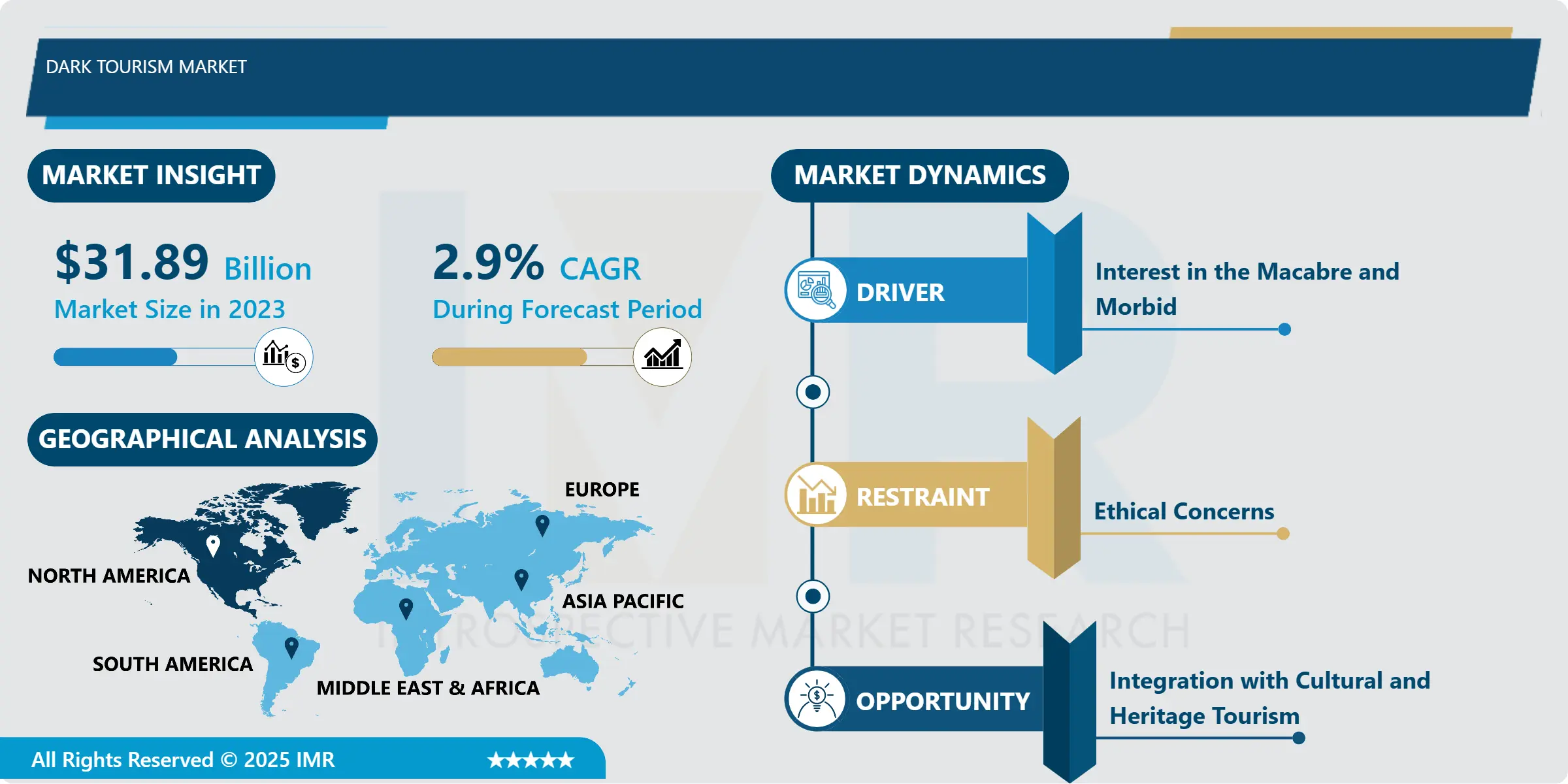
Dark Tourism Market Size Was Valued at USD 31.89 Billion in 2023, and is Projected to Reach USD 41.25 Billion by 2032, Growing at a CAGR of 2.90% From 2024-2032.
Dark tourism is the tourism that focuses at capturing places related to death or adversity, for instance the battlefields, cemeteries, disaster zones, as well as prisons. This covers tourism that involves historical and current activities that are thought to encompass the touristic interest in the macabre including wars, natural disasters and executions among others. Dark tourism is, in a sense, an education tool that enables the clients to learn abouat different events and cultures, which are hard to come across in other ways.
The Dark Tourism market categorizes the segment of tourism specifically for sites that are associated with death, suffering or grief like battlefields, cemetery, forts, abandoned buildings, crime scenes, and old prisons. This market segment has been growing with the trend of tourist looking for the off the beaten track experiences that are also shocking at times and offer historical and social perspectives. Dark tourism attractions allow the visitors to learn about the past occurrences, use the knowledge about them and analyze psychological and emotional aspect of the history. Promoters for this market include a shift in preferences towards a different type of tourism, a greater access to information via the internet and also arising consciousness of heritage conservation.
Dark Tourism market is forecasted to expand giving more tourists’ attraction because they desire to receive both fun and knowledge. This growth is also due to the increasing numbers of heritage sites and museums all over the world that are associated with the darker side of history. However, there are still issues like: ethical issues, issues of negative perception, and issues to do with visitor experience management. A destination manager has to achieve the economic goal while dealing with cultural history as well as the social implication of presenting such history on the inhabitants of the concerned destination. With the market maturing in the future, a lot of attention will have to be given to how people interact with travellers and offer sound practical information while preserving the enshrinements of history.
Dark Tourism Market Trend Analysis:
Ethical Considerations in Dark Tourism Expansion
Dark tourism therefore is a form of tourism that attracts tourists to sites that are linked with death, violence and the supernatural kind, comprising of condemned structures like prison, death structures like concentration camp, war zones like battle field, haunted places like an open space which is supposed to have been a scene of murder and death and disaster areas. Such tourism is fascinating to people with a more profound need to touch history, come through the full-blown shock, and interact with the past. The growing interest in these places is a trend in today’s demand – everyone is looking for experiences other than the standard ‘attractions and landmarks. There other factors that have led to the emergence of dark tourism including; the improvement of the technology where tourist have enhanced experience of the dark attractions for instance VR and AR appeal. These technologies not only add value to the experience by making it more engaging but a method of storing and sharing history that may otherwise be lost or ignored.
In the extensive development of the dark tourism market, the new concepts and types of services provided are in the form of themes, educations and interaction and activities to enhance the visit and expand the knowledge of the event and history associated with those dark tourism sites. This is especially true for areas that have a history of suffering and war, in which dark tourism has been a leading and stable segment. It also triggers issues of concern regarding commodification of contentious spaces, the effects on indigenous inhabitants and historiography. There is a growing concern among operators to meet customers’ need while at the same time maintaining the sites economically viable and sensible to the victims of the incidents. Therefore, the market for dark tourism is expected to go on growing in order to satisfy various kinds of travelers interested in the historical and social processes happening in the world.
Rising Demand for Dark Tourism Destinations
On the growth of tourism and with the development of the desire to visit nontraditional places for the travel industry, death places connected to historical events, war, and different fatalities will become more popular. This trend is attributed to the idea to explore the history of people with regards to the aspects that people number of times prefer, which provides darker yet much more profound perspective on culture and change. The Dark Tourism market can totally benefit from this by offering attractions that will include history specials such as historical expertise, special guided tours, official displays and even educational crusades to help people appreciate the grimmer side of history. Such experiences can enable the travellers to chronologically relate with history and in turn learn and think more emphatically.
Moreover, cooperation with native populations and authorities to preserve such places can improve the practicability of the sites and attract more consumers. In getting the support of these stakeholders, the Dark Tourism market can make sure that these sites can be represented and maintained in an appropriate manner. Not only does this partnership serve the purpose of conservation but also serves the boost local economy through tourism income. The modern market can consider extending its reach by offering the content that would bring awareness of these places’ history and advocate appropriate conduct on vacation.
Dark Tourism Market Segment Analysis:
Dark Tourism Market is Segmented on the basis of By Tour Type, Traveler Type, Tourist Type, Booking Channel and Region.
By Tour Type, Holocaust Tourism segment is expected to dominate the market during the forecast period
Holocaust tourism is the exploration of areas for historical and memorable effects related to the Holocaust perpetuated during World War II. It is usually involving trip to concentration camps and their museums and memorial places where historical events are portrayed. The ones existing today provide a powerful and virtuous opportunity for the tourist to come to terms with the tragedy that happened during the Second World War and its consequences for humans, families, societies. It is to promote understanding, thinking and to learn history; people should feel and realize the tragedy and think about the rights and diversity in the contemporary world. Holocaust tourism has a significant function as a tool for history and awareness, and that makes it possible to deliver understanding to the future generations regarding the price, which people pay for hatred, prejudice and discrimination.
According to the travelers involved in Holocaust tourism, most of them are very passionate in concern with history and human rights. They are looking for a reflective one which is not equivalent to tourist experience but expecting more than that: a voyage they can feel and think about. These visitors are more often history oriented and interested in these places as being memorial stories which are taught through touching and personal experiences of Holocaust. The color and formality of these visits inspires reflection about man’s ability to survive in the face of adversity, and the significance of remembering evil in our past in order to ensure that such evil is not repeated in the future.
By Booking Channel, Direct segment expected to held the largest share
Customers who make an individual reservation may have a better-defined view of the self and needs. The same applies to the present study and the notion of direct bookings as such experiences are more frequent to those particular types of the niche tourism where tourists look for more unique and specialized tours and their guides. These travelers are much more involved in the planning stages, and choose their tours keenly in accordance with their own expectation levels. They prefer personal communication and may have rather great expectations towards the quality and theme of the interaction. They will be in a position to get what they want completely, be it through getting the appropriate packages that will suit their discriminate, or getting a unique access point, or even using the adequate expert.
This type of traveller is usually pickier and is even ready to spend extra time and effort for a search of the tours connected with the given topic. They value the ability to engage guides and organizers themselves and to pose questions, and as a result gain a broader insight into the content of the material. Sometimes, the direct bookings enable these travelers to book certain experiences in a way that caters to their interests and also deliver a firsthand meaningful and memorable tour. This approach is especially relevant for those sector that focuses on the so-called niche tourism because it is likely that the tour itself might make or break the experience as well as the amount of knowledge one gains from the experience.
Dark Tourism Market Regional Insights:
North America is Expected to Dominate the Market Over the Forecast period
The case is the same with North America where the sector is, however, taking shape and already enjoys relatively high popularity due to historical sites, battlefields, and crime scenes. Other nations, for the most part, united states and Canada, possess a wide variety of such locations, such as battlefields of different wars, criminal Scenes, and sites of ghost sightings. The rate at which these places attracts visitors together with the emergence of cultural and experiential tourism has boosted dark tourism. Some of them are – Alcatraz Island Tours, Gettysburg Battlefield Tours, the Jack the Ripper Tours in London. The North American market is also experiencing improvements in travelling technology that assists tourist in organizing themselves and visiting these destinations. Such advancement has made it easier to have direct and personal interaction with pessimistic historical and cultural perspectives.
There are, so much so the market for dark tourism has been able to experience significant boost in North America supplemented by the rising trends of using tourism for educational purpose. Historically curious people are always touring the globe especially the regions those enable them understand certain historical events, societal problems and the culture among others. This trend is seen in the so-called Ghost and Crime Scene tours and in visits to Scream miles such as the Colorado Stanley Hotel made famous by Stephen King’s ‘Shining’. Besides the entertainment, they get from these experiences, people are encouraged to think about the lessons and even negative aspects of societal progress. The market expansion is also reflected by the well-developed infrastructure of North American destinations for tourism based on death punishment where distinct entertainment services intensified with such a focus, including guided tours, multimedia installations, and thematic hotels are intensively developed.
Active Key Players in the Dark Tourism Market:
Lupine Travel Company (USA)
Chornobyl Tours (Ukraine)
Young Pioneer Tours (Russia)
Aero Travels (India)
Atlas Obscura (USA)
Dark Rome Tours (Italy)
Anne Frank House (Netherlands)
Auschwitz-Birkenau Memorial and Museum (Poland)
Alcatraz Cruises (USA)
Haunted History Tours (USA)
Other Active Players
Key Industry Developments in the Dark Tourism Market:
In March 2023, Chornobyl Tours highlighted guided excursions into the Chornobyl Exclusion Zone in Ukraine, providing an in-depth exploration of the 1986 nuclear disaster site. The company was adept at navigating the complexities of accessing this highly restricted area, offering a rare and insightful experience for visitors.
Chapter 1: Introduction
1.1 Scope and Coverage
Chapter 2:Executive Summary
Chapter 3: Market Landscape
3.1 Market Dynamics
3.1.1 Drivers
3.1.2 Restraints
3.1.3 Opportunities
3.1.4 Challenges
3.2 Market Trend Analysis
3.3 PESTLE Analysis
3.4 Porter’s Five Forces Analysis
3.5 Industry Value Chain Analysis
3.6 Ecosystem
3.7 Regulatory Landscape
3.8 Price Trend Analysis
3.9 Patent Analysis
3.10 Technology Evolution
3.11 Investment Pockets
3.12 Import-Export Analysis
Chapter 4: Dark Tourism Market by Tour Type
4.1 Dark Tourism Market Snapshot and Growth Engine
4.2 Dark Tourism Market Overview
4.3 Holocaust Tourism
4.3.1 Introduction and Market Overview
4.3.2 Historic and Forecasted Market Size in Value USD and Volume Units (2017-2032F)
4.3.3 Key Market Trends, Growth Factors and Opportunities
4.3.4 Holocaust Tourism: Geographic Segmentation Analysis
4.4 Genocide Tourism
4.4.1 Introduction and Market Overview
4.4.2 Historic and Forecasted Market Size in Value USD and Volume Units (2017-2032F)
4.4.3 Key Market Trends, Growth Factors and Opportunities
4.4.4 Genocide Tourism: Geographic Segmentation Analysis
4.5 Paranormal Tourism
4.5.1 Introduction and Market Overview
4.5.2 Historic and Forecasted Market Size in Value USD and Volume Units (2017-2032F)
4.5.3 Key Market Trends, Growth Factors and Opportunities
4.5.4 Paranormal Tourism: Geographic Segmentation Analysis
4.6 Battlefield Tourism
4.6.1 Introduction and Market Overview
4.6.2 Historic and Forecasted Market Size in Value USD and Volume Units (2017-2032F)
4.6.3 Key Market Trends, Growth Factors and Opportunities
4.6.4 Battlefield Tourism: Geographic Segmentation Analysis
4.7 Nuclear Tourism and Others
4.7.1 Introduction and Market Overview
4.7.2 Historic and Forecasted Market Size in Value USD and Volume Units (2017-2032F)
4.7.3 Key Market Trends, Growth Factors and Opportunities
4.7.4 Nuclear Tourism and Others: Geographic Segmentation Analysis
Chapter 5: Dark Tourism Market by Traveler Type
5.1 Dark Tourism Market Snapshot and Growth Engine
5.2 Dark Tourism Market Overview
5.3 Couples
5.3.1 Introduction and Market Overview
5.3.2 Historic and Forecasted Market Size in Value USD and Volume Units (2017-2032F)
5.3.3 Key Market Trends, Growth Factors and Opportunities
5.3.4 Couples: Geographic Segmentation Analysis
5.4 Solo
5.4.1 Introduction and Market Overview
5.4.2 Historic and Forecasted Market Size in Value USD and Volume Units (2017-2032F)
5.4.3 Key Market Trends, Growth Factors and Opportunities
5.4.4 Solo: Geographic Segmentation Analysis
5.5 Family and Groups
5.5.1 Introduction and Market Overview
5.5.2 Historic and Forecasted Market Size in Value USD and Volume Units (2017-2032F)
5.5.3 Key Market Trends, Growth Factors and Opportunities
5.5.4 Family and Groups: Geographic Segmentation Analysis
Chapter 6: Dark Tourism Market by Tourist Type
6.1 Dark Tourism Market Snapshot and Growth Engine
6.2 Dark Tourism Market Overview
6.3 Domestic and International
6.3.1 Introduction and Market Overview
6.3.2 Historic and Forecasted Market Size in Value USD and Volume Units (2017-2032F)
6.3.3 Key Market Trends, Growth Factors and Opportunities
6.3.4 Domestic and International: Geographic Segmentation Analysis
Chapter 7: Dark Tourism Market by Booking Channel
7.1 Dark Tourism Market Snapshot and Growth Engine
7.2 Dark Tourism Market Overview
7.3 Direct
7.3.1 Introduction and Market Overview
7.3.2 Historic and Forecasted Market Size in Value USD and Volume Units (2017-2032F)
7.3.3 Key Market Trends, Growth Factors and Opportunities
7.3.4 Direct: Geographic Segmentation Analysis
7.4 Travel Agent and place Booking
7.4.1 Introduction and Market Overview
7.4.2 Historic and Forecasted Market Size in Value USD and Volume Units (2017-2032F)
7.4.3 Key Market Trends, Growth Factors and Opportunities
7.4.4 Travel Agent and place Booking: Geographic Segmentation Analysis
Chapter 8: Company Profiles and Competitive Analysis
8.1 Competitive Landscape
8.1.1 Competitive Benchmarking
8.1.2 Dark Tourism Market Share by Manufacturer (2023)
8.1.3 Industry BCG Matrix
8.1.4 Heat Map Analysis
8.1.5 Mergers and Acquisitions
8.2 LUPINE TRAVEL COMPANY
8.2.1 Company Overview
8.2.2 Key Executives
8.2.3 Company Snapshot
8.2.4 Role of the Company in the Market
8.2.5 Sustainability and Social Responsibility
8.2.6 Operating Business Segments
8.2.7 Product Portfolio
8.2.8 Business Performance
8.2.9 Key Strategic Moves and Recent Developments
8.2.10 SWOT Analysis
8.3 CHORNOBYL TOURS
8.4 YOUNG PIONEER TOURS
8.5 AERO TRAVELS
8.6 ATLAS OBSCURA
8.7 DARK ROME TOURS
8.8 ANNE FRANK HOUSE
8.9 AUSCHWITZ-BIRKENAU MEMORIAL AND MUSEUM
8.10 ALCATRAZ CRUISES
8.11 HAUNTED HISTORY TOURS
8.12 OTHER ACTIVE PLAYERS
Chapter 9: Global Dark Tourism Market By Region
9.1 Overview
9.2. North America Dark Tourism Market
9.2.1 Key Market Trends, Growth Factors and Opportunities
9.2.2 Top Key Companies
9.2.3 Historic and Forecasted Market Size by Segments
9.2.4 Historic and Forecasted Market Size By Tour Type
9.2.4.1 Holocaust Tourism
9.2.4.2 Genocide Tourism
9.2.4.3 Paranormal Tourism
9.2.4.4 Battlefield Tourism
9.2.4.5 Nuclear Tourism and Others
9.2.5 Historic and Forecasted Market Size By Traveler Type
9.2.5.1 Couples
9.2.5.2 Solo
9.2.5.3 Family and Groups
9.2.6 Historic and Forecasted Market Size By Tourist Type
9.2.6.1 Domestic and International
9.2.7 Historic and Forecasted Market Size By Booking Channel
9.2.7.1 Direct
9.2.7.2 Travel Agent and place Booking
9.2.8 Historic and Forecast Market Size by Country
9.2.8.1 US
9.2.8.2 Canada
9.2.8.3 Mexico
9.3. Eastern Europe Dark Tourism Market
9.3.1 Key Market Trends, Growth Factors and Opportunities
9.3.2 Top Key Companies
9.3.3 Historic and Forecasted Market Size by Segments
9.3.4 Historic and Forecasted Market Size By Tour Type
9.3.4.1 Holocaust Tourism
9.3.4.2 Genocide Tourism
9.3.4.3 Paranormal Tourism
9.3.4.4 Battlefield Tourism
9.3.4.5 Nuclear Tourism and Others
9.3.5 Historic and Forecasted Market Size By Traveler Type
9.3.5.1 Couples
9.3.5.2 Solo
9.3.5.3 Family and Groups
9.3.6 Historic and Forecasted Market Size By Tourist Type
9.3.6.1 Domestic and International
9.3.7 Historic and Forecasted Market Size By Booking Channel
9.3.7.1 Direct
9.3.7.2 Travel Agent and place Booking
9.3.8 Historic and Forecast Market Size by Country
9.3.8.1 Russia
9.3.8.2 Bulgaria
9.3.8.3 The Czech Republic
9.3.8.4 Hungary
9.3.8.5 Poland
9.3.8.6 Romania
9.3.8.7 Rest of Eastern Europe
9.4. Western Europe Dark Tourism Market
9.4.1 Key Market Trends, Growth Factors and Opportunities
9.4.2 Top Key Companies
9.4.3 Historic and Forecasted Market Size by Segments
9.4.4 Historic and Forecasted Market Size By Tour Type
9.4.4.1 Holocaust Tourism
9.4.4.2 Genocide Tourism
9.4.4.3 Paranormal Tourism
9.4.4.4 Battlefield Tourism
9.4.4.5 Nuclear Tourism and Others
9.4.5 Historic and Forecasted Market Size By Traveler Type
9.4.5.1 Couples
9.4.5.2 Solo
9.4.5.3 Family and Groups
9.4.6 Historic and Forecasted Market Size By Tourist Type
9.4.6.1 Domestic and International
9.4.7 Historic and Forecasted Market Size By Booking Channel
9.4.7.1 Direct
9.4.7.2 Travel Agent and place Booking
9.4.8 Historic and Forecast Market Size by Country
9.4.8.1 Germany
9.4.8.2 UK
9.4.8.3 France
9.4.8.4 The Netherlands
9.4.8.5 Italy
9.4.8.6 Spain
9.4.8.7 Rest of Western Europe
9.5. Asia Pacific Dark Tourism Market
9.5.1 Key Market Trends, Growth Factors and Opportunities
9.5.2 Top Key Companies
9.5.3 Historic and Forecasted Market Size by Segments
9.5.4 Historic and Forecasted Market Size By Tour Type
9.5.4.1 Holocaust Tourism
9.5.4.2 Genocide Tourism
9.5.4.3 Paranormal Tourism
9.5.4.4 Battlefield Tourism
9.5.4.5 Nuclear Tourism and Others
9.5.5 Historic and Forecasted Market Size By Traveler Type
9.5.5.1 Couples
9.5.5.2 Solo
9.5.5.3 Family and Groups
9.5.6 Historic and Forecasted Market Size By Tourist Type
9.5.6.1 Domestic and International
9.5.7 Historic and Forecasted Market Size By Booking Channel
9.5.7.1 Direct
9.5.7.2 Travel Agent and place Booking
9.5.8 Historic and Forecast Market Size by Country
9.5.8.1 China
9.5.8.2 India
9.5.8.3 Japan
9.5.8.4 South Korea
9.5.8.5 Malaysia
9.5.8.6 Thailand
9.5.8.7 Vietnam
9.5.8.8 The Philippines
9.5.8.9 Australia
9.5.8.10 New Zealand
9.5.8.11 Rest of APAC
9.6. Middle East & Africa Dark Tourism Market
9.6.1 Key Market Trends, Growth Factors and Opportunities
9.6.2 Top Key Companies
9.6.3 Historic and Forecasted Market Size by Segments
9.6.4 Historic and Forecasted Market Size By Tour Type
9.6.4.1 Holocaust Tourism
9.6.4.2 Genocide Tourism
9.6.4.3 Paranormal Tourism
9.6.4.4 Battlefield Tourism
9.6.4.5 Nuclear Tourism and Others
9.6.5 Historic and Forecasted Market Size By Traveler Type
9.6.5.1 Couples
9.6.5.2 Solo
9.6.5.3 Family and Groups
9.6.6 Historic and Forecasted Market Size By Tourist Type
9.6.6.1 Domestic and International
9.6.7 Historic and Forecasted Market Size By Booking Channel
9.6.7.1 Direct
9.6.7.2 Travel Agent and place Booking
9.6.8 Historic and Forecast Market Size by Country
9.6.8.1 Turkiye
9.6.8.2 Bahrain
9.6.8.3 Kuwait
9.6.8.4 Saudi Arabia
9.6.8.5 Qatar
9.6.8.6 UAE
9.6.8.7 Israel
9.6.8.8 South Africa
9.7. South America Dark Tourism Market
9.7.1 Key Market Trends, Growth Factors and Opportunities
9.7.2 Top Key Companies
9.7.3 Historic and Forecasted Market Size by Segments
9.7.4 Historic and Forecasted Market Size By Tour Type
9.7.4.1 Holocaust Tourism
9.7.4.2 Genocide Tourism
9.7.4.3 Paranormal Tourism
9.7.4.4 Battlefield Tourism
9.7.4.5 Nuclear Tourism and Others
9.7.5 Historic and Forecasted Market Size By Traveler Type
9.7.5.1 Couples
9.7.5.2 Solo
9.7.5.3 Family and Groups
9.7.6 Historic and Forecasted Market Size By Tourist Type
9.7.6.1 Domestic and International
9.7.7 Historic and Forecasted Market Size By Booking Channel
9.7.7.1 Direct
9.7.7.2 Travel Agent and place Booking
9.7.8 Historic and Forecast Market Size by Country
9.7.8.1 Brazil
9.7.8.2 Argentina
9.7.8.3 Rest of SA
Chapter 10 Analyst Viewpoint and Conclusion
10.1 Recommendations and Concluding Analysis
10.2 Potential Market Strategies
Chapter 11 Research Methodology
11.1 Research Process
11.2 Primary Research
11.3 Secondary Research
Q1: What would be the forecast period in the Dark Tourism Market research report?
A1: The forecast period in the Market research report is 2024-2032.
Q2: Who are the key players in the Dark Tourism Market?
A2: Lupine Travel Company (USA), Chornobyl Tours (Ukraine), Young Pioneer Tours (Russia), Aero Travels (India), Atlas Obscura (USA), Dark Rome Tours (Italy), Anne Frank House (Netherlands), Auschwitz-Birkenau Memorial and Museum (Poland), Alcatraz Cruises (USA), Haunted History Tours (USA), and Other Active Players.
Q3: What are the segments of the Dark Tourism Market?
A3: The Dark Tourism Market is segmented into By Tour Type, Traveler Type, Tourist Type, Booking Channel and region. By Tour Type, the market is categorized into Holocaust Tourism, Genocide Tourism, Paranormal Tourism, Battlefield Tourism, Nuclear Tourism and Others. By Traveler Type, the market is categorized into Couples, Solo, Family and Groups. By Tourist Type, the market is categorized into Domestic and International. By Booking Channel, the market is categorized into Direct, Travel Agent and Marketplace Booking. By region, it is analyzed across North America (U.S.; Canada; Mexico), Eastern Europe (Bulgaria; The Czech Republic; Hungary; Poland; Romania; Rest of Eastern Europe), Western Europe (Germany; UK; France; Netherlands; Italy; Russia; Spain; Rest of Western Europe), Asia-Pacific (China; India; Japan; Southeast Asia, etc.), South America (Brazil; Argentina, etc.), Middle East & Africa (Saudi Arabia; South Africa, etc.).
Q4: What is the Dark Tourism Market?
A4: Dark tourism refers to the practice of visiting sites associated with death, tragedy, and suffering, such as battlefields, cemeteries, disaster sites, and former prisons. It encompasses tourism experiences centered around historical and contemporary events that are often deemed unpleasant or morbid, such as war, natural disasters, and executions. Dark tourism provides visitors with an opportunity to learn about and reflect on these events, offering a unique perspective on history and culture.
Q5: How big is the Dark Tourism Market?
A5: Dark Tourism Market Size Was Valued at USD 31.89 Billion in 2023, and is Projected to Reach USD 41.25 Billion by 2032, Growing at a CAGR of 2.90% From 2024-2032.
How to buy a report from Megatrends.jp
On the product page, select the license you want: Single User License or Enterprise License.
Select the report language:
- English Report
- English Report + Japanese Translation
Click the Buy Now button.
You’ll be redirected to the checkout page. Enter your company and payment details.
Click Place Order to complete your purchase.
Confirmation: You’ll receive an order confirmation email. Our team will then follow up with your report delivery.
If you have questions, fill out the contact form below or email us at sales1@megatrends.jp.
Thank you for choosing Megatrends.jp!