24時間365日サポート — いつでもお客様をサポートいたします。
お問い合わせ


Electronic Gas Volume Correctors Market In-Depth Insights And Analysis 2024-2032
Electronic Gas Volume Correctors (EVCs) are crucial instruments in the natural gas sector, intended to precisely measure and regulate gas volumes amid varying pressure and temperature conditions. These gadgets operate by detecting pulses from gas meters and employing real-time temperature and pressure information to modify the gas volume to standard conditions. EVCs are essential for maintaining consistency in gas volume measurements, facilitating accurate billing, adherence to regulations, and effective energy utilization.

IMR
Description
Electronic Gas Volume Correctors Market Synopsis
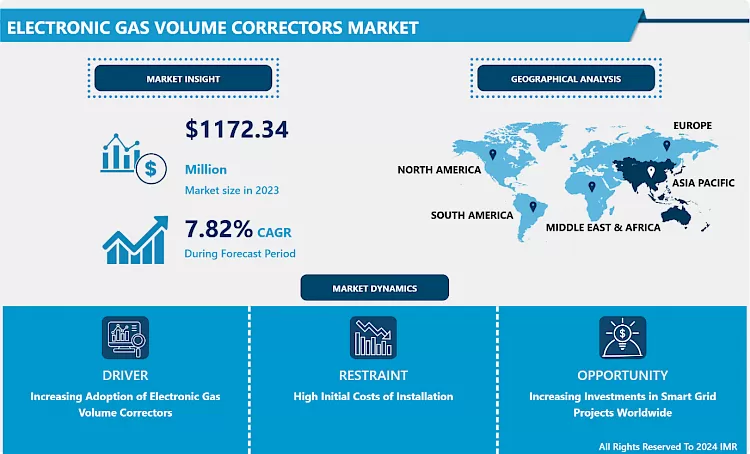
Electronic Gas Volume Correctors Market Size Was Valued at USD 1172.34 Million in 2023, and is Projected to Reach USD 2308.59 Million by 2032, Growing at a CAGR of 7.82% From 2024-2032.
Electronic Gas Volume Correctors (EVCs) are crucial instruments in the natural gas sector, intended to precisely measure and regulate gas volumes amid varying pressure and temperature conditions. These gadgets operate by detecting pulses from gas meters and employing real-time temperature and pressure information to modify the gas volume to standard conditions. EVCs are essential for maintaining consistency in gas volume measurements, facilitating accurate billing, adherence to regulations, and effective energy utilization.
EVCs function by modifying gas flow measurements to align with a standard reference condition, usually involving a constant temperature and pressure. The instrument assesses the real gas flow at the consumption or transmission site, recording pulse signals from a gas meter. EVC employs sensors to track pressure and temperature, assess deviations from norms, and adjust gas volumes to ensure uniform reporting throughout the distribution network for billing and compliance.
Various kinds of Electronic Gas Volume Correctors are offered, each designed for particular operational requirements and surroundings. The most frequently utilized are the portable and stationary EVCs. Portable EVCs are utilized for temporary measurement and calibration of gas meters, frequently in field environments. These devices are created for easy relocation and utilization at various measurement locations. In contrast, fixed EVCs are installed permanently in gas measurement systems and are intended for ongoing monitoring. PTZ (Pressure, Temperature, and Volume) correctors represent some of the most sophisticated EVCs, providing immediate data modifications for variations in pressure and temperature. These models are extremely precise and are utilized in extensive gas transmission networks, where accuracy is essential. Certain EVCs provide extra features like remote data transmission, wireless connectivity, and cloud-based analytics, allowing operators to retrieve gas flow data from Distence.
Electronic Gas Volume Correctors Market Trend Analysis:
Increasing Adoption of Electronic Gas Volume Correctors
The increasing use of Electronic Gas Volume Correctors (EVCs) greatly aids the expansion of the global EVC market. EVCs guarantee accurate measurement of natural gas by adjusting for changes in pressure and temperature. For example, in gas utilities, an EVC can adjust a recorded gas volume of 1,000 cubic meters at 60°F and 14.7 psi to meet standard conditions, ensuring precise billing and adherence to regulatory standards. Technological progress has allowed contemporary EVCs to connect with IoT frameworks, enabling immediate data transfer and distant monitoring. For instance, utility firms utilizing IoT-enabled EVCs noted a 15-20% decrease in operational expenses from enhanced monitoring and fewer manual interventions. The need for these advanced systems is increasing, especially in areas prioritizing digital transformation in gas management.
As global natural gas usage is expected to surpass 4,200 billion cubic meters by 2025, the need for effective measurement systems such as EVCs is likely to increase. This growth is additionally backed by technological advancements and tighter industry regulations. EVCs have turned into essential instruments for guaranteeing operational efficiency and adherence to regulations, establishing them as a fundamental element of contemporary gas management systems.
Increasing Investments in Smart Grid Projects Worldwide
The rising investments in smart grid initiatives worldwide offer a considerable growth potential for the Electronic Gas Volume Correctors (EVC) sector. Governments and utility companies are focusing on updating electrical grids to enhance efficiency, minimize losses, and facilitate improved energy management. Smart grids depend on accurate measurements of gas and electricity flow, which is vital for their advanced metering infrastructure and real-time data capabilities, thus making Electronic Gas Volume Correctors crucial. These devices guarantee precise billing and efficient energy allocation by adjusting for fluctuations in temperature and pressure.
The worldwide transition to renewable energy sources and decentralized power generation is increasingly driving the demand for smart grids. EVCs play a crucial role in regulating the variable energy production from renewable sources such as wind and solar, guaranteeing that energy usage is precisely recorded and invoiced, irrespective of fluctuations in supply. For example, in countries such as Germany and the United States, where the integration of renewable energy is increasing, the implementation of smart grid technologies is driving a greater demand for EVCs. These devices assist in ensuring precise energy measurement, which is essential for utility providers and consumers to effectively control energy usage.
Electronic Gas Volume Correctors Market Segment Analysis:
Electronic Gas Volume Correctors Market is segmented on the basis of product type, type, functionality, application, end-use industry and region
By Product Type, Single-Channel EVCs segment is expected to dominate the market during the forecast period
The market for single-channel electronic volume correctors (EVC) is witnessing significant growth, driven by the increasing demand for accurate gas measurement and compliance with regulations in the energy sector. A notable trend is the adoption of advanced EVCs that offer enhanced digital features, such as IoT integration and wireless communication. These features enable remote monitoring, immediate data evaluation, and seamless compatibility with smart metering systems. The shift toward sustainability and efficiency in energy management is progressively encouraging the adoption of single-channel EVCs. They are favored for their simplicity, cost-effectiveness, and precision in managing smaller gas distribution networks. The capability of the devices to function with various gas meters makes them highly versatile, catering to residential, commercial, and industrial requirements. Geographically, growth is robust in emerging markets where modernizing infrastructure and digitizing energy are primary priorities.
The market for single-channel Electronic Volume Correctors (EVC) offers considerable potential as industries and utilities prioritize precision, efficiency, and compliance with regulations in gas measurement. The rise in urbanization and growth of infrastructure, particularly in developing countries, is enhancing the demand for accurate gas measurement systems, resulting in a significant market for single-channel EVCs.
By Type, Mains Powered Volume Correctors segment held the largest share of 63.44% in 2023
The Electronic Gas Volume Correctors (EVC) market is witnessing a trend driven by the need for precise gas measurement and billing in commercial and industrial fields. EVCs utilize advanced pressure and temperature sensors to precisely measure gas volume, compensating for changes in operating conditions like temperature and pressure. Market trends emphasize the requirement for sensors that are highly accurate, very stable, and low power, aligning with the demand for prolonged use in battery-powered systems. The adoption of IoT-enabled EVCs is also on the rise, offering remote oversight, immediate data exchange, and advanced analytics. These characteristics enhance operational efficiency and ensure compliance with regulations. Highlighting energy efficiency and sustainability encourages the embrace of low-power designs, ensuring lasting and reliable performance. With the increase in natural gas consumption and the tightening of global metering standards, the EVC market is poised for expansion, especially in regions facing significant industrialization and infrastructure development.
Electronic Gas Volume Correctors Market Regional Insights:
Asia Pacific is Expected to Dominate the Market Over the Forecast period
The Asia Pacific area is witnessing substantial development in several sectors, with prominent progress in energy, water management, and the chemical sector. In 2023, China’s oil and gas sector achieved a significant milestone, exceeding 390 million metric tons of oil equivalent in production, bolstered by government efforts focused on boosting energy security. India’s swift urban growth has led to an increase in wastewater production, amounting to 72,368 million liters per day (MLD) of sewage, of which only 28% is treated, worsening the strain on water resources. The nation’s water and wastewater sector, the fifth-largest in the world, is anticipated to rise from $11 billion to $18 billion by 2026. Japan’s housing industry, comprising 65.02 million housing units, is fueling the need for accurate energy measurement solutions like Electronic Gas Volume Correctors (EVCs), essential for precise gas volume assessment in a nation with varied climate conditions. The chemical sectors in South Korea, Malaysia, Thailand, and Vietnam have demonstrated strong growth, characterized by rising imports and exports, indicating greater demand for specialized goods.
South Korea, especially, continues to be a top exporter of organic chemicals. Thailand’s chemical exports, comprising organic chemicals valued at $4.01 billion, underscore the necessity for precise fluid and gas measurement systems such as EVCs, which are vital in petrochemical manufacturing. Vietnam’s thriving food and beverage (F&B) sector, projected to hit $39 billion by 2026, is generating significant demand for EVCs to enhance energy efficiency in production and logistics. The EVC market is also experiencing growth in nations such as the Philippines, Australia, New Zealand, Indonesia, Singapore, and Sri Lanka, fueled by heightened industrial development, effective water management, and the demand for accurate measurement systems in water and gas distribution.
Electronic Gas Volume Correctors Market Top Key Players:
Honeywell International Inc. (USA)
Landis+Gyr (Switzerland)
Elgas, S.R.O. (Slovakia)
Metreg Technologies GmbH (Germany)
AIUT (Gliwice, Poland)
Samgas Romania (Romania)
Sacofgas Srl (Italy)
RMG Messtechnik (Germany)
Pietro Fiorentini S.P.A. (Italy)
Zenner (Germany)
Galvanic Applied Sciences (Canada)
Dresser Utility Solutions (USA)
Plum (Poland)
Wigersma & Sikkema (Netherlands)
Metrix Italia (Italy)
Gold Card (China)
Kimpex Flow Pvt. Ltd. (India)
Flow Metering Technology Private Limited (India), and Other Active Players.
Key Industry Developments in the Electronic Gas Volume Correctors Market:
In November 2024, Landis+Gyr a global leader in integrated energy management solutions, signed a comprehensive 15-year agreement with TREFOR Infrastruktur A/S, TREFOR Vand A/S, and TREFOR Varme A/S to deliver, implement, and support a new generation of smart meters and digital infrastructure across TREFOR’s service areas. This collaboration marks a significant milestone in Denmark’s ongoing transition towards a more efficient, data-driven utility landscape.
In September 2024, Honeywell announced it has signed an agreement with USA BioEnergy (USABE) to implement its Experion PKS Distributed Control System (DCS) and safety system at USABE’s new Texas Renewable Fuels Bon Wier advanced biorefinery, which is designed to convert wood waste into sustainable aviation fuel (SAF). This collaboration underscores Honeywell’s alignment of its portfolio to three compelling megatrends—automation, the future of aviation, and energy transition.
Chapter 1: Introduction
1.1 Scope and Coverage
Chapter 2:Executive Summary
Chapter 3: Market Landscape
3.1 Market Dynamics
3.1.1 Drivers
3.1.2 Restraints
3.1.3 Opportunities
3.1.4 Challenges
3.2 Market Trend Analysis
3.3 PESTLE Analysis
3.4 Porter’s Five Forces Analysis
3.5 Industry Value Chain Analysis
3.6 Ecosystem
3.7 Regulatory Landscape
3.8 Price Trend Analysis
3.9 Patent Analysis
3.10 Technology Evolution
3.11 Investment Pockets
3.12 Import-Export Analysis
Chapter 4: Electronic Gas Volume Correctors Market by Product Type (2018-2032)
4.1 Electronic Gas Volume Correctors Market Snapshot and Growth Engine
4.2 Market Overview
4.3 Single-Channel EVCs
4.3.1 Introduction and Market Overview
4.3.2 Historic and Forecasted Market Size in Value USD and Volume Units
4.3.3 Key Market Trends, Growth Factors, and Opportunities
4.3.4 Geographic Segmentation Analysis
4.4 Multi-Channel EVCs
Chapter 5: Electronic Gas Volume Correctors Market by Type (2018-2032)
5.1 Electronic Gas Volume Correctors Market Snapshot and Growth Engine
5.2 Market Overview
5.3 Mains Powered Volume Correctors
5.3.1 Introduction and Market Overview
5.3.2 Historic and Forecasted Market Size in Value USD and Volume Units
5.3.3 Key Market Trends, Growth Factors, and Opportunities
5.3.4 Geographic Segmentation Analysis
5.4 Battery Powered Volume Correctors
Chapter 6: Electronic Gas Volume Correctors Market by Functionality (2018-2032)
6.1 Electronic Gas Volume Correctors Market Snapshot and Growth Engine
6.2 Market Overview
6.3 Combined Correction
6.3.1 Introduction and Market Overview
6.3.2 Historic and Forecasted Market Size in Value USD and Volume Units
6.3.3 Key Market Trends, Growth Factors, and Opportunities
6.3.4 Geographic Segmentation Analysis
6.4 Pressure Correction
6.5 Temperature Correction
Chapter 7: Electronic Gas Volume Correctors Market by Application (2018-2032)
7.1 Electronic Gas Volume Correctors Market Snapshot and Growth Engine
7.2 Market Overview
7.3 Industrial
7.3.1 Introduction and Market Overview
7.3.2 Historic and Forecasted Market Size in Value USD and Volume Units
7.3.3 Key Market Trends, Growth Factors, and Opportunities
7.3.4 Geographic Segmentation Analysis
7.4 Commercial
7.5 Residential
Chapter 8: Electronic Gas Volume Correctors Market by End-Use Industry (2018-2032)
8.1 Electronic Gas Volume Correctors Market Snapshot and Growth Engine
8.2 Market Overview
8.3 Oil & Gas
8.3.1 Introduction and Market Overview
8.3.2 Historic and Forecasted Market Size in Value USD and Volume Units
8.3.3 Key Market Trends, Growth Factors, and Opportunities
8.3.4 Geographic Segmentation Analysis
8.4 Chemical
8.5 Water & Wastewater
8.6 Food & Beverage
8.7 Others
Chapter 9: Company Profiles and Competitive Analysis
9.1 Competitive Landscape
9.1.1 Competitive Benchmarking
9.1.2 Electronic Gas Volume Correctors Market Share by Manufacturer (2024)
9.1.3 Industry BCG Matrix
9.1.4 Heat Map Analysis
9.1.5 Mergers and Acquisitions
9.2 HONEYWELL INTERNATIONAL INC. (USA)
9.2.1 Company Overview
9.2.2 Key Executives
9.2.3 Company Snapshot
9.2.4 Role of the Company in the Market
9.2.5 Sustainability and Social Responsibility
9.2.6 Operating Business Segments
9.2.7 Product Portfolio
9.2.8 Business Performance
9.2.9 Key Strategic Moves and Recent Developments
9.2.10 SWOT Analysis
9.3 LANDIS+GYR (SWITZERLAND)
9.4 ELGAS
9.5 S.R.O. (SLOVAKIA)
9.6 METREG TECHNOLOGIES GMBH (GERMANY)
9.7 AIUT (GLIWICE
9.8 POLAND)
9.9 SAMGAS ROMANIA (ROMANIA)
9.10 SACOFGAS SRL (ITALY)
9.11 RMG MESSTECHNIK (GERMANY)
9.12 PIETRO FIORENTINI S.P.A. (ITALY)
9.13 ZENNER (GERMANY)
9.14 GALVANIC APPLIED SCIENCES (CANADA)
9.15 DRESSER UTILITY SOLUTIONS (USA)
9.16 PLUM (POLAND)
9.17 WIGERSMA & SIKKEMA (NETHERLANDS)
9.18 METRIX ITALIA (ITALY)
9.19 GOLD CARD (CHINA)
9.20 KIMPEX FLOW PVT. LTD. (INDIA)
9.21 FLOW METERING TECHNOLOGY PRIVATE LIMITED (INDIA)
9.22 AND
Chapter 10: Global Electronic Gas Volume Correctors Market By Region
10.1 Overview
10.2. North America Electronic Gas Volume Correctors Market
10.2.1 Key Market Trends, Growth Factors and Opportunities
10.2.2 Top Key Companies
10.2.3 Historic and Forecasted Market Size by Segments
10.2.4 Historic and Forecasted Market Size by Product Type
10.2.4.1 Single-Channel EVCs
10.2.4.2 Multi-Channel EVCs
10.2.5 Historic and Forecasted Market Size by Type
10.2.5.1 Mains Powered Volume Correctors
10.2.5.2 Battery Powered Volume Correctors
10.2.6 Historic and Forecasted Market Size by Functionality
10.2.6.1 Combined Correction
10.2.6.2 Pressure Correction
10.2.6.3 Temperature Correction
10.2.7 Historic and Forecasted Market Size by Application
10.2.7.1 Industrial
10.2.7.2 Commercial
10.2.7.3 Residential
10.2.8 Historic and Forecasted Market Size by End-Use Industry
10.2.8.1 Oil & Gas
10.2.8.2 Chemical
10.2.8.3 Water & Wastewater
10.2.8.4 Food & Beverage
10.2.8.5 Others
10.2.9 Historic and Forecast Market Size by Country
10.2.9.1 US
10.2.9.2 Canada
10.2.9.3 Mexico
10.3. Eastern Europe Electronic Gas Volume Correctors Market
10.3.1 Key Market Trends, Growth Factors and Opportunities
10.3.2 Top Key Companies
10.3.3 Historic and Forecasted Market Size by Segments
10.3.4 Historic and Forecasted Market Size by Product Type
10.3.4.1 Single-Channel EVCs
10.3.4.2 Multi-Channel EVCs
10.3.5 Historic and Forecasted Market Size by Type
10.3.5.1 Mains Powered Volume Correctors
10.3.5.2 Battery Powered Volume Correctors
10.3.6 Historic and Forecasted Market Size by Functionality
10.3.6.1 Combined Correction
10.3.6.2 Pressure Correction
10.3.6.3 Temperature Correction
10.3.7 Historic and Forecasted Market Size by Application
10.3.7.1 Industrial
10.3.7.2 Commercial
10.3.7.3 Residential
10.3.8 Historic and Forecasted Market Size by End-Use Industry
10.3.8.1 Oil & Gas
10.3.8.2 Chemical
10.3.8.3 Water & Wastewater
10.3.8.4 Food & Beverage
10.3.8.5 Others
10.3.9 Historic and Forecast Market Size by Country
10.3.9.1 Russia
10.3.9.2 Bulgaria
10.3.9.3 The Czech Republic
10.3.9.4 Hungary
10.3.9.5 Poland
10.3.9.6 Romania
10.3.9.7 Rest of Eastern Europe
10.4. Western Europe Electronic Gas Volume Correctors Market
10.4.1 Key Market Trends, Growth Factors and Opportunities
10.4.2 Top Key Companies
10.4.3 Historic and Forecasted Market Size by Segments
10.4.4 Historic and Forecasted Market Size by Product Type
10.4.4.1 Single-Channel EVCs
10.4.4.2 Multi-Channel EVCs
10.4.5 Historic and Forecasted Market Size by Type
10.4.5.1 Mains Powered Volume Correctors
10.4.5.2 Battery Powered Volume Correctors
10.4.6 Historic and Forecasted Market Size by Functionality
10.4.6.1 Combined Correction
10.4.6.2 Pressure Correction
10.4.6.3 Temperature Correction
10.4.7 Historic and Forecasted Market Size by Application
10.4.7.1 Industrial
10.4.7.2 Commercial
10.4.7.3 Residential
10.4.8 Historic and Forecasted Market Size by End-Use Industry
10.4.8.1 Oil & Gas
10.4.8.2 Chemical
10.4.8.3 Water & Wastewater
10.4.8.4 Food & Beverage
10.4.8.5 Others
10.4.9 Historic and Forecast Market Size by Country
10.4.9.1 Germany
10.4.9.2 UK
10.4.9.3 France
10.4.9.4 The Netherlands
10.4.9.5 Italy
10.4.9.6 Spain
10.4.9.7 Rest of Western Europe
10.5. Asia Pacific Electronic Gas Volume Correctors Market
10.5.1 Key Market Trends, Growth Factors and Opportunities
10.5.2 Top Key Companies
10.5.3 Historic and Forecasted Market Size by Segments
10.5.4 Historic and Forecasted Market Size by Product Type
10.5.4.1 Single-Channel EVCs
10.5.4.2 Multi-Channel EVCs
10.5.5 Historic and Forecasted Market Size by Type
10.5.5.1 Mains Powered Volume Correctors
10.5.5.2 Battery Powered Volume Correctors
10.5.6 Historic and Forecasted Market Size by Functionality
10.5.6.1 Combined Correction
10.5.6.2 Pressure Correction
10.5.6.3 Temperature Correction
10.5.7 Historic and Forecasted Market Size by Application
10.5.7.1 Industrial
10.5.7.2 Commercial
10.5.7.3 Residential
10.5.8 Historic and Forecasted Market Size by End-Use Industry
10.5.8.1 Oil & Gas
10.5.8.2 Chemical
10.5.8.3 Water & Wastewater
10.5.8.4 Food & Beverage
10.5.8.5 Others
10.5.9 Historic and Forecast Market Size by Country
10.5.9.1 China
10.5.9.2 India
10.5.9.3 Japan
10.5.9.4 South Korea
10.5.9.5 Malaysia
10.5.9.6 Thailand
10.5.9.7 Vietnam
10.5.9.8 The Philippines
10.5.9.9 Australia
10.5.9.10 New Zealand
10.5.9.11 Rest of APAC
10.6. Middle East & Africa Electronic Gas Volume Correctors Market
10.6.1 Key Market Trends, Growth Factors and Opportunities
10.6.2 Top Key Companies
10.6.3 Historic and Forecasted Market Size by Segments
10.6.4 Historic and Forecasted Market Size by Product Type
10.6.4.1 Single-Channel EVCs
10.6.4.2 Multi-Channel EVCs
10.6.5 Historic and Forecasted Market Size by Type
10.6.5.1 Mains Powered Volume Correctors
10.6.5.2 Battery Powered Volume Correctors
10.6.6 Historic and Forecasted Market Size by Functionality
10.6.6.1 Combined Correction
10.6.6.2 Pressure Correction
10.6.6.3 Temperature Correction
10.6.7 Historic and Forecasted Market Size by Application
10.6.7.1 Industrial
10.6.7.2 Commercial
10.6.7.3 Residential
10.6.8 Historic and Forecasted Market Size by End-Use Industry
10.6.8.1 Oil & Gas
10.6.8.2 Chemical
10.6.8.3 Water & Wastewater
10.6.8.4 Food & Beverage
10.6.8.5 Others
10.6.9 Historic and Forecast Market Size by Country
10.6.9.1 Turkiye
10.6.9.2 Bahrain
10.6.9.3 Kuwait
10.6.9.4 Saudi Arabia
10.6.9.5 Qatar
10.6.9.6 UAE
10.6.9.7 Israel
10.6.9.8 South Africa
10.7. South America Electronic Gas Volume Correctors Market
10.7.1 Key Market Trends, Growth Factors and Opportunities
10.7.2 Top Key Companies
10.7.3 Historic and Forecasted Market Size by Segments
10.7.4 Historic and Forecasted Market Size by Product Type
10.7.4.1 Single-Channel EVCs
10.7.4.2 Multi-Channel EVCs
10.7.5 Historic and Forecasted Market Size by Type
10.7.5.1 Mains Powered Volume Correctors
10.7.5.2 Battery Powered Volume Correctors
10.7.6 Historic and Forecasted Market Size by Functionality
10.7.6.1 Combined Correction
10.7.6.2 Pressure Correction
10.7.6.3 Temperature Correction
10.7.7 Historic and Forecasted Market Size by Application
10.7.7.1 Industrial
10.7.7.2 Commercial
10.7.7.3 Residential
10.7.8 Historic and Forecasted Market Size by End-Use Industry
10.7.8.1 Oil & Gas
10.7.8.2 Chemical
10.7.8.3 Water & Wastewater
10.7.8.4 Food & Beverage
10.7.8.5 Others
10.7.9 Historic and Forecast Market Size by Country
10.7.9.1 Brazil
10.7.9.2 Argentina
10.7.9.3 Rest of SA
Chapter 11 Analyst Viewpoint and Conclusion
11.1 Recommendations and Concluding Analysis
11.2 Potential Market Strategies
Chapter 12 Research Methodology
12.1 Research Process
12.2 Primary Research
12.3 Secondary Research
Q1: What would be the forecast period in the Electronic Gas Volume Correctors Market research report?
A1: The forecast period in the Electronic Gas Volume Correctors Market research report is 2024-2032.
Q2: Who are the key players in the Electronic Gas Volume Correctors Market?
A2: Honeywell International Inc. (USA), Landis+Gyr (Switzerland), Elgas, S.R.O. (Slovakia), Metreg Technologies GmbH (Germany), AIUT (Poland), Samgas Romania (Romania), Sacofgas Srl (Italy), RMG Messtechnik (Germany), Pietro Fiorentini S.P.A. (Italy), Zenner (Germany), Galvanic Applied Sciences (Canada), Dresser Utility Solutions (USA), Plum (Poland), Wigersma & Sikkema (Netherlands), Metrix Italia (Italy), Gold Card (China), Kimpex Flow Pvt. Ltd. (India), Flow Metering Technology Private Limited (India), and Other Active Players.
Q3: What are the segments of the Electronic Gas Volume Correctors Market?
A3: The Electronic Gas Volume Correctors Market is segmented into Product Type, Type, Functionality, Application, End-Use Industry, and region. By Product Type, the market is categorized into Single-Channel Evcs, Multi-Channel Evcs. By TYPE, the market is categorized into Mains Powered Volume Correctors, Battery Powered Volume Correctors. By Functionality, the market is categorized into Combined Correction, Pressure Correction, Temperature Correction. By Application, the market is categorized into Industrial, Commercial, Residential. By End-Use Industry, the market is categorized into Oil & Gas, Chemical, Water & Wastewater, Food & Beverage, Others. By region, it is analyzed across North America (U.S.; Canada; Mexico), Eastern Europe (Bulgaria; The Czech Republic; Hungary; Poland; Romania; Rest of Eastern Europe), Western Europe (Germany; UK; France; Netherlands; Italy; Russia; Spain; Rest of Western Europe), Asia-Pacific (China; India; Japan; Southeast Asia, etc.), South America (Brazil; Argentina, etc.), Middle East & Africa (Saudi Arabia; South Africa, etc.).
Q4: What is the Electronic Gas Volume Correctors Market?
A4: Electronic Gas Volume Correctors (EVCs) are crucial instruments in the natural gas sector, intended to precisely measure and regulate gas volumes amid varying pressure and temperature conditions. These gadgets operate by detecting pulses from gas meters and employing real-time temperature and pressure information to modify the gas volume to standard conditions. EVCs are essential for maintaining consistency in gas volume measurements, facilitating accurate billing, adherence to regulations, and effective energy utilization.
Q5: How big is the Electronic Gas Volume Correctors Market?
A5: Electronic Gas Volume Correctors Market Size Was Valued at USD 1172.34 Million in 2023, and is Projected to Reach USD 2308.59 Million by 2032, Growing at a CAGR of 7.82% From 2024-2032.
How to buy a report from Megatrends.jp
On the product page, select the license you want: Single User License or Enterprise License.
Select the report language:
- English Report
- English Report + Japanese Translation
Click the Buy Now button.
You’ll be redirected to the checkout page. Enter your company and payment details.
Click Place Order to complete your purchase.
Confirmation: You’ll receive an order confirmation email. Our team will then follow up with your report delivery.
If you have questions, fill out the contact form below or email us at sales1@megatrends.jp.
Thank you for choosing Megatrends.jp!
Related products