24時間365日サポート — いつでもお客様をサポートいたします。
お問い合わせ
Energy Security Market-Current Analysis by Market Share
The energy security market addresses the increasing global concerns related to the availability, accessibility, and reliability of energy resources. It encompasses a range of technologies, policies, and strategies aimed at safeguarding the uninterrupted supply of energy and mitigating risks associated with potential disruptions.

IMR
Description
Energy Security Market Synopsis
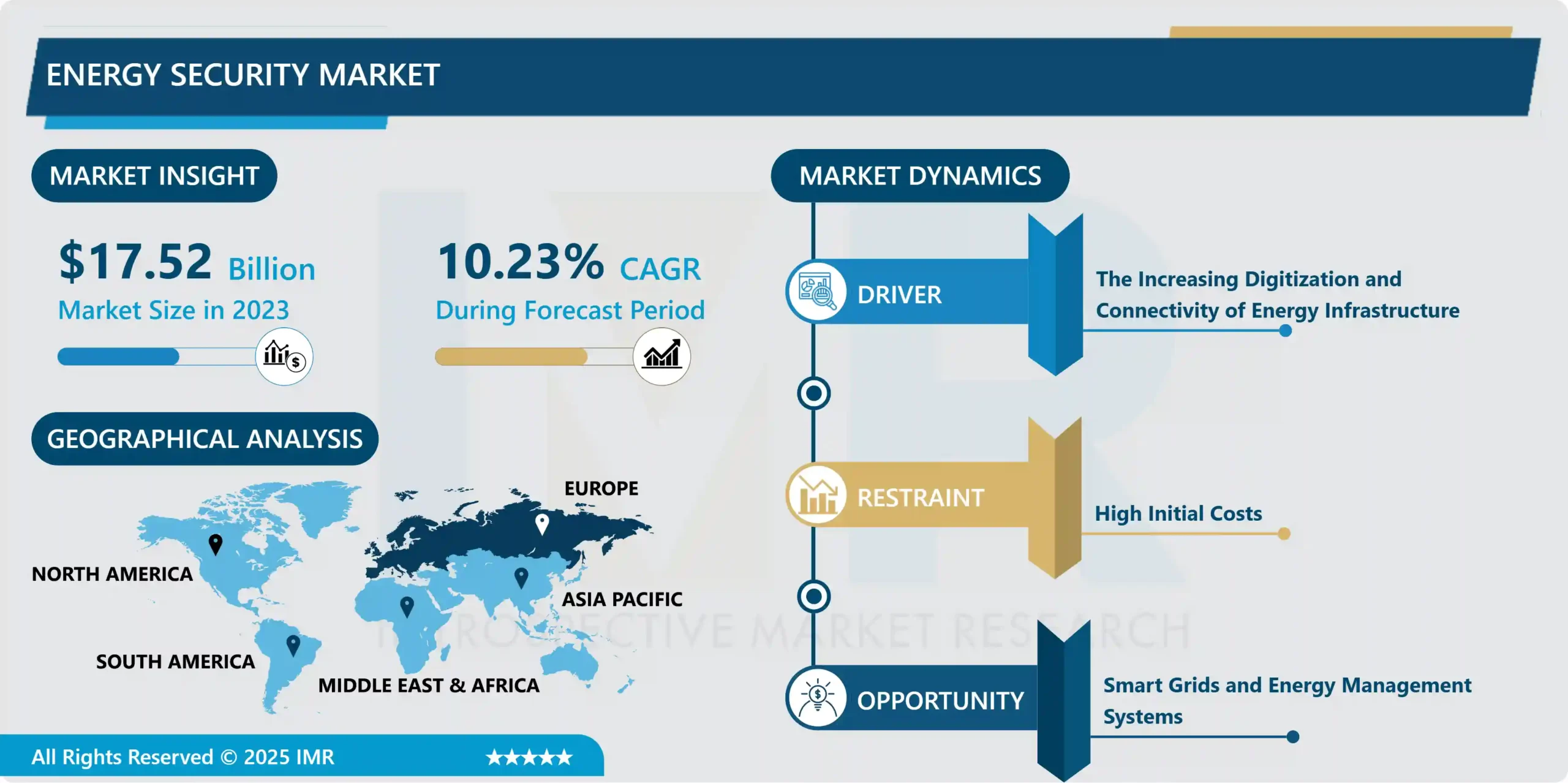
Energy Security Market Size Was Valued at USD 17.52 Billion in 2023 and is Projected to Reach USD 42.1 Billion by 2032, Growing at a CAGR of 10.23 % From 2024-2032.
The energy security market addresses the increasing global concerns related to the availability, accessibility, and reliability of energy resources. It encompasses a range of technologies, policies, and strategies aimed at safeguarding the uninterrupted supply of energy and mitigating risks associated with potential disruptions.
Key components of the energy security market include infrastructure protection, cybersecurity, diversification of energy sources, and emergency response planning. With the growing dependence on interconnected and digitized energy systems, the need for robust cybersecurity measures has become paramount to prevent unauthorized access, data breaches, and potential disruptions to critical energy infrastructure.
Governments and organizations are investing in advanced technologies such as smart grids, microgrids, and energy storage solutions to enhance resilience and ensure a stable energy supply. The market also emphasizes the importance of renewable energy sources and energy efficiency measures to reduce reliance on traditional fossil fuels, enhancing both environmental sustainability and energy security.
In addition to technological advancements, geopolitical factors play a crucial role in shaping the energy security landscape. Countries are actively engaging in diplomatic efforts, energy alliances, and strategic partnerships to secure reliable access to energy resources and navigate potential geopolitical tensions that could impact energy supplies.
Energy Security Market Trend Analysis
The Increasing Digitization and Connectivity of Energy Infrastructure
The Energy Security Market is experiencing significant growth driven by the increasing digitization and connectivity of energy infrastructure. As modern societies become more dependent on digital technologies, the energy sector is undergoing a transformative shift towards smart grids, advanced metering systems, and interconnected devices. This digitalization offers numerous benefits, including enhanced monitoring, control, and efficiency of energy systems.
With these advancements come new challenges and vulnerabilities, making energy security a top priority. The interconnectivity of energy infrastructure opens avenues for potential cyber threats and physical attacks. As a result, there is a growing demand for robust security solutions to safeguard critical energy assets and ensure uninterrupted power supply.
The Energy Security Market responds to this need by offering a range of solutions such as cybersecurity measures, physical security systems, and advanced analytics to detect and mitigate potential threats. Governments, utilities, and private entities are investing in these technologies to build resilience against cyber-attacks, natural disasters, and other potential disruptions.
Smart Grids and Energy Management Systems Creates an Opportunity for Energy Security Market
Smart Grids and Energy Management Systems (EMS) represent a significant opportunity for the Energy Security Market, offering a comprehensive approach to enhance the resilience and reliability of energy infrastructure. Smart Grids leverage advanced technologies, such as IoT devices, sensors, and communication networks, to create an intelligent and interconnected energy delivery system.
These systems enable real-time monitoring, control, and optimization of energy distribution, allowing utilities to respond swiftly to disruptions and ensure continuous power supply. By integrating renewable energy sources and storage technologies, Smart Grids contribute to a more sustainable and diversified energy mix, reducing dependence on traditional fossil fuels and enhancing overall energy security.
Energy Management Systems play a crucial role in optimizing energy consumption and efficiency. They provide tools for monitoring and analyzing energy usage patterns, enabling organizations to make informed decisions to reduce energy waste and costs. Additionally, EMS facilitates demand response programs, allowing for dynamic adjustments in energy consumption during peak periods or emergencies.
Energy Security Market Segment Analysis:
Energy Security Market Segmented based into Power Plants, Technologies, Components and Industry Type.
By Power Plants, Thermal & Hydro segment is expected to dominate the market during the forecast period
The thermal power plants, often fueled by coal, natural gas, or oil, are integral to meeting the growing global energy demand due to their reliability and consistent power generation capabilities. These plants contribute significantly to energy security by providing a stable and continuous power supply, essential for industrial, residential, and commercial needs.
Similarly, hydroelectric power plants harness the energy of flowing water to generate electricity, offering a renewable and sustainable source of power. Their ability to provide base-load power and serve as a reliable source in various geographical locations enhances energy security.
The dominance of thermal and hydro segments in the energy security market can be attributed to their established infrastructure, proven technological reliability, and the ability to adapt to diverse environmental conditions. Governments and industries worldwide are increasingly investing in these segments to strengthen their energy security strategies, aiming to mitigate the risks associated with energy supply disruptions and ensure a resilient power infrastructure for the future.
By Technologies, Network Security segment held the largest share of 56.4% in 2022
The increasing digitization and connectivity of energy infrastructure have made it more susceptible to cyber threats, prompting a heightened focus on network security measures. With the widespread adoption of smart grids, IoT devices, and advanced communication technologies in the energy sector, the need for robust network security solutions has become paramount.
Network Security technologies play a crucial role in safeguarding critical energy infrastructure from cyberattacks, unauthorized access, and data breaches. These technologies encompass firewalls, intrusion detection systems, encryption protocols, and other advanced cybersecurity measures designed to detect, prevent, and respond to cyber threats in real-time.
The growing interconnectivity of energy systems, coupled with the rising sophistication of cyber threats, has propelled the demand for comprehensive network security solutions. Energy companies are increasingly investing in state-of-the-art technologies to secure their networks and ensure the uninterrupted and reliable operation of their critical infrastructure.
Energy Security Market Regional Insights:
Europe is Expected to Dominate the Market Over the Forecast period
Europe has been a significant player in the global energy security market, given its emphasis on renewable energy sources, energy efficiency, and efforts to diversify its energy mix. The region has been at the forefront of adopting advanced technologies to enhance energy infrastructure resilience and reduce dependencies on external energy sources.
Several factors contribute to Europe’s dominance in the energy security market. The European Union (EU) has been proactive in implementing policies to ensure a secure and sustainable energy supply, with a focus on reducing carbon emissions. Investments in smart grids, energy storage, and cybersecurity measures have further strengthened the region’s energy infrastructure.
Additionally, the geopolitical landscape and the quest for energy independence have driven European countries to explore domestic energy sources, such as wind, solar, and nuclear power. These initiatives contribute to a more secure and resilient energy supply, positioning Europe as a key player in the global energy security market.
Energy Security Market Top Key Players:
Siemens (Germany)
Honeywell International Inc. (United States)
Schneider Electric (France)
ABB Ltd. (Switzerland)
General Electric (United States)
Lockheed Martin Corporation (United States)
Raytheon Technologies Corporation (United States)
Northrop Grumman Corporation (United States)
BAE Systems plc (United Kingdom)
Johnson Controls International plc (Ireland)
Thales Group (France)
Huawei Technologies Co., Ltd. (China)
Symantec Corporation (United States)
McAfee, LLC (United States)
Fortinet, Inc. (United States)
Cisco Systems, Inc. (United States)
IBM Corporation (United States)
Siemens Energy AG (Germany)
Emerson Electric Co. (United States)
Schneider Electric SE (France), and Other Major Players.
Key Industry Developments in the Energy Security Market:
In November 2023, Siemens Energy and Air Liquide have joined forces to establish a groundbreaking 1-gigawatt electrolyzer factory in Berlin. This strategic collaboration aims to expedite the growth of the hydrogen economy by leveraging Siemens Energy’s expertise in energy technology and Air Liquide’s proficiency in industrial gases. The initiative signals a significant step towards advancing sustainable hydrogen production and fostering a greener energy landscape.
In October 2023, Siemens Energy achieves a groundbreaking milestone by operating a gas turbine exclusively with 100% renewable hydrogen, marking a historic world first. This accomplishment is a result of collaborative efforts within the HYFLEXPOWER consortium. The successful integration of renewable hydrogen in gas turbine technology demonstrates significant progress towards sustainable energy solutions, showcasing Siemens Energy’s commitment to advancing clean and efficient power generation.
Chapter 1: Introduction
1.1 Scope and Coverage
Chapter 2:Executive Summary
Chapter 3: Market Landscape
3.1 Market Dynamics
3.1.1 Drivers
3.1.2 Restraints
3.1.3 Opportunities
3.1.4 Challenges
3.2 Market Trend Analysis
3.3 PESTLE Analysis
3.4 Porter’s Five Forces Analysis
3.5 Industry Value Chain Analysis
3.6 Ecosystem
3.7 Regulatory Landscape
3.8 Price Trend Analysis
3.9 Patent Analysis
3.10 Technology Evolution
3.11 Investment Pockets
3.12 Import-Export Analysis
Chapter 4: Energy Security Market by Power Plants (2018-2032)
4.1 Energy Security Market Snapshot and Growth Engine
4.2 Market Overview
4.3 Nuclear
4.3.1 Introduction and Market Overview
4.3.2 Historic and Forecasted Market Size in Value USD and Volume Units
4.3.3 Key Market Trends, Growth Factors, and Opportunities
4.3.4 Geographic Segmentation Analysis
4.4 Thermal & Hydro
4.5 Oil & Gas
4.6 Renewable Energy
Chapter 5: Energy Security Market by Technologies (2018-2032)
5.1 Energy Security Market Snapshot and Growth Engine
5.2 Market Overview
5.3 Physical Security
5.3.1 Introduction and Market Overview
5.3.2 Historic and Forecasted Market Size in Value USD and Volume Units
5.3.3 Key Market Trends, Growth Factors, and Opportunities
5.3.4 Geographic Segmentation Analysis
5.4 Network Security
Chapter 6: Energy Security Market by Components (2018-2032)
6.1 Energy Security Market Snapshot and Growth Engine
6.2 Market Overview
6.3 Solution
6.3.1 Introduction and Market Overview
6.3.2 Historic and Forecasted Market Size in Value USD and Volume Units
6.3.3 Key Market Trends, Growth Factors, and Opportunities
6.3.4 Geographic Segmentation Analysis
6.4 Service
Chapter 7: Energy Security Market by Industry Type (2018-2032)
7.1 Energy Security Market Snapshot and Growth Engine
7.2 Market Overview
7.3 Energy & Power
7.3.1 Introduction and Market Overview
7.3.2 Historic and Forecasted Market Size in Value USD and Volume Units
7.3.3 Key Market Trends, Growth Factors, and Opportunities
7.3.4 Geographic Segmentation Analysis
7.4 IT & Telecommunication
Chapter 8: Company Profiles and Competitive Analysis
8.1 Competitive Landscape
8.1.1 Competitive Benchmarking
8.1.2 Energy Security Market Share by Manufacturer (2024)
8.1.3 Industry BCG Matrix
8.1.4 Heat Map Analysis
8.1.5 Mergers and Acquisitions
8.2 NEC CORPORATION (JAPAN)
8.2.1 Company Overview
8.2.2 Key Executives
8.2.3 Company Snapshot
8.2.4 Role of the Company in the Market
8.2.5 Sustainability and Social Responsibility
8.2.6 Operating Business Segments
8.2.7 Product Portfolio
8.2.8 Business Performance
8.2.9 Key Strategic Moves and Recent Developments
8.2.10 SWOT Analysis
8.3 3M COGENT (UNITED STATES)
8.4 FUJITSU LIMITED (JAPAN)
8.5 MORPHO (SAFRAN) (FRANCE)
8.6 CROSSMATCH TECHNOLOGIES (UNITED STATES)
8.7 BIOENABLE TECHNOLOGIES PVT. LTD. (INDIA)
8.8 SUPREMA INC. (SOUTH KOREA)
8.9 ZKTECO INC. (CHINA)
8.10 IMPRIVATA INC. (UNITED STATES)
8.11 GEMALTO N.V. (NETHERLANDS)
8.12 AWARE INC. (UNITED STATES)
8.13 COGNITEC SYSTEMS GMBH (GERMANY)
8.14 GREEN BIT S.P.A. (ITALY)
8.15 SECUGEN CORPORATION (UNITED STATES)
8.16 STANLEY BLACK & DECKER INC. (UNITED STATES)
8.17 SRI INTERNATIONAL (UNITED STATES)
8.18 BIO-KEY INTERNATIONAL INC. (UNITED STATES)
8.19 HID GLOBAL (UNITED STATES)
8.20 INTEGRATED BIOMETRICS (UNITED STATES)
8.21 BIOMETRICS4ALL INC. (UNITED STATES)
8.22
Chapter 9: Global Energy Security Market By Region
9.1 Overview
9.2. North America Energy Security Market
9.2.1 Key Market Trends, Growth Factors and Opportunities
9.2.2 Top Key Companies
9.2.3 Historic and Forecasted Market Size by Segments
9.2.4 Historic and Forecasted Market Size by Power Plants
9.2.4.1 Nuclear
9.2.4.2 Thermal & Hydro
9.2.4.3 Oil & Gas
9.2.4.4 Renewable Energy
9.2.5 Historic and Forecasted Market Size by Technologies
9.2.5.1 Physical Security
9.2.5.2 Network Security
9.2.6 Historic and Forecasted Market Size by Components
9.2.6.1 Solution
9.2.6.2 Service
9.2.7 Historic and Forecasted Market Size by Industry Type
9.2.7.1 Energy & Power
9.2.7.2 IT & Telecommunication
9.2.8 Historic and Forecast Market Size by Country
9.2.8.1 US
9.2.8.2 Canada
9.2.8.3 Mexico
9.3. Eastern Europe Energy Security Market
9.3.1 Key Market Trends, Growth Factors and Opportunities
9.3.2 Top Key Companies
9.3.3 Historic and Forecasted Market Size by Segments
9.3.4 Historic and Forecasted Market Size by Power Plants
9.3.4.1 Nuclear
9.3.4.2 Thermal & Hydro
9.3.4.3 Oil & Gas
9.3.4.4 Renewable Energy
9.3.5 Historic and Forecasted Market Size by Technologies
9.3.5.1 Physical Security
9.3.5.2 Network Security
9.3.6 Historic and Forecasted Market Size by Components
9.3.6.1 Solution
9.3.6.2 Service
9.3.7 Historic and Forecasted Market Size by Industry Type
9.3.7.1 Energy & Power
9.3.7.2 IT & Telecommunication
9.3.8 Historic and Forecast Market Size by Country
9.3.8.1 Russia
9.3.8.2 Bulgaria
9.3.8.3 The Czech Republic
9.3.8.4 Hungary
9.3.8.5 Poland
9.3.8.6 Romania
9.3.8.7 Rest of Eastern Europe
9.4. Western Europe Energy Security Market
9.4.1 Key Market Trends, Growth Factors and Opportunities
9.4.2 Top Key Companies
9.4.3 Historic and Forecasted Market Size by Segments
9.4.4 Historic and Forecasted Market Size by Power Plants
9.4.4.1 Nuclear
9.4.4.2 Thermal & Hydro
9.4.4.3 Oil & Gas
9.4.4.4 Renewable Energy
9.4.5 Historic and Forecasted Market Size by Technologies
9.4.5.1 Physical Security
9.4.5.2 Network Security
9.4.6 Historic and Forecasted Market Size by Components
9.4.6.1 Solution
9.4.6.2 Service
9.4.7 Historic and Forecasted Market Size by Industry Type
9.4.7.1 Energy & Power
9.4.7.2 IT & Telecommunication
9.4.8 Historic and Forecast Market Size by Country
9.4.8.1 Germany
9.4.8.2 UK
9.4.8.3 France
9.4.8.4 The Netherlands
9.4.8.5 Italy
9.4.8.6 Spain
9.4.8.7 Rest of Western Europe
9.5. Asia Pacific Energy Security Market
9.5.1 Key Market Trends, Growth Factors and Opportunities
9.5.2 Top Key Companies
9.5.3 Historic and Forecasted Market Size by Segments
9.5.4 Historic and Forecasted Market Size by Power Plants
9.5.4.1 Nuclear
9.5.4.2 Thermal & Hydro
9.5.4.3 Oil & Gas
9.5.4.4 Renewable Energy
9.5.5 Historic and Forecasted Market Size by Technologies
9.5.5.1 Physical Security
9.5.5.2 Network Security
9.5.6 Historic and Forecasted Market Size by Components
9.5.6.1 Solution
9.5.6.2 Service
9.5.7 Historic and Forecasted Market Size by Industry Type
9.5.7.1 Energy & Power
9.5.7.2 IT & Telecommunication
9.5.8 Historic and Forecast Market Size by Country
9.5.8.1 China
9.5.8.2 India
9.5.8.3 Japan
9.5.8.4 South Korea
9.5.8.5 Malaysia
9.5.8.6 Thailand
9.5.8.7 Vietnam
9.5.8.8 The Philippines
9.5.8.9 Australia
9.5.8.10 New Zealand
9.5.8.11 Rest of APAC
9.6. Middle East & Africa Energy Security Market
9.6.1 Key Market Trends, Growth Factors and Opportunities
9.6.2 Top Key Companies
9.6.3 Historic and Forecasted Market Size by Segments
9.6.4 Historic and Forecasted Market Size by Power Plants
9.6.4.1 Nuclear
9.6.4.2 Thermal & Hydro
9.6.4.3 Oil & Gas
9.6.4.4 Renewable Energy
9.6.5 Historic and Forecasted Market Size by Technologies
9.6.5.1 Physical Security
9.6.5.2 Network Security
9.6.6 Historic and Forecasted Market Size by Components
9.6.6.1 Solution
9.6.6.2 Service
9.6.7 Historic and Forecasted Market Size by Industry Type
9.6.7.1 Energy & Power
9.6.7.2 IT & Telecommunication
9.6.8 Historic and Forecast Market Size by Country
9.6.8.1 Turkiye
9.6.8.2 Bahrain
9.6.8.3 Kuwait
9.6.8.4 Saudi Arabia
9.6.8.5 Qatar
9.6.8.6 UAE
9.6.8.7 Israel
9.6.8.8 South Africa
9.7. South America Energy Security Market
9.7.1 Key Market Trends, Growth Factors and Opportunities
9.7.2 Top Key Companies
9.7.3 Historic and Forecasted Market Size by Segments
9.7.4 Historic and Forecasted Market Size by Power Plants
9.7.4.1 Nuclear
9.7.4.2 Thermal & Hydro
9.7.4.3 Oil & Gas
9.7.4.4 Renewable Energy
9.7.5 Historic and Forecasted Market Size by Technologies
9.7.5.1 Physical Security
9.7.5.2 Network Security
9.7.6 Historic and Forecasted Market Size by Components
9.7.6.1 Solution
9.7.6.2 Service
9.7.7 Historic and Forecasted Market Size by Industry Type
9.7.7.1 Energy & Power
9.7.7.2 IT & Telecommunication
9.7.8 Historic and Forecast Market Size by Country
9.7.8.1 Brazil
9.7.8.2 Argentina
9.7.8.3 Rest of SA
Chapter 10 Analyst Viewpoint and Conclusion
10.1 Recommendations and Concluding Analysis
10.2 Potential Market Strategies
Chapter 11 Research Methodology
11.1 Research Process
11.2 Primary Research
11.3 Secondary Research
Q1: What would be the forecast period in the Energy Security Market research report?
A1: The forecast period in the Energy Security Market research report is 2023-2032.
Q2: Who are the key players in the Energy Security Market?
A2: Siemens (Germany), Honeywell International Inc. (United States), Schneider Electric (France), ABB Ltd. (Switzerland), General Electric (United States), Lockheed Martin Corporation (United States), Raytheon Technologies Corporation (United States), Northrop Grumman Corporation (United States), BAE Systems plc (United Kingdom), Johnson Controls International plc (Ireland), Thales Group (France), Huawei Technologies Co., Ltd. (China), Symantec Corporation (United States), McAfee, LLC (United States), Fortinet, Inc. (United States), Cisco Systems, Inc. (United States), IBM Corporation (United States), Siemens Energy AG (Germany), Emerson Electric Co. (United States), Schneider Electric SE (France), and Other Major Players.
Q3: What are the segments of the Energy Security Market?
A3: Energy Security Market is segmented into Power Plants, Technologies, Components Industry Type and region. By Power Plants, the market is categorized into Nuclear, Thermal & Hydro, Oil & Gas, Renewable Energy. By Technologies, the market is categorized into Physical Security, Network Security. By Components the market is categorized into Solution, Service. By Industry Type the market is categorized into Energy & Power, IT & Telecommunication. By region, it is analyzed across North America (U.S.; Canada; Mexico), Eastern Europe (Bulgaria; The Czech Republic; Hungary; Poland; Romania; Rest of Eastern Europe), Western Europe (Germany; UK; France; Netherlands; Italy; Russia; Spain; Rest of Western Europe), Asia-Pacific (China; India; Japan; Southeast Asia, etc.), South America (Brazil; Argentina, etc.), Middle East & Africa (Saudi Arabia; South Africa, etc.).
Q4: What is the Energy Security Market?
A4: The energy security market addresses the increasing global concerns related to the availability, accessibility, and reliability of energy resources. It encompasses a range of technologies, policies, and strategies aimed at safeguarding the uninterrupted supply of energy and mitigating risks associated with potential disruptions.
Q5: How big is the Energy Security Market?
A5: Energy Security Market Size Was Valued at USD 17.52 Billion in 2023 and is Projected to Reach USD 42.1 Billion by 2032, Growing at a CAGR of 10.23 % From 2024-2032.
How to buy a report from Megatrends.jp
On the product page, select the license you want: Single User License or Enterprise License.
Select the report language:
- English Report
- English Report + Japanese Translation
Click the Buy Now button.
You’ll be redirected to the checkout page. Enter your company and payment details.
Click Place Order to complete your purchase.
Confirmation: You’ll receive an order confirmation email. Our team will then follow up with your report delivery.
If you have questions, fill out the contact form below or email us at sales1@megatrends.jp.
Thank you for choosing Megatrends.jp!