24時間365日サポート — いつでもお客様をサポートいたします。
お問い合わせ

IoT Node and Gateway Market | Global Size, Share & Industry Trends
Internet of Things is a new emerging trend in smart devices which are largely associated with the daily tasks of a huge population around the world. Such devices are generally cloud-based controllers and intelligent sensors. Cloud connectivity allows IoT devices to run seamlessly with quick and secure data transfer and storage.

IMR
Description
Global IOT Node and Gateway Market Synopsis
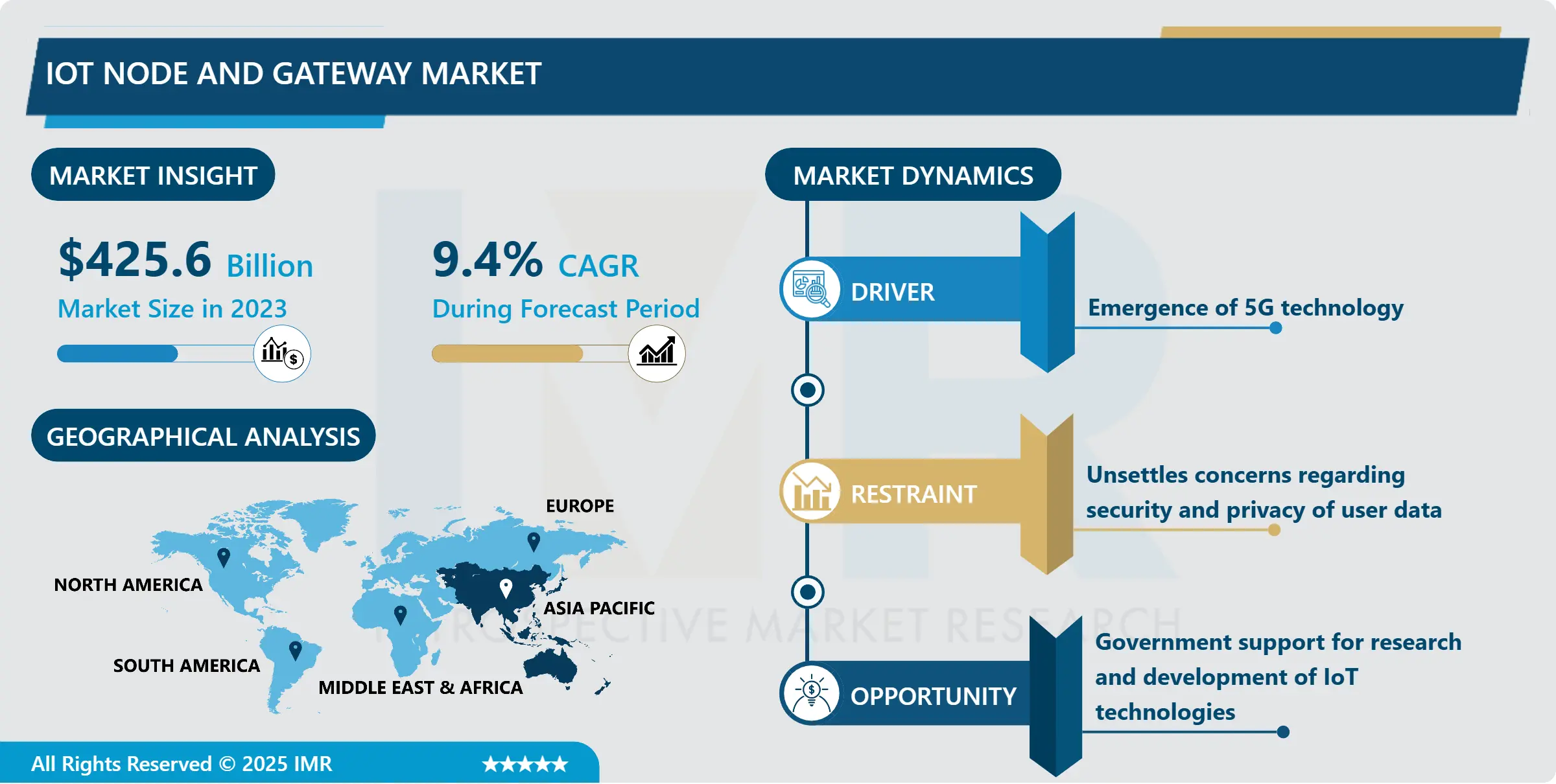
IoT Node and Gateway Market Size Was Valued at USD 465.61 Billion in 2024, and is Projected to Reach USD 955.35 Billion by 2032, Growing at a CAGR of 9.4 % From 2025-2032.
The Internet of Things is a new emerging trend in smart devices which are largely associated with the daily tasks of a huge population around the world. Such devices are generally cloud-based controllers and intelligent sensors. Cloud connectivity allows IoT devices to run seamlessly with quick and secure data transfer and storage.
An IoT Gateway is a connection point between cloud and intelligent gadgets, sensors, and controllers which can be in a physical unit or software program. An IoT gateway consists dedicated hardware appliance or software program which allows all data moving between IoT devices and cloud runs through an IoT gateway which can be stated as an intelligent controlling gateway.
IoT gateway work as a network router between IoT devices and the cloud. One of the main features of IoT gateway is to handle both inbound and outbound traffic from IoT devices to the cloud. Most of the gateway only sent traffic in one direction. Inbound traffic is used for device management and optimizing tasks whereas outbound data is used for sending data to the cloud from IoT devices. IoT gateway also processes the data before sending it to the cloud which summarizes and aggregates data to reduce the volume before sending it to the cloud which created better response time as well as network transmission cost.
The devices used in the data transmission process in the IoT are called nodes. Devices that are providing sensor data or devices that are generally controlled through the cloud can be referred to as nodes. Temperature-controlled sensors, door locks, security sensors, and other low-energy Bluetooth sensors are among the IoT node devices. The current trend of massive adoption of network-connected devices has pushed the market of smart gadgets and IoT devices which have reflected sharply on IoT nodes and gateway markets globally.
Global IOT Node and Gateway Market Trend Analysis
Emergence of 5G technology
The Internet penetration rate has increased to a great extent in the past 10–15 years, in developed regions such as North America and Europe. The upcoming launch of the fifth generation of cellular mobile communications or 5G is likely to reflect positively on the IoT market. This is primarily due to the fact that 5G networks will go a long way towards improving the performance and reliability of these connected devices. 5G will address the need for a faster network with higher capacity that can serve connectivity needs. The 5G spectrum expands the frequencies on which digital cellular technologies will transfer data. This wider spectrum available for use increases the overall bandwidth of cellular networks, allowing additional devices to connect.
The commercial success of any IoT is ultimately tied to its performance, which is dependent on how quickly it can communicate with other IoT devices, smartphones and tablets, and software in the form of its app or website, and more. With 5G, data transfer speeds will increase significantly. 5G will be 10 times faster than current LTE networks. This increase in speed will allow IoT devices to communicate and share data faster than ever. 5G is the foundation for realizing the full potential of IoT. The industry is working to develop new global standards and pre 5G products to benefit industries everywhere.
One of the pivotal drivers behind the surge in IoT nodes and gateways is the inherent capacity of 5G to handle an unprecedented volume of data transmission. This capability is crucial in accommodating the massive influx of data generated by IoT devices. With 5G’s ability to process and transfer vast amounts of data seamlessly and swiftly, IoT devices can operate more efficiently, enabling real-time data processing and decision-making, which is essential in numerous sectors such as healthcare, manufacturing, and smart cities.
Government support for research and development of IoT technologies
Governments across the world are supporting and funding research and development of IoT to boost their productivity. Governments of multiple countries are looking for improvements and innovation in key areas such as smart traffic management systems, energy conservation through smart meters, and security system improvements through smart cameras. Moreover, various governments are funding new IoT research projects for the development of smart cities in the future.
Government support for the research and development of IoT technologies, specifically focused on IoT nodes and gateways, represents a pivotal opportunity driving significant growth within this market segment. Across the globe, governments are increasingly recognizing the transformative potential of IoT in enhancing various sectors, from healthcare and transportation to infrastructure and beyond. This recognition has spurred substantial investments and initiatives aimed at fostering innovation and accelerating the adoption of IoT technologies.
The infusion of government support, whether through funding, policy incentives, or collaborative programs, plays a crucial role in catalyzing R&D efforts within the IoT node and gateway market. These investments fuel technological advancements, driving the creation of more efficient, secure, and interconnected devices. By providing financial resources, regulatory frameworks, and conducive environments for experimentation and innovation, governments encourage the development of cutting-edge IoT solutions.
Global IOT Node and Gateway Market Segment Analysis:
Global IOT Node and Gateway Market Segmented on the basis of type, application, and end-users.
By Component, sensors segment is expected to dominate the market during the forecast period
Sensors stand at the forefront of the IoT Node and Gateway Market’s evolution, wielding unmatched potential for growth. Their ascendancy is fueled by a convergence of pivotal factors that orchestrate their prominence in this landscape. Primarily, the escalating demand for real-time data collection and analysis across industries galvanizes the necessity for sensors. These miniature powerhouses serve as the sensory receptors, capturing diverse data points ranging from temperature and humidity to motion and light. Their role as the foundational element in IoT ecosystems is pivotal, enabling the translation of physical phenomena into meaningful digital insights.
By Connectivity, Cellular segment held the largest share in 2024
The realm of connectivity within the IoT Node and Gateway Market is experiencing a seismic shift, and at the forefront of this transformation stands the cellular segment. This domain’s meteoric rise is propelled by a convergence of factors that propel cellular connectivity to the zenith of growth within the IoT landscape. Cellular connectivity offers unparalleled advantages, particularly in terms of coverage, reliability, and scalability, fostering its rapid adoption across diverse industries. With widespread infrastructure and global coverage, cellular networks empower IoT devices to function seamlessly across vast territories, even in remote or previously inaccessible locations. This extended reach plays a pivotal role in industries like transportation, agriculture, and utilities, where ubiquitous connectivity is paramount for operational efficiency and real-time monitoring.
Global IOT Node and Gateway Market Regional Insights:
Asia Pacific is Expected to Dominate the Market Over the Forecast period
India’s IoT ecosystem is rapidly expanding, fuelled by government initiatives such as Digital India and Smart Cities Mission. The country’s vast population, rising smartphone penetration, and increasing connectivity infrastructure drive IoT solutions adoption across industries. IoT gateways form a critical part of this ecosystem by enabling consistent network and information exchange between IoT gadgets and the cloud.
Greater China is both a huge market for industrial IoT and a major supplier of component technologies, which consist of sensors, microchips, and other components that are the fabric of IoT. Also, after initially using IoT to drive efficiency improvement, Chinese manufacturers are focused on the potential for revenue growth and risk management. As a result, nations such as Thailand, Indonesia, and Vietnam are anticipated to become more vital as China shifts to more efficient generation as companies look for alternative ways to manufacture items closer to new clients within the region.
Global IOT Node and Gateway Market Top Key Players:
Cisco Systems, Inc. (United States)
Notion. (United States)
Helium System Inc. (United States)
Samsara Networks Inc. (United States)
Beep Inc. (United States)
Dell Technologies Inc. (United States)
Hewlett Packard Enterprise Development LP (United States)
Ubiquiti Inc. (United States)
Intel Corporation (United States)
Texas Instruments Incorporated (United States)
Microchip Technology Inc. (United States)
Huawei Technologies Co., Ltd. (China)
NXP Semiconductors N.V. (Netherlands)
Quectel Wireless Solutions Co., Ltd. (China)
Sierra Wireless, Inc. (Canada)
STMicroelectronics N.V. (Switzerland)
Telit Communications PLC (United Kingdom)
Toshiba Corporation (Japan)
TE Connectivity Ltd. (Switzerland)
Estimote Inc. (Poland)
Advantech Co., Ltd. (Taiwan)
Aaeon Technology Inc. (Taiwan)
Nexcom International Co. Ltd. (Taiwan)
Eurotech S.P.A. (Italy)
Adlink Technology Inc. (Taiwan), other active players
Key Industry Developments in the Global IOT Node and Gateway Market:
In Jan 2025, SparkFun partnered with Digi to release a new Quick-Start Board designed for LoRaWAN IoT development. This board simplifies the process of building and deploying LoRaWAN-based IoT solutions, offering developers an easy entry point into low-power wide-area network (LPWAN) technology. The collaboration aims to accelerate IoT innovation, enabling faster prototyping, reduced development time, and easier integration of LoRaWAN capabilities in a variety of IoT applications.
In July 2023, – Advantech introduced a new digital commerce platform, IoTMart International, to facilitate cross-border online business services. This platform complements Advantech’s existing distribution model. It is specifically designed to cater to the diverse requirements of different customer segments, particularly focusing on the needs of small and medium-sized customers.
Chapter 1: Introduction
1.1 Scope and Coverage
Chapter 2:Executive Summary
Chapter 3: Market Landscape
3.1 Market Dynamics
3.1.1 Drivers
3.1.2 Restraints
3.1.3 Opportunities
3.1.4 Challenges
3.2 Market Trend Analysis
3.3 PESTLE Analysis
3.4 Porter’s Five Forces Analysis
3.5 Industry Value Chain Analysis
3.6 Ecosystem
3.7 Regulatory Landscape
3.8 Price Trend Analysis
3.9 Patent Analysis
3.10 Technology Evolution
3.11 Investment Pockets
3.12 Import-Export Analysis
Chapter 4: IoT Node and Gateway Market by Component (2018-2032)
4.1 IoT Node and Gateway Market Snapshot and Growth Engine
4.2 Market Overview
4.3 Processor
4.3.1 Introduction and Market Overview
4.3.2 Historic and Forecasted Market Size in Value USD and Volume Units
4.3.3 Key Market Trends, Growth Factors, and Opportunities
4.3.4 Geographic Segmentation Analysis
4.4 Sensor
4.5 Memory
4.6 Storage Devices
Chapter 5: IoT Node and Gateway Market by Connectivity (2018-2032)
5.1 IoT Node and Gateway Market Snapshot and Growth Engine
5.2 Market Overview
5.3 Bluetooth
5.3.1 Introduction and Market Overview
5.3.2 Historic and Forecasted Market Size in Value USD and Volume Units
5.3.3 Key Market Trends, Growth Factors, and Opportunities
5.3.4 Geographic Segmentation Analysis
5.4 Wi-Fi
5.5 ZigBee
5.6 Ethernet
5.7 Cellular
Chapter 6: IoT Node and Gateway Market by End User (2018-2032)
6.1 IoT Node and Gateway Market Snapshot and Growth Engine
6.2 Market Overview
6.3 Automotive and Transportation
6.3.1 Introduction and Market Overview
6.3.2 Historic and Forecasted Market Size in Value USD and Volume Units
6.3.3 Key Market Trends, Growth Factors, and Opportunities
6.3.4 Geographic Segmentation Analysis
6.4 Healthcare
6.5 Industrial
6.6 Consumer Electronics
6.7 BFSI
6.8 Oil and Gas
6.9 Retail
6.10 Aerospace and Defense
Chapter 7: Company Profiles and Competitive Analysis
7.1 Competitive Landscape
7.1.1 Competitive Benchmarking
7.1.2 IoT Node and Gateway Market Share by Manufacturer (2024)
7.1.3 Industry BCG Matrix
7.1.4 Heat Map Analysis
7.1.5 Mergers and Acquisitions
7.2 GENERAL ELECTRIC COMPANY (US)
7.2.1 Company Overview
7.2.2 Key Executives
7.2.3 Company Snapshot
7.2.4 Role of the Company in the Market
7.2.5 Sustainability and Social Responsibility
7.2.6 Operating Business Segments
7.2.7 Product Portfolio
7.2.8 Business Performance
7.2.9 Key Strategic Moves and Recent Developments
7.2.10 SWOT Analysis
7.3 CLEAVER SCIENTIFIC (UK)
7.4 BIO-RAD LABORATORIES INC. (US)
7.5 MERCK KGAA (GERMANY)
7.6 DANAHER CORPORATION (US)
7.7 AGILENT TECHNOLOGIES INC (US)
7.8 WATERS CORPORATION (US)
7.9 SHIMADZU CORPORATION (JAPAN)
7.10 CREATIVE PROTEOMICS (US)
7.11 PERKINELMER INC. (THE US)
7.12 MS BIOWORKS (US)
7.13 RIGAKU CORPORATION (JAPAN)
7.14 ANALYTIK JENA (GERMANY)
7.15 VPROTEOMICS (INDIA)
7.16 PROMEGA CORPORATION (US)
7.17 BRUKER CORPORATION (US)
7.18 SARTORIUS AG (GERMANY)
7.19 HORIBA LTD. (JAPAN)
7.20 QIAGEN N.V. (NETHERLANDS)
7.21 THERMO FISHER SCIENTIFIC INC. (US)
7.22 JEOL LTD. (JAPAN)
7.23 MASSTECH INC. (US)
7.24 ADVION INC. (THE US)
7.25 SERVA ELECTROPHORESIS GMBH (GERMANY)
7.26 MILLIPORESIGMA (US)
Chapter 8: Global IoT Node and Gateway Market By Region
8.1 Overview
8.2. North America IoT Node and Gateway Market
8.2.1 Key Market Trends, Growth Factors and Opportunities
8.2.2 Top Key Companies
8.2.3 Historic and Forecasted Market Size by Segments
8.2.4 Historic and Forecasted Market Size by Component
8.2.4.1 Processor
8.2.4.2 Sensor
8.2.4.3 Memory
8.2.4.4 Storage Devices
8.2.5 Historic and Forecasted Market Size by Connectivity
8.2.5.1 Bluetooth
8.2.5.2 Wi-Fi
8.2.5.3 ZigBee
8.2.5.4 Ethernet
8.2.5.5 Cellular
8.2.6 Historic and Forecasted Market Size by End User
8.2.6.1 Automotive and Transportation
8.2.6.2 Healthcare
8.2.6.3 Industrial
8.2.6.4 Consumer Electronics
8.2.6.5 BFSI
8.2.6.6 Oil and Gas
8.2.6.7 Retail
8.2.6.8 Aerospace and Defense
8.2.7 Historic and Forecast Market Size by Country
8.2.7.1 US
8.2.7.2 Canada
8.2.7.3 Mexico
8.3. Eastern Europe IoT Node and Gateway Market
8.3.1 Key Market Trends, Growth Factors and Opportunities
8.3.2 Top Key Companies
8.3.3 Historic and Forecasted Market Size by Segments
8.3.4 Historic and Forecasted Market Size by Component
8.3.4.1 Processor
8.3.4.2 Sensor
8.3.4.3 Memory
8.3.4.4 Storage Devices
8.3.5 Historic and Forecasted Market Size by Connectivity
8.3.5.1 Bluetooth
8.3.5.2 Wi-Fi
8.3.5.3 ZigBee
8.3.5.4 Ethernet
8.3.5.5 Cellular
8.3.6 Historic and Forecasted Market Size by End User
8.3.6.1 Automotive and Transportation
8.3.6.2 Healthcare
8.3.6.3 Industrial
8.3.6.4 Consumer Electronics
8.3.6.5 BFSI
8.3.6.6 Oil and Gas
8.3.6.7 Retail
8.3.6.8 Aerospace and Defense
8.3.7 Historic and Forecast Market Size by Country
8.3.7.1 Russia
8.3.7.2 Bulgaria
8.3.7.3 The Czech Republic
8.3.7.4 Hungary
8.3.7.5 Poland
8.3.7.6 Romania
8.3.7.7 Rest of Eastern Europe
8.4. Western Europe IoT Node and Gateway Market
8.4.1 Key Market Trends, Growth Factors and Opportunities
8.4.2 Top Key Companies
8.4.3 Historic and Forecasted Market Size by Segments
8.4.4 Historic and Forecasted Market Size by Component
8.4.4.1 Processor
8.4.4.2 Sensor
8.4.4.3 Memory
8.4.4.4 Storage Devices
8.4.5 Historic and Forecasted Market Size by Connectivity
8.4.5.1 Bluetooth
8.4.5.2 Wi-Fi
8.4.5.3 ZigBee
8.4.5.4 Ethernet
8.4.5.5 Cellular
8.4.6 Historic and Forecasted Market Size by End User
8.4.6.1 Automotive and Transportation
8.4.6.2 Healthcare
8.4.6.3 Industrial
8.4.6.4 Consumer Electronics
8.4.6.5 BFSI
8.4.6.6 Oil and Gas
8.4.6.7 Retail
8.4.6.8 Aerospace and Defense
8.4.7 Historic and Forecast Market Size by Country
8.4.7.1 Germany
8.4.7.2 UK
8.4.7.3 France
8.4.7.4 The Netherlands
8.4.7.5 Italy
8.4.7.6 Spain
8.4.7.7 Rest of Western Europe
8.5. Asia Pacific IoT Node and Gateway Market
8.5.1 Key Market Trends, Growth Factors and Opportunities
8.5.2 Top Key Companies
8.5.3 Historic and Forecasted Market Size by Segments
8.5.4 Historic and Forecasted Market Size by Component
8.5.4.1 Processor
8.5.4.2 Sensor
8.5.4.3 Memory
8.5.4.4 Storage Devices
8.5.5 Historic and Forecasted Market Size by Connectivity
8.5.5.1 Bluetooth
8.5.5.2 Wi-Fi
8.5.5.3 ZigBee
8.5.5.4 Ethernet
8.5.5.5 Cellular
8.5.6 Historic and Forecasted Market Size by End User
8.5.6.1 Automotive and Transportation
8.5.6.2 Healthcare
8.5.6.3 Industrial
8.5.6.4 Consumer Electronics
8.5.6.5 BFSI
8.5.6.6 Oil and Gas
8.5.6.7 Retail
8.5.6.8 Aerospace and Defense
8.5.7 Historic and Forecast Market Size by Country
8.5.7.1 China
8.5.7.2 India
8.5.7.3 Japan
8.5.7.4 South Korea
8.5.7.5 Malaysia
8.5.7.6 Thailand
8.5.7.7 Vietnam
8.5.7.8 The Philippines
8.5.7.9 Australia
8.5.7.10 New Zealand
8.5.7.11 Rest of APAC
8.6. Middle East & Africa IoT Node and Gateway Market
8.6.1 Key Market Trends, Growth Factors and Opportunities
8.6.2 Top Key Companies
8.6.3 Historic and Forecasted Market Size by Segments
8.6.4 Historic and Forecasted Market Size by Component
8.6.4.1 Processor
8.6.4.2 Sensor
8.6.4.3 Memory
8.6.4.4 Storage Devices
8.6.5 Historic and Forecasted Market Size by Connectivity
8.6.5.1 Bluetooth
8.6.5.2 Wi-Fi
8.6.5.3 ZigBee
8.6.5.4 Ethernet
8.6.5.5 Cellular
8.6.6 Historic and Forecasted Market Size by End User
8.6.6.1 Automotive and Transportation
8.6.6.2 Healthcare
8.6.6.3 Industrial
8.6.6.4 Consumer Electronics
8.6.6.5 BFSI
8.6.6.6 Oil and Gas
8.6.6.7 Retail
8.6.6.8 Aerospace and Defense
8.6.7 Historic and Forecast Market Size by Country
8.6.7.1 Turkiye
8.6.7.2 Bahrain
8.6.7.3 Kuwait
8.6.7.4 Saudi Arabia
8.6.7.5 Qatar
8.6.7.6 UAE
8.6.7.7 Israel
8.6.7.8 South Africa
8.7. South America IoT Node and Gateway Market
8.7.1 Key Market Trends, Growth Factors and Opportunities
8.7.2 Top Key Companies
8.7.3 Historic and Forecasted Market Size by Segments
8.7.4 Historic and Forecasted Market Size by Component
8.7.4.1 Processor
8.7.4.2 Sensor
8.7.4.3 Memory
8.7.4.4 Storage Devices
8.7.5 Historic and Forecasted Market Size by Connectivity
8.7.5.1 Bluetooth
8.7.5.2 Wi-Fi
8.7.5.3 ZigBee
8.7.5.4 Ethernet
8.7.5.5 Cellular
8.7.6 Historic and Forecasted Market Size by End User
8.7.6.1 Automotive and Transportation
8.7.6.2 Healthcare
8.7.6.3 Industrial
8.7.6.4 Consumer Electronics
8.7.6.5 BFSI
8.7.6.6 Oil and Gas
8.7.6.7 Retail
8.7.6.8 Aerospace and Defense
8.7.7 Historic and Forecast Market Size by Country
8.7.7.1 Brazil
8.7.7.2 Argentina
8.7.7.3 Rest of SA
Chapter 9 Analyst Viewpoint and Conclusion
9.1 Recommendations and Concluding Analysis
9.2 Potential Market Strategies
Chapter 10 Research Methodology
10.1 Research Process
10.2 Primary Research
10.3 Secondary Research
Q1: What would be the forecast period in the Global IOT Node and Gateway Market research report?
A1: The forecast period in the Global IOT Node and Gateway Market research report is 2025-2032.
Q2: Who are the key players in the Global IOT Node and Gateway Market?
A2: Cisco Systems, Inc., Notion., Helium System Inc., Samsara Networks Inc., Beep Inc., Dell Technologies Inc., Hewlett Packard Enterprise Development LP, Ubiquiti Inc., Intel Corporation, Texas Instruments Incorporated, Microchip Technology Inc., Huawei Technologies Co., Ltd., NXP Semiconductors N.V., Quectel Wireless Solutions Co., Ltd., Sierra Wireless, Inc., STMicroelectronics N.V., Telit Communications PLC, Toshiba Corporation, TE Connectivity Ltd., Estimote Inc., Advantech Co., Ltd., Aaeon Technology Inc., Nexcom International Co. Ltd., Eurotech S.P.A., Adlink Technology Inc. and Other Active Players.
Q3: What are the segments of the Global IOT Node and Gateway Market?
A3: The IoT Node and Gateway Market is segmented into Hardware, Application, End-Use and region. By Hardware, the market is categorized into Processor, Sensor, Connectivity IC, Memory Device, Logic Device. By Application, the market is categorized into Industrial, Consumer. By End-Use, the market is categorized into Healthcare, Wearable devices, Consumer electronics, Retail, BFSI. By region, it is analyzed across North America (U.S.; Canada; Mexico), Eastern Europe (Bulgaria; The Czech Republic; Hungary; Poland; Romania; Rest of Eastern Europe), Western Europe (Germany; UK; France; Netherlands; Italy; Russia; Spain; Rest of Western Europe), Asia-Pacific (China; India; Japan; Southeast Asia, etc.), South America (Brazil; Argentina, etc.), Middle East & Africa (Saudi Arabia; South Africa, etc.).
Q4: What is the Global IOT Node and Gateway Market?
A4: The Internet of Things is a new emerging trend in smart devices which are largely associated with the daily tasks of a huge population around the world. Such devices are generally cloud-based controllers and intelligent sensors. Cloud connectivity allows IoT devices to run seamlessly with quick and secure data transfer and storage. An IoT Gateway is a connection point between cloud and intelligent gadgets, sensors, and controllers which can be in a physical unit or software program
Q5: How big is the Global IOT Node and Gateway Market?
A5: IoT Node and Gateway Market Size Was Valued at USD 465.61 Billion in 2024, and is Projected to Reach USD 955.35 Billion by 2032, Growing at a CAGR of 9.4 % From 2025-2032.
How to buy a report from Megatrends.jp
On the product page, select the license you want: Single User License or Enterprise License.
Select the report language:
- English Report
- English Report + Japanese Translation
Click the Buy Now button.
You’ll be redirected to the checkout page. Enter your company and payment details.
Click Place Order to complete your purchase.
Confirmation: You’ll receive an order confirmation email. Our team will then follow up with your report delivery.
If you have questions, fill out the contact form below or email us at sales1@megatrends.jp.
Thank you for choosing Megatrends.jp!