24時間365日サポート — いつでもお客様をサポートいたします。
お問い合わせ
Kitchenware Market: Size, Share, Growth & Forecast (2024-2032)
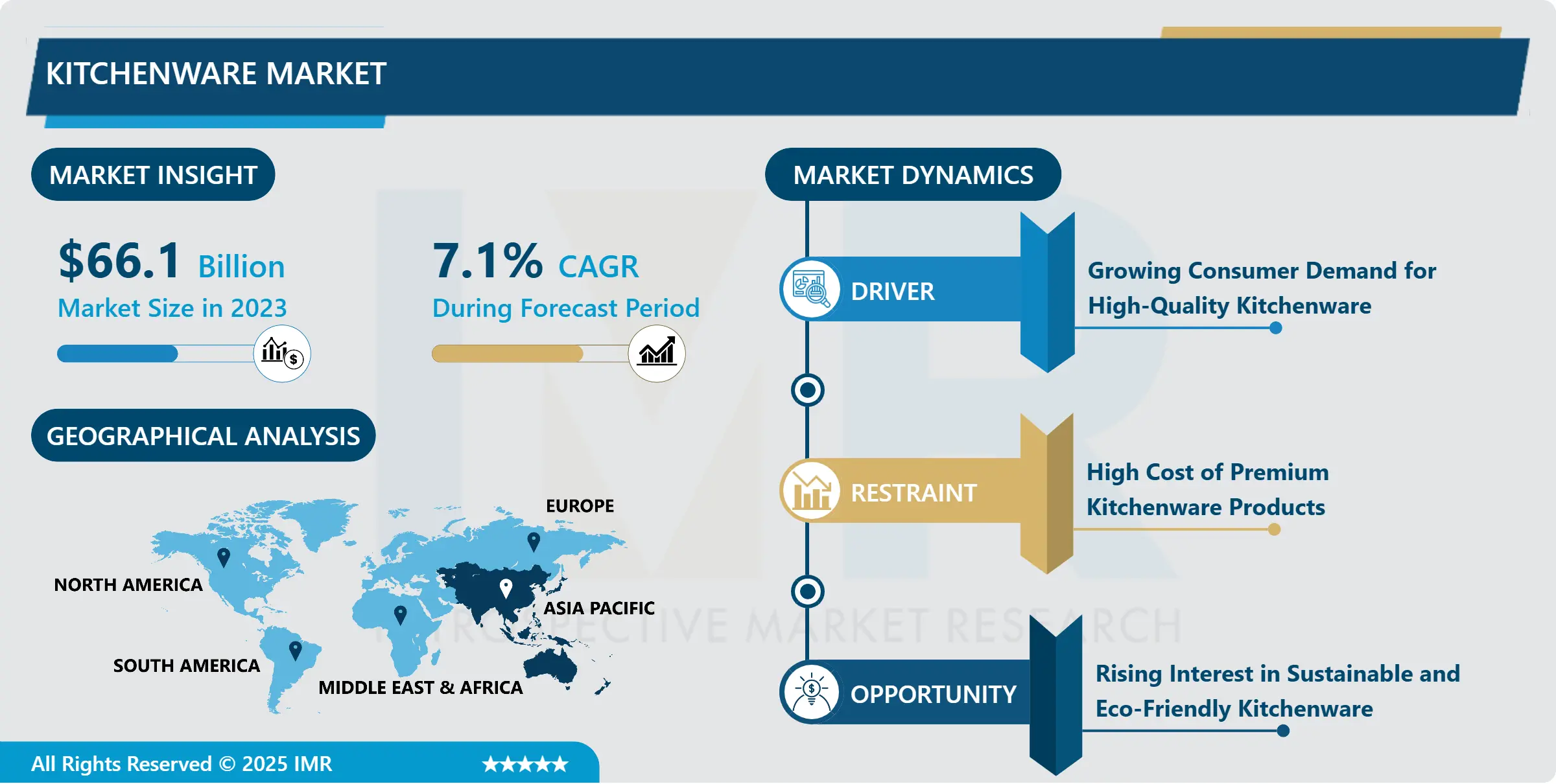
Kitchenware Market Size Was Valued at USD 66.10 Billion in 2023, and is Projected to Reach USD 122.55 Billion by 2032, Growing at a CAGR of 7.10% From 2024-2032.

IMR
Description
Kitchenware Market Synopsis:
Kitchenware Market Size Was Valued at USD 66.10 Billion in 2023, and is Projected to Reach USD 122.55 Billion by 2032, Growing at a CAGR of 7.10% From 2024-2032.
The kitchenware market includes all the products that are used in preparing food, cooking and serving it. This is accessories such as utensils, dishes dishes, kitchen gadgets, jars and bottles and knick knacks and gadgets which can be of various material aimed at improving both form and function of kitchens. The market operates within the residential and commercial spaces to provide cooking, serving along with storage solutions for kitchen utensils.
The main force boosting the kitchenware market is the growing need for functional and attractive kitchen products. Consumers are getting more conscious with the quality and durability in the kitchen utensils as well as the appearance as due to the increase in home cooking trend. Furthermore, development in material technology has led to improved product characteristics including the non-stick coated items and energy saving appliances.
Another is increased population of the middle-class people and increased number of houses with disposable income across the globe. This has shifted emphasis towards high quality cookware since the consumers will go for best brands in order to have the very best in their kitchen. Also, the change of lifestyle and popularity of home cooking and influential social networks has also affected the demand for kitchenware product.
Kitchenware Market Trend Analysis:
Increasing adoption of smart kitchen appliances
One of the key trends that emerged in the market of kitchenware is the growth of demand for smart kitchen appliances. Smart home appliances such as smart ovens, refrigerator, and cooking appliances with in-built IoT capability are widely used by people in course of looking for convenience and effectiveness from gadgets in their homes. The wiki also includes information that these appliances may include additions that can include remote control, voice control, and individualized cooking options.
Sustainability is another trending topic in the market and is on the rise. The consumer is waking up to the environmental conservation theme, swiftly moving towards kitchenware products that are made from bamboo, recycled plastics or any of the environmentally friendly metals. It is pressuring companies to incorporate environmentally friendly policies as well as create merchandise with as small an ecological footprint as possible.
The growing interest in home cooking and DIY culinary activities
Current trend of home cooking and other do it yourself cooking related activities are other opportunity areas for the kitchen ware products. Cooking influencers, participating in TV shows and food blogs made people pay close attention to kitchen utensils that can make a difference. This development gives manufacturers an opportunity to bring new products into the market that will be effective for the home chefs.
On average consumers-diva-tv consumers are willing to pay increasingly for premium and luxury kitchenware especially in the developed world. With the consumer spending more time in the comfort of their homes, premium features as found in the gourmet fryer or authentic tableau utensils are quickly becoming market favorites. This creates opportunities for both traditional and new generation kitchenware companies to provide high end consumers with quality and exotic kitchenware brands.
Kitchenware Market Segment Analysis:
Kitchenware Market is Segmented on the basis of Product Type, Material, End User, and Region.
By Product Type, Cookware segment is expected to dominate the market during the forecast period
The key product segments which can be used to classify the kitchenware market include: Utensils are stay cooking ware and include those items that are used in preparing and cooking foods such as pots and pans. utensils includes those used in serving food and are covered by tablewares such as plates and bowls.
Kitchen utensils are intricately part of the K.T.A which includes gadgets such as knives, peeler and cutting boards. Storage & Organization products we have are various containers, racks and organizers that aimed to make the kitchen items well-ordered. Small kitchen appliances contains products such as blenders, toaster and coffee makers which are useful in meal preparation and conveniences in cooking.
By Material, Stainless-Steel segment expected to held the largest share
This means that kitchenware products are available in varying materials with the accompanying benefits. Stainless steel is exceptional because it is very hard wearing and resistant to rust and is shiny, commonly used in utensils and pots. Everything a modern kitchen needs can be created using plastic because it is light, affordable and has enormous variability.
Mason has its benefit when it’s used because it is transparent and beautiful; it is used in prepared storage boxes and table wears. Ceramic is used because of its surface appearance and heat-resistant features used in kitchen utensils and dishes respectively. One of these elements, aluminum, is very light yet strong and desirably has a high thermal conductivity, good for use in utensils, for example. Cast Iron is great for holding heat well, and you commonly see them used in skillets and dutch ovens. Wood: used in utensils, and cutting boards and storage, The favour for wood is due to its raw look and sustainability.
Kitchenware Market Regional Insights:
Asia Pacific is Expected to Dominate the Market Over the Forecast period
The Asia Pacific region holds the largest share in the kitchenware market and is preceded by China and India. It may be therefore concluded that for kitchenware products, both traditional and with modern elements, there is continuously increasing demand as a result of demographic trends within countries of these regions – a middle-class population, increased disposable income per capita, a shift towards home cooking, and a rise in culinary culture. Also, the region enjoys a strong manufacturing culture to boot and serves as a dominant producer of kitchenware products for export.
Demand for the economy as well as the luxury segment of kitchenware is increasing at a high rate in the Asia Pacific region. A variety of products from low-cost, plastic-handled tools that are preferably disposable to premium quality ceramic cookware suits consumers’ demands. This dominance is also driven by the dynamics in the population density across the region, coupled with the modern forms of retail segmentation such as supermarkets stores and internet based stores making kitchedware products more reachable to the public.
Active Key Players in the Kitchenware Market:
Cuisinart (USA)
Hamilton Beach (USA)
Kenwood (UK)
Le Creuset (France)
Lodge Cast Iron (USA)
OXO (USA)
Smeg (Italy)
T-fal (France)
Williams-Sonoma (USA)
Zwilling J.A. Henckels (Germany), and Other Active Players
Chapter 1: Introduction
1.1 Scope and Coverage
Chapter 2:Executive Summary
Chapter 3: Market Landscape
3.1 Market Dynamics
3.1.1 Drivers
3.1.2 Restraints
3.1.3 Opportunities
3.1.4 Challenges
3.2 Market Trend Analysis
3.3 PESTLE Analysis
3.4 Porter’s Five Forces Analysis
3.5 Industry Value Chain Analysis
3.6 Ecosystem
3.7 Regulatory Landscape
3.8 Price Trend Analysis
3.9 Patent Analysis
3.10 Technology Evolution
3.11 Investment Pockets
3.12 Import-Export Analysis
Chapter 4: Kitchenware Market by Product Type
4.1 Kitchenware Market Snapshot and Growth Engine
4.2 Kitchenware Market Overview
4.3 Cookware
4.3.1 Introduction and Market Overview
4.3.2 Historic and Forecasted Market Size in Value USD and Volume Units (2017-2032F)
4.3.3 Key Market Trends, Growth Factors and Opportunities
4.3.4 Cookware: Geographic Segmentation Analysis
4.4 Tableware
4.4.1 Introduction and Market Overview
4.4.2 Historic and Forecasted Market Size in Value USD and Volume Units (2017-2032F)
4.4.3 Key Market Trends, Growth Factors and Opportunities
4.4.4 Tableware: Geographic Segmentation Analysis
4.5 Kitchen Tools & Accessories
4.5.1 Introduction and Market Overview
4.5.2 Historic and Forecasted Market Size in Value USD and Volume Units (2017-2032F)
4.5.3 Key Market Trends, Growth Factors and Opportunities
4.5.4 Kitchen Tools & Accessories: Geographic Segmentation Analysis
4.6 Storage & Organization
4.6.1 Introduction and Market Overview
4.6.2 Historic and Forecasted Market Size in Value USD and Volume Units (2017-2032F)
4.6.3 Key Market Trends, Growth Factors and Opportunities
4.6.4 Storage & Organization: Geographic Segmentation Analysis
4.7 Small Kitchen Appliances
4.7.1 Introduction and Market Overview
4.7.2 Historic and Forecasted Market Size in Value USD and Volume Units (2017-2032F)
4.7.3 Key Market Trends, Growth Factors and Opportunities
4.7.4 Small Kitchen Appliances: Geographic Segmentation Analysis
Chapter 5: Kitchenware Market by Material
5.1 Kitchenware Market Snapshot and Growth Engine
5.2 Kitchenware Market Overview
5.3 Stainless Steel
5.3.1 Introduction and Market Overview
5.3.2 Historic and Forecasted Market Size in Value USD and Volume Units (2017-2032F)
5.3.3 Key Market Trends, Growth Factors and Opportunities
5.3.4 Stainless Steel: Geographic Segmentation Analysis
5.4 Plastic
5.4.1 Introduction and Market Overview
5.4.2 Historic and Forecasted Market Size in Value USD and Volume Units (2017-2032F)
5.4.3 Key Market Trends, Growth Factors and Opportunities
5.4.4 Plastic: Geographic Segmentation Analysis
5.5 Glass
5.5.1 Introduction and Market Overview
5.5.2 Historic and Forecasted Market Size in Value USD and Volume Units (2017-2032F)
5.5.3 Key Market Trends, Growth Factors and Opportunities
5.5.4 Glass: Geographic Segmentation Analysis
5.6 Ceramic
5.6.1 Introduction and Market Overview
5.6.2 Historic and Forecasted Market Size in Value USD and Volume Units (2017-2032F)
5.6.3 Key Market Trends, Growth Factors and Opportunities
5.6.4 Ceramic: Geographic Segmentation Analysis
5.7 Aluminum
5.7.1 Introduction and Market Overview
5.7.2 Historic and Forecasted Market Size in Value USD and Volume Units (2017-2032F)
5.7.3 Key Market Trends, Growth Factors and Opportunities
5.7.4 Aluminum: Geographic Segmentation Analysis
5.8 Cast Iron
5.8.1 Introduction and Market Overview
5.8.2 Historic and Forecasted Market Size in Value USD and Volume Units (2017-2032F)
5.8.3 Key Market Trends, Growth Factors and Opportunities
5.8.4 Cast Iron: Geographic Segmentation Analysis
5.9 Wood
5.9.1 Introduction and Market Overview
5.9.2 Historic and Forecasted Market Size in Value USD and Volume Units (2017-2032F)
5.9.3 Key Market Trends, Growth Factors and Opportunities
5.9.4 Wood: Geographic Segmentation Analysis
Chapter 6: Kitchenware Market by End User
6.1 Kitchenware Market Snapshot and Growth Engine
6.2 Kitchenware Market Overview
6.3 Stainless Steel
6.3.1 Introduction and Market Overview
6.3.2 Historic and Forecasted Market Size in Value USD and Volume Units (2017-2032F)
6.3.3 Key Market Trends, Growth Factors and Opportunities
6.3.4 Stainless Steel: Geographic Segmentation Analysis
6.4 Plastic
6.4.1 Introduction and Market Overview
6.4.2 Historic and Forecasted Market Size in Value USD and Volume Units (2017-2032F)
6.4.3 Key Market Trends, Growth Factors and Opportunities
6.4.4 Plastic: Geographic Segmentation Analysis
6.5 Glass
6.5.1 Introduction and Market Overview
6.5.2 Historic and Forecasted Market Size in Value USD and Volume Units (2017-2032F)
6.5.3 Key Market Trends, Growth Factors and Opportunities
6.5.4 Glass: Geographic Segmentation Analysis
6.6 Ceramic
6.6.1 Introduction and Market Overview
6.6.2 Historic and Forecasted Market Size in Value USD and Volume Units (2017-2032F)
6.6.3 Key Market Trends, Growth Factors and Opportunities
6.6.4 Ceramic: Geographic Segmentation Analysis
6.7 Aluminum
6.7.1 Introduction and Market Overview
6.7.2 Historic and Forecasted Market Size in Value USD and Volume Units (2017-2032F)
6.7.3 Key Market Trends, Growth Factors and Opportunities
6.7.4 Aluminum: Geographic Segmentation Analysis
6.8 Cast Iron
6.8.1 Introduction and Market Overview
6.8.2 Historic and Forecasted Market Size in Value USD and Volume Units (2017-2032F)
6.8.3 Key Market Trends, Growth Factors and Opportunities
6.8.4 Cast Iron: Geographic Segmentation Analysis
6.9 Wood
6.9.1 Introduction and Market Overview
6.9.2 Historic and Forecasted Market Size in Value USD and Volume Units (2017-2032F)
6.9.3 Key Market Trends, Growth Factors and Opportunities
6.9.4 Wood: Geographic Segmentation Analysis
Chapter 7: Company Profiles and Competitive Analysis
7.1 Competitive Landscape
7.1.1 Competitive Benchmarking
7.1.2 Kitchenware Market Share by Manufacturer (2023)
7.1.3 Industry BCG Matrix
7.1.4 Heat Map Analysis
7.1.5 Mergers and Acquisitions
7.2 T-FAL (FRANCE)
7.2.1 Company Overview
7.2.2 Key Executives
7.2.3 Company Snapshot
7.2.4 Role of the Company in the Market
7.2.5 Sustainability and Social Responsibility
7.2.6 Operating Business Segments
7.2.7 Product Portfolio
7.2.8 Business Performance
7.2.9 Key Strategic Moves and Recent Developments
7.2.10 SWOT Analysis
7.3 CUISINART (USA)
7.4 LE CREUSET (FRANCE)
7.5 WILLIAMS-SONOMA (USA)
7.6 HAMILTON BEACH (USA)
7.7 KENWOOD (UK)
7.8 ZWILLING J.A. HENCKELS (GERMANY)
7.9 LODGE CAST IRON (USA)
7.10 SMEG (ITALY)
7.11 OXO (USA)
7.12 OTHER ACTIVE PLAYERS
Chapter 8: Global Kitchenware Market By Region
8.1 Overview
8.2. North America Kitchenware Market
8.2.1 Key Market Trends, Growth Factors and Opportunities
8.2.2 Top Key Companies
8.2.3 Historic and Forecasted Market Size by Segments
8.2.4 Historic and Forecasted Market Size By Product Type
8.2.4.1 Cookware
8.2.4.2 Tableware
8.2.4.3 Kitchen Tools & Accessories
8.2.4.4 Storage & Organization
8.2.4.5 Small Kitchen Appliances
8.2.5 Historic and Forecasted Market Size By Material
8.2.5.1 Stainless Steel
8.2.5.2 Plastic
8.2.5.3 Glass
8.2.5.4 Ceramic
8.2.5.5 Aluminum
8.2.5.6 Cast Iron
8.2.5.7 Wood
8.2.6 Historic and Forecasted Market Size By End User
8.2.6.1 Stainless Steel
8.2.6.2 Plastic
8.2.6.3 Glass
8.2.6.4 Ceramic
8.2.6.5 Aluminum
8.2.6.6 Cast Iron
8.2.6.7 Wood
8.2.7 Historic and Forecast Market Size by Country
8.2.7.1 US
8.2.7.2 Canada
8.2.7.3 Mexico
8.3. Eastern Europe Kitchenware Market
8.3.1 Key Market Trends, Growth Factors and Opportunities
8.3.2 Top Key Companies
8.3.3 Historic and Forecasted Market Size by Segments
8.3.4 Historic and Forecasted Market Size By Product Type
8.3.4.1 Cookware
8.3.4.2 Tableware
8.3.4.3 Kitchen Tools & Accessories
8.3.4.4 Storage & Organization
8.3.4.5 Small Kitchen Appliances
8.3.5 Historic and Forecasted Market Size By Material
8.3.5.1 Stainless Steel
8.3.5.2 Plastic
8.3.5.3 Glass
8.3.5.4 Ceramic
8.3.5.5 Aluminum
8.3.5.6 Cast Iron
8.3.5.7 Wood
8.3.6 Historic and Forecasted Market Size By End User
8.3.6.1 Stainless Steel
8.3.6.2 Plastic
8.3.6.3 Glass
8.3.6.4 Ceramic
8.3.6.5 Aluminum
8.3.6.6 Cast Iron
8.3.6.7 Wood
8.3.7 Historic and Forecast Market Size by Country
8.3.7.1 Russia
8.3.7.2 Bulgaria
8.3.7.3 The Czech Republic
8.3.7.4 Hungary
8.3.7.5 Poland
8.3.7.6 Romania
8.3.7.7 Rest of Eastern Europe
8.4. Western Europe Kitchenware Market
8.4.1 Key Market Trends, Growth Factors and Opportunities
8.4.2 Top Key Companies
8.4.3 Historic and Forecasted Market Size by Segments
8.4.4 Historic and Forecasted Market Size By Product Type
8.4.4.1 Cookware
8.4.4.2 Tableware
8.4.4.3 Kitchen Tools & Accessories
8.4.4.4 Storage & Organization
8.4.4.5 Small Kitchen Appliances
8.4.5 Historic and Forecasted Market Size By Material
8.4.5.1 Stainless Steel
8.4.5.2 Plastic
8.4.5.3 Glass
8.4.5.4 Ceramic
8.4.5.5 Aluminum
8.4.5.6 Cast Iron
8.4.5.7 Wood
8.4.6 Historic and Forecasted Market Size By End User
8.4.6.1 Stainless Steel
8.4.6.2 Plastic
8.4.6.3 Glass
8.4.6.4 Ceramic
8.4.6.5 Aluminum
8.4.6.6 Cast Iron
8.4.6.7 Wood
8.4.7 Historic and Forecast Market Size by Country
8.4.7.1 Germany
8.4.7.2 UK
8.4.7.3 France
8.4.7.4 The Netherlands
8.4.7.5 Italy
8.4.7.6 Spain
8.4.7.7 Rest of Western Europe
8.5. Asia Pacific Kitchenware Market
8.5.1 Key Market Trends, Growth Factors and Opportunities
8.5.2 Top Key Companies
8.5.3 Historic and Forecasted Market Size by Segments
8.5.4 Historic and Forecasted Market Size By Product Type
8.5.4.1 Cookware
8.5.4.2 Tableware
8.5.4.3 Kitchen Tools & Accessories
8.5.4.4 Storage & Organization
8.5.4.5 Small Kitchen Appliances
8.5.5 Historic and Forecasted Market Size By Material
8.5.5.1 Stainless Steel
8.5.5.2 Plastic
8.5.5.3 Glass
8.5.5.4 Ceramic
8.5.5.5 Aluminum
8.5.5.6 Cast Iron
8.5.5.7 Wood
8.5.6 Historic and Forecasted Market Size By End User
8.5.6.1 Stainless Steel
8.5.6.2 Plastic
8.5.6.3 Glass
8.5.6.4 Ceramic
8.5.6.5 Aluminum
8.5.6.6 Cast Iron
8.5.6.7 Wood
8.5.7 Historic and Forecast Market Size by Country
8.5.7.1 China
8.5.7.2 India
8.5.7.3 Japan
8.5.7.4 South Korea
8.5.7.5 Malaysia
8.5.7.6 Thailand
8.5.7.7 Vietnam
8.5.7.8 The Philippines
8.5.7.9 Australia
8.5.7.10 New Zealand
8.5.7.11 Rest of APAC
8.6. Middle East & Africa Kitchenware Market
8.6.1 Key Market Trends, Growth Factors and Opportunities
8.6.2 Top Key Companies
8.6.3 Historic and Forecasted Market Size by Segments
8.6.4 Historic and Forecasted Market Size By Product Type
8.6.4.1 Cookware
8.6.4.2 Tableware
8.6.4.3 Kitchen Tools & Accessories
8.6.4.4 Storage & Organization
8.6.4.5 Small Kitchen Appliances
8.6.5 Historic and Forecasted Market Size By Material
8.6.5.1 Stainless Steel
8.6.5.2 Plastic
8.6.5.3 Glass
8.6.5.4 Ceramic
8.6.5.5 Aluminum
8.6.5.6 Cast Iron
8.6.5.7 Wood
8.6.6 Historic and Forecasted Market Size By End User
8.6.6.1 Stainless Steel
8.6.6.2 Plastic
8.6.6.3 Glass
8.6.6.4 Ceramic
8.6.6.5 Aluminum
8.6.6.6 Cast Iron
8.6.6.7 Wood
8.6.7 Historic and Forecast Market Size by Country
8.6.7.1 Turkiye
8.6.7.2 Bahrain
8.6.7.3 Kuwait
8.6.7.4 Saudi Arabia
8.6.7.5 Qatar
8.6.7.6 UAE
8.6.7.7 Israel
8.6.7.8 South Africa
8.7. South America Kitchenware Market
8.7.1 Key Market Trends, Growth Factors and Opportunities
8.7.2 Top Key Companies
8.7.3 Historic and Forecasted Market Size by Segments
8.7.4 Historic and Forecasted Market Size By Product Type
8.7.4.1 Cookware
8.7.4.2 Tableware
8.7.4.3 Kitchen Tools & Accessories
8.7.4.4 Storage & Organization
8.7.4.5 Small Kitchen Appliances
8.7.5 Historic and Forecasted Market Size By Material
8.7.5.1 Stainless Steel
8.7.5.2 Plastic
8.7.5.3 Glass
8.7.5.4 Ceramic
8.7.5.5 Aluminum
8.7.5.6 Cast Iron
8.7.5.7 Wood
8.7.6 Historic and Forecasted Market Size By End User
8.7.6.1 Stainless Steel
8.7.6.2 Plastic
8.7.6.3 Glass
8.7.6.4 Ceramic
8.7.6.5 Aluminum
8.7.6.6 Cast Iron
8.7.6.7 Wood
8.7.7 Historic and Forecast Market Size by Country
8.7.7.1 Brazil
8.7.7.2 Argentina
8.7.7.3 Rest of SA
Chapter 9 Analyst Viewpoint and Conclusion
9.1 Recommendations and Concluding Analysis
9.2 Potential Market Strategies
Chapter 10 Research Methodology
10.1 Research Process
10.2 Primary Research
10.3 Secondary Research
Q1: What would be the forecast period in the Kitchenware Market research report?
A1: The forecast period in the Kitchenware Market research report is 2024-2032.
Q2: Who are the key players in the Kitchenware Market?
A2: T-fal (France), Cuisinart (USA), Le Creuset (France), Williams-Sonoma (USA), Hamilton Beach (USA), Kenwood (UK), Zwilling J.A. Henckels (Germany), Lodge Cast Iron (USA), Smeg (Italy), OXO (USA), and Other Active Players.
Q3: What are the segments of the Kitchenware Market?
A3: The Kitchenware Market is Segmented on the basis of Product Type, Material, End User, and Region. By Product Type, the market is categorized into Cookware, Tableware, Kitchen Tools & Accessories, Storage & Organization, Small Kitchen Appliances. By Material, the market is categorized into Stainless Steel, Plastic, Glass, Ceramic, Aluminum, Cast Iron, Wood. By End User, the market is categorized into Stainless Steel, Plastic, Glass, Ceramic, Aluminum, Cast Iron, Wood. By region, it is analyzed across North America (U.S., Canada, Mexico), Eastern Europe (Russia, Bulgaria, The Czech Republic, Hungary, Poland, Romania, Rest of Eastern Europe), Western Europe (Germany, UK, France, Netherlands, Italy, Spain, Rest of Western Europe), Asia Pacific (China, India, Japan, South Korea, Malaysia, Thailand, Vietnam, The Philippines, Australia, New Zealand, Rest of APAC), Middle East & Africa (Turkiye, Bahrain, Kuwait, Saudi Arabia, Qatar, UAE, Israel, South Africa), South America (Brazil, Argentina, Rest of SA).
Q4: What is the Kitchenware Market?
A4: The kitchenware market includes all the products that are used in preparing food, cooking and serving it. This is accessories such as utensils, dishes dishes, kitchen gadgets, jars and bottles and knick knacks and gadgets which can be of various material aimed at improving both form and function of kitchens. The market operates within the residential and commercial spaces to provide cooking, serving along with storage solutions for kitchen utensils.
Q5: How big is the Kitchenware Market?
A5: Kitchenware Market Size Was Valued at USD 66.10 Billion in 2023, and is Projected to Reach USD 122.55 Billion by 2032, Growing at a CAGR of 7.10% From 2024-2032.
How to buy a report from Megatrends.jp
On the product page, select the license you want: Single User License or Enterprise License.
Select the report language:
- English Report
- English Report + Japanese Translation
Click the Buy Now button.
You’ll be redirected to the checkout page. Enter your company and payment details.
Click Place Order to complete your purchase.
Confirmation: You’ll receive an order confirmation email. Our team will then follow up with your report delivery.
If you have questions, fill out the contact form below or email us at sales1@megatrends.jp.
Thank you for choosing Megatrends.jp!