24時間365日サポート — いつでもお客様をサポートいたします。
お問い合わせ
Passive Electronic Components Market - Overview and Outlook by Potential Growth By 2024-2032
1 × ¥660,950- Vendor:
IMR






Subtotal: ¥21,811,350
Passive Electronic Components Market - Overview and Outlook by Potential Growth By 2024-2032
1 × ¥660,950- Vendor:
IMR
Subtotal: ¥21,811,350
Music Tourism Market Emerging Trends, Competitive Landscape & Forecast (2024-2032)
Music tourism means when people travel to a particular place just to watch or perform in concert or other forms of musical performances as well as visiting musical sites of interest. Music tourism is rising as a subcategory of the overall tourism, as people are interested in an active sound adventure, which involves traveling to discover musical related attractions

IMR
Description
Music Tourism Market Synopsis:
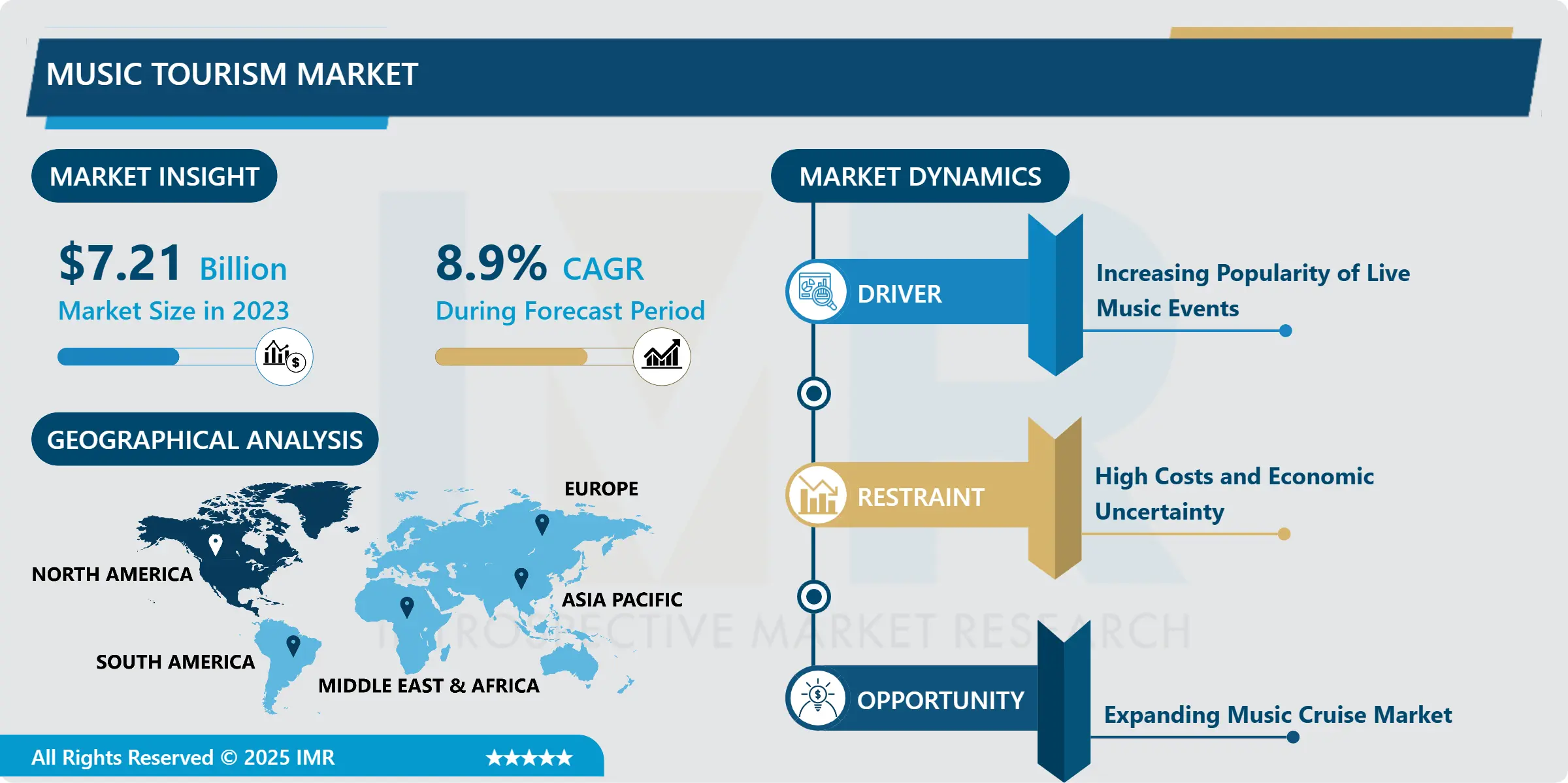
Music Tourism Market Size Was Valued at USD 7.21 Billion in 2023, and is Projected to Reach USD 15.53 Billion by 2032, Growing at a CAGR of 8.9% From 2024-2032.
Music tourism means when people travel to a particular place just to watch or perform in concert or other forms of musical performances as well as visiting musical sites of interest. Music tourism is rising as a subcategory of the overall tourism, as people are interested in an active sound adventure, which involves traveling to discover musical related attractions.
The market for music tourism has also continue to steadily grow over the recent past due to the rising number of music festivals, concerts and other musical performances. These events become not only local spectacles but also performances witnessed by the specifically-targeted international tourists. In as much as music tourism targets specific cultural groups given that music is a product of culture, music as an entertainment product caters for every one. More so like Coachella, Tomorrowland, Glastonbury festival, and SXSW are reasonably famous event brands that attract attendees from all over the world. Such events work well in enriching culture and are also source of revenues for the hosting cities or countries say through accommodation, feeding, transport and merchandise.
Technology has also played a vital role in development of music tourism because elements like live streaming and social media platforms have doubled or even tripled the outreach of those shows. Music festivals and concerts are now in the global radar, while idea of going to a music event as a tourism experience can be popular among the youth in search of adventure and fun with cultural exchange. Moreover, places with extensive musical traditions are now ideal for music tourism, for example, Nashville or Memphis or New Orleans with their historical musical cultures. This has brought with it what is referred to as ‘music cruises’ and musical ‘theme parks’ meant to create traveling experiences within the revels of music. However, the sector is still young and relevant, and new types of formats and music-associated experiences are being launched to address new markets.
Music Tourism Market Trend Analysis:
Rise of Music Festivals
Of all the trends identified in the music tourism niche, music festivals may well be the most prominent. Turner claims festivals such as Coachella, Glastonbury and Tomorrowland are now virtually unmissable with millions in attendance annually. These festivals are no more confined to music, but have evolved into ethnic food and art festivals, dressing and other bespoke experiences, thereby developing them into complete tourism products. A growing number of social networks and streaming services has only amplified the popularity of these festivities and helped global fans attend them. Besides, the exposure to large audiences has become an important aspect due to the immersion experience of the large scale festivals which provides people a chance to create memories as well as experience different international scenes.
These festivals are also becoming particularly attractive as the choice of performances is much broader. Different kinds of music are played at festivals, and this helps to bring in many people, so the festivals are more likely to be more open to everyone. Moreover, today people started to celebrate festivals at different places worldwide including traditional cities and exotic locations, that made music tourism as a global type. Festival tourism is on the rise as tourists seek to engage in such events as cultural festivals, therefore, destinations have had to improve the physical facilities and accessibility of destinations. The increase in the number of differentiated events like EDM festival or jazz festival contributes the growth of the market and brings variety of events for music lovers with different preferences.
Expanding Music Cruise Market
Among all the opportunities of the music tourism market, extending the music cruise sector is one of the most potential ones. Music cruises are relatively a new form of entertainment wherein the basic fundamentals of music performances are combined with the travel products. These cruises provide guests an opportunity to watch live performances from the best artists when on board, and themed music trips to the various ports of call. Music cruises as a subsegment of music tourism is still in the development stage compared to other music tourism segments but if explored is enormous. It becomes clear therefore that with the new age travellers; the millennials and the generation z which are more inclined to travelling with a twist that is, travelling that is backed up by performance art; music cruises fit perfectly in this bracket.
Possibilities of developing various specialized types of music cruises that focus on a definite style, from rock’n’roll to hip hop and from techno to electronic dance music (EDM) offer more choices for music tourists. As these cruises gain popularity cruise operators are now teaming up with music promoters and record labels to add more attraction. For instance, a cruise that is themed around Electronic Dance Music or Country music will barbecue requisite kind of audience and artists so the cruise, the artists and the audience are fit for each other. By targeting specific cultures, audiences or segments, there is possible to create better scenes and the impression significant in the benefit of participating companies, and therefore the music cruises could constitute a fast-growing niche within the worldwide tourism market. In light of the sustained focus on diverse forms of tourism, as well as on live performances, the music cruise segment presents the potential for fast growth.
Music Tourism Market Segment Analysis:
Music Tourism Market is Segmented on the basis of Type of Event, Travel Type, Traveler Type, Music Genre, Tourist Spending, and Region.
By Type of Event, Music Festivals segment is expected to dominate the market during the forecast period
Festivals are the largest and most important products within the music tourism market. They occur over several days and can sometime bring together thousands of people where different artists from different genres perform. They happen in outdoor arena or in large grounds often accompanied by other events such as food festivals or art fairs, means visitors get a spree of cultural events. With more of these events being held in the future, the economic returns of music festivals are also increasing, as tourists patronize transport, accommodation, or festival-related apparel and accessories.
Concert and event performances are available for any style and it may range from an individual performer and a small audience to a stadium one. Such events are dedicated to particular artist or bands and many people buy tickets which do a great deal for the economy of the town. People go to these concerts, some even plan their vacations around them, these tourists bring money to the airlines, the hotels or any other business. The dynamic augmentation of music accessibility on the global level and the elementary need for live performances also positively influence the development of this segment of tourism based on music.
By Travel Type, Domestic segment expected to held the largest share
From the paper’s perspective, the domestic music consumption means people who travel within the country to attend music performances. In this segment, the phenomenon of “le reliure familliale” helps to get more familiar and cheap to a wider range of consumers. The growth of global music festivals and events may have succeeded in making domestic music tourism more appealing and more accessible and for persons may not have the wish to travel outside their countries.
Music tourism destination can be defined as travel undertaken by people outside a particular country with the intention of attending musical events. Experiences in this segment are dictated by orientations toward world music artists and massive worldwide music festivals. Many foreigners come for sight seeing and this has a positive effect on the economy , not only do they have to pay for tickets and guide but also other products and services. The globalization of music and growth in promotion of music tourism through the internet has led to the increase of the expanded broader international events.
Music Tourism Market Regional Insights:
North America is Expected to Dominate the Market Over the Forecast period
North America appears to be the dominating region in music tourism, thanks to giant events such as the Lollapalooza, Coachella, huge events in Hollywood bowl and Madison square Garden and many others. Los Angeles, New York, Nashville and other cities receive millions of music tourists each year. They already have developed transportation, musical scenes, and famous events in the world, which may become the foundation of the region. Especially when it comes to jazz, country, rock and, more recently, electronic music, America, particularly the United States has had a very vibrant music history which Made the country even more attractive for music tourist.
It Continues that there has been a rise in the number of foreign visitors visiting North America to attend events such as, the Coachella, Lollapalooza and Ultra institute festival among others. Music lovers get the opportunity to attend these events easily accompanied with the fact that the region has well developed tourism market. Besides, the Department of tourism of the U.S. government, as well as other private companies have boosted music as cultural tourism hence making it more attractive to tourists from all over the world.
Active Key Players in the Music Tourism Market:
Live Nation Entertainment (USA)
AEG Live (USA)
Feld Entertainment (USA)
Eventbrite (USA)
Madison Square Garden Company (USA)
Ticketmaster (USA)
TUI Group (Germany)
The SSE Arena (UK)
The O2 (UK)
Cirque du Soleil (Canada)
Goldenvoice (USA)
International Music Summit (USA), and Other Active Players
Chapter 1: Introduction
1.1 Scope and Coverage
Chapter 2:Executive Summary
Chapter 3: Market Landscape
3.1 Market Dynamics
3.1.1 Drivers
3.1.2 Restraints
3.1.3 Opportunities
3.1.4 Challenges
3.2 Market Trend Analysis
3.3 PESTLE Analysis
3.4 Porter’s Five Forces Analysis
3.5 Industry Value Chain Analysis
3.6 Ecosystem
3.7 Regulatory Landscape
3.8 Price Trend Analysis
3.9 Patent Analysis
3.10 Technology Evolution
3.11 Investment Pockets
3.12 Import-Export Analysis
Chapter 4: Music Tourism Market by Type of Event
4.1 Music Tourism Market Snapshot and Growth Engine
4.2 Music Tourism Market Overview
4.3 Music Festivals
4.3.1 Introduction and Market Overview
4.3.2 Historic and Forecasted Market Size in Value USD and Volume Units (2017-2032F)
4.3.3 Key Market Trends, Growth Factors and Opportunities
4.3.4 Music Festivals: Geographic Segmentation Analysis
4.4 Concerts and Live Performances
4.4.1 Introduction and Market Overview
4.4.2 Historic and Forecasted Market Size in Value USD and Volume Units (2017-2032F)
4.4.3 Key Market Trends, Growth Factors and Opportunities
4.4.4 Concerts and Live Performances: Geographic Segmentation Analysis
4.5 Music Conferences and Expos
4.5.1 Introduction and Market Overview
4.5.2 Historic and Forecasted Market Size in Value USD and Volume Units (2017-2032F)
4.5.3 Key Market Trends, Growth Factors and Opportunities
4.5.4 Music Conferences and Expos: Geographic Segmentation Analysis
4.6 Music Cruises
4.6.1 Introduction and Market Overview
4.6.2 Historic and Forecasted Market Size in Value USD and Volume Units (2017-2032F)
4.6.3 Key Market Trends, Growth Factors and Opportunities
4.6.4 Music Cruises: Geographic Segmentation Analysis
Chapter 5: Music Tourism Market by Travel Type
5.1 Music Tourism Market Snapshot and Growth Engine
5.2 Music Tourism Market Overview
5.3 Domestic
5.3.1 Introduction and Market Overview
5.3.2 Historic and Forecasted Market Size in Value USD and Volume Units (2017-2032F)
5.3.3 Key Market Trends, Growth Factors and Opportunities
5.3.4 Domestic: Geographic Segmentation Analysis
5.4 International
5.4.1 Introduction and Market Overview
5.4.2 Historic and Forecasted Market Size in Value USD and Volume Units (2017-2032F)
5.4.3 Key Market Trends, Growth Factors and Opportunities
5.4.4 International: Geographic Segmentation Analysis
Chapter 6: Music Tourism Market by Traveler Type
6.1 Music Tourism Market Snapshot and Growth Engine
6.2 Music Tourism Market Overview
6.3 Solo Travelers
6.3.1 Introduction and Market Overview
6.3.2 Historic and Forecasted Market Size in Value USD and Volume Units (2017-2032F)
6.3.3 Key Market Trends, Growth Factors and Opportunities
6.3.4 Solo Travelers: Geographic Segmentation Analysis
6.4 Group Travelers
6.4.1 Introduction and Market Overview
6.4.2 Historic and Forecasted Market Size in Value USD and Volume Units (2017-2032F)
6.4.3 Key Market Trends, Growth Factors and Opportunities
6.4.4 Group Travelers: Geographic Segmentation Analysis
6.5 Family Travelers
6.5.1 Introduction and Market Overview
6.5.2 Historic and Forecasted Market Size in Value USD and Volume Units (2017-2032F)
6.5.3 Key Market Trends, Growth Factors and Opportunities
6.5.4 Family Travelers: Geographic Segmentation Analysis
Chapter 7: Music Tourism Market by Music Genre
7.1 Music Tourism Market Snapshot and Growth Engine
7.2 Music Tourism Market Overview
7.3 Rock
7.3.1 Introduction and Market Overview
7.3.2 Historic and Forecasted Market Size in Value USD and Volume Units (2017-2032F)
7.3.3 Key Market Trends, Growth Factors and Opportunities
7.3.4 Rock : Geographic Segmentation Analysis
7.4 Pop
7.4.1 Introduction and Market Overview
7.4.2 Historic and Forecasted Market Size in Value USD and Volume Units (2017-2032F)
7.4.3 Key Market Trends, Growth Factors and Opportunities
7.4.4 Pop: Geographic Segmentation Analysis
7.5 Classical
7.5.1 Introduction and Market Overview
7.5.2 Historic and Forecasted Market Size in Value USD and Volume Units (2017-2032F)
7.5.3 Key Market Trends, Growth Factors and Opportunities
7.5.4 Classical: Geographic Segmentation Analysis
7.6 Jazz
7.6.1 Introduction and Market Overview
7.6.2 Historic and Forecasted Market Size in Value USD and Volume Units (2017-2032F)
7.6.3 Key Market Trends, Growth Factors and Opportunities
7.6.4 Jazz: Geographic Segmentation Analysis
7.7 Electronic/Dance
7.7.1 Introduction and Market Overview
7.7.2 Historic and Forecasted Market Size in Value USD and Volume Units (2017-2032F)
7.7.3 Key Market Trends, Growth Factors and Opportunities
7.7.4 Electronic/Dance: Geographic Segmentation Analysis
7.8 Country
7.8.1 Introduction and Market Overview
7.8.2 Historic and Forecasted Market Size in Value USD and Volume Units (2017-2032F)
7.8.3 Key Market Trends, Growth Factors and Opportunities
7.8.4 Country: Geographic Segmentation Analysis
7.9 Others
7.9.1 Introduction and Market Overview
7.9.2 Historic and Forecasted Market Size in Value USD and Volume Units (2017-2032F)
7.9.3 Key Market Trends, Growth Factors and Opportunities
7.9.4 Others: Geographic Segmentation Analysis
Chapter 8: Music Tourism Market by Tourist Spending
8.1 Music Tourism Market Snapshot and Growth Engine
8.2 Music Tourism Market Overview
8.3 Budget
8.3.1 Introduction and Market Overview
8.3.2 Historic and Forecasted Market Size in Value USD and Volume Units (2017-2032F)
8.3.3 Key Market Trends, Growth Factors and Opportunities
8.3.4 Budget: Geographic Segmentation Analysis
8.4 Mid-Range
8.4.1 Introduction and Market Overview
8.4.2 Historic and Forecasted Market Size in Value USD and Volume Units (2017-2032F)
8.4.3 Key Market Trends, Growth Factors and Opportunities
8.4.4 Mid-Range: Geographic Segmentation Analysis
8.5 Luxury
8.5.1 Introduction and Market Overview
8.5.2 Historic and Forecasted Market Size in Value USD and Volume Units (2017-2032F)
8.5.3 Key Market Trends, Growth Factors and Opportunities
8.5.4 Luxury: Geographic Segmentation Analysis
Chapter 9: Company Profiles and Competitive Analysis
9.1 Competitive Landscape
9.1.1 Competitive Benchmarking
9.1.2 Music Tourism Market Share by Manufacturer (2023)
9.1.3 Industry BCG Matrix
9.1.4 Heat Map Analysis
9.1.5 Mergers and Acquisitions
9.2 LIVE NATION ENTERTAINMENT (USA)
9.2.1 Company Overview
9.2.2 Key Executives
9.2.3 Company Snapshot
9.2.4 Role of the Company in the Market
9.2.5 Sustainability and Social Responsibility
9.2.6 Operating Business Segments
9.2.7 Product Portfolio
9.2.8 Business Performance
9.2.9 Key Strategic Moves and Recent Developments
9.2.10 SWOT Analysis
9.3 AEG LIVE (USA)
9.4 FELD ENTERTAINMENT (USA)
9.5 EVENTBRITE (USA)
9.6 MADISON SQUARE GARDEN COMPANY (USA)
9.7 TICKETMASTER (USA)
9.8 TUI GROUP (GERMANY)
9.9 THE SSE ARENA (UK)
9.10 THE O2 (UK)
9.11 CIRQUE DU SOLEIL (CANADA)
9.12 GOLDENVOICE (USA)
9.13 INTERNATIONAL MUSIC SUMMIT (USA)
9.14 OTHER ACTIVE PLAYERS
Chapter 10: Global Music Tourism Market By Region
10.1 Overview
10.2. North America Music Tourism Market
10.2.1 Key Market Trends, Growth Factors and Opportunities
10.2.2 Top Key Companies
10.2.3 Historic and Forecasted Market Size by Segments
10.2.4 Historic and Forecasted Market Size By Type of Event
10.2.4.1 Music Festivals
10.2.4.2 Concerts and Live Performances
10.2.4.3 Music Conferences and Expos
10.2.4.4 Music Cruises
10.2.5 Historic and Forecasted Market Size By Travel Type
10.2.5.1 Domestic
10.2.5.2 International
10.2.6 Historic and Forecasted Market Size By Traveler Type
10.2.6.1 Solo Travelers
10.2.6.2 Group Travelers
10.2.6.3 Family Travelers
10.2.7 Historic and Forecasted Market Size By Music Genre
10.2.7.1 Rock
10.2.7.2 Pop
10.2.7.3 Classical
10.2.7.4 Jazz
10.2.7.5 Electronic/Dance
10.2.7.6 Country
10.2.7.7 Others
10.2.8 Historic and Forecasted Market Size By Tourist Spending
10.2.8.1 Budget
10.2.8.2 Mid-Range
10.2.8.3 Luxury
10.2.9 Historic and Forecast Market Size by Country
10.2.9.1 US
10.2.9.2 Canada
10.2.9.3 Mexico
10.3. Eastern Europe Music Tourism Market
10.3.1 Key Market Trends, Growth Factors and Opportunities
10.3.2 Top Key Companies
10.3.3 Historic and Forecasted Market Size by Segments
10.3.4 Historic and Forecasted Market Size By Type of Event
10.3.4.1 Music Festivals
10.3.4.2 Concerts and Live Performances
10.3.4.3 Music Conferences and Expos
10.3.4.4 Music Cruises
10.3.5 Historic and Forecasted Market Size By Travel Type
10.3.5.1 Domestic
10.3.5.2 International
10.3.6 Historic and Forecasted Market Size By Traveler Type
10.3.6.1 Solo Travelers
10.3.6.2 Group Travelers
10.3.6.3 Family Travelers
10.3.7 Historic and Forecasted Market Size By Music Genre
10.3.7.1 Rock
10.3.7.2 Pop
10.3.7.3 Classical
10.3.7.4 Jazz
10.3.7.5 Electronic/Dance
10.3.7.6 Country
10.3.7.7 Others
10.3.8 Historic and Forecasted Market Size By Tourist Spending
10.3.8.1 Budget
10.3.8.2 Mid-Range
10.3.8.3 Luxury
10.3.9 Historic and Forecast Market Size by Country
10.3.9.1 Russia
10.3.9.2 Bulgaria
10.3.9.3 The Czech Republic
10.3.9.4 Hungary
10.3.9.5 Poland
10.3.9.6 Romania
10.3.9.7 Rest of Eastern Europe
10.4. Western Europe Music Tourism Market
10.4.1 Key Market Trends, Growth Factors and Opportunities
10.4.2 Top Key Companies
10.4.3 Historic and Forecasted Market Size by Segments
10.4.4 Historic and Forecasted Market Size By Type of Event
10.4.4.1 Music Festivals
10.4.4.2 Concerts and Live Performances
10.4.4.3 Music Conferences and Expos
10.4.4.4 Music Cruises
10.4.5 Historic and Forecasted Market Size By Travel Type
10.4.5.1 Domestic
10.4.5.2 International
10.4.6 Historic and Forecasted Market Size By Traveler Type
10.4.6.1 Solo Travelers
10.4.6.2 Group Travelers
10.4.6.3 Family Travelers
10.4.7 Historic and Forecasted Market Size By Music Genre
10.4.7.1 Rock
10.4.7.2 Pop
10.4.7.3 Classical
10.4.7.4 Jazz
10.4.7.5 Electronic/Dance
10.4.7.6 Country
10.4.7.7 Others
10.4.8 Historic and Forecasted Market Size By Tourist Spending
10.4.8.1 Budget
10.4.8.2 Mid-Range
10.4.8.3 Luxury
10.4.9 Historic and Forecast Market Size by Country
10.4.9.1 Germany
10.4.9.2 UK
10.4.9.3 France
10.4.9.4 The Netherlands
10.4.9.5 Italy
10.4.9.6 Spain
10.4.9.7 Rest of Western Europe
10.5. Asia Pacific Music Tourism Market
10.5.1 Key Market Trends, Growth Factors and Opportunities
10.5.2 Top Key Companies
10.5.3 Historic and Forecasted Market Size by Segments
10.5.4 Historic and Forecasted Market Size By Type of Event
10.5.4.1 Music Festivals
10.5.4.2 Concerts and Live Performances
10.5.4.3 Music Conferences and Expos
10.5.4.4 Music Cruises
10.5.5 Historic and Forecasted Market Size By Travel Type
10.5.5.1 Domestic
10.5.5.2 International
10.5.6 Historic and Forecasted Market Size By Traveler Type
10.5.6.1 Solo Travelers
10.5.6.2 Group Travelers
10.5.6.3 Family Travelers
10.5.7 Historic and Forecasted Market Size By Music Genre
10.5.7.1 Rock
10.5.7.2 Pop
10.5.7.3 Classical
10.5.7.4 Jazz
10.5.7.5 Electronic/Dance
10.5.7.6 Country
10.5.7.7 Others
10.5.8 Historic and Forecasted Market Size By Tourist Spending
10.5.8.1 Budget
10.5.8.2 Mid-Range
10.5.8.3 Luxury
10.5.9 Historic and Forecast Market Size by Country
10.5.9.1 China
10.5.9.2 India
10.5.9.3 Japan
10.5.9.4 South Korea
10.5.9.5 Malaysia
10.5.9.6 Thailand
10.5.9.7 Vietnam
10.5.9.8 The Philippines
10.5.9.9 Australia
10.5.9.10 New Zealand
10.5.9.11 Rest of APAC
10.6. Middle East & Africa Music Tourism Market
10.6.1 Key Market Trends, Growth Factors and Opportunities
10.6.2 Top Key Companies
10.6.3 Historic and Forecasted Market Size by Segments
10.6.4 Historic and Forecasted Market Size By Type of Event
10.6.4.1 Music Festivals
10.6.4.2 Concerts and Live Performances
10.6.4.3 Music Conferences and Expos
10.6.4.4 Music Cruises
10.6.5 Historic and Forecasted Market Size By Travel Type
10.6.5.1 Domestic
10.6.5.2 International
10.6.6 Historic and Forecasted Market Size By Traveler Type
10.6.6.1 Solo Travelers
10.6.6.2 Group Travelers
10.6.6.3 Family Travelers
10.6.7 Historic and Forecasted Market Size By Music Genre
10.6.7.1 Rock
10.6.7.2 Pop
10.6.7.3 Classical
10.6.7.4 Jazz
10.6.7.5 Electronic/Dance
10.6.7.6 Country
10.6.7.7 Others
10.6.8 Historic and Forecasted Market Size By Tourist Spending
10.6.8.1 Budget
10.6.8.2 Mid-Range
10.6.8.3 Luxury
10.6.9 Historic and Forecast Market Size by Country
10.6.9.1 Turkiye
10.6.9.2 Bahrain
10.6.9.3 Kuwait
10.6.9.4 Saudi Arabia
10.6.9.5 Qatar
10.6.9.6 UAE
10.6.9.7 Israel
10.6.9.8 South Africa
10.7. South America Music Tourism Market
10.7.1 Key Market Trends, Growth Factors and Opportunities
10.7.2 Top Key Companies
10.7.3 Historic and Forecasted Market Size by Segments
10.7.4 Historic and Forecasted Market Size By Type of Event
10.7.4.1 Music Festivals
10.7.4.2 Concerts and Live Performances
10.7.4.3 Music Conferences and Expos
10.7.4.4 Music Cruises
10.7.5 Historic and Forecasted Market Size By Travel Type
10.7.5.1 Domestic
10.7.5.2 International
10.7.6 Historic and Forecasted Market Size By Traveler Type
10.7.6.1 Solo Travelers
10.7.6.2 Group Travelers
10.7.6.3 Family Travelers
10.7.7 Historic and Forecasted Market Size By Music Genre
10.7.7.1 Rock
10.7.7.2 Pop
10.7.7.3 Classical
10.7.7.4 Jazz
10.7.7.5 Electronic/Dance
10.7.7.6 Country
10.7.7.7 Others
10.7.8 Historic and Forecasted Market Size By Tourist Spending
10.7.8.1 Budget
10.7.8.2 Mid-Range
10.7.8.3 Luxury
10.7.9 Historic and Forecast Market Size by Country
10.7.9.1 Brazil
10.7.9.2 Argentina
10.7.9.3 Rest of SA
Chapter 11 Analyst Viewpoint and Conclusion
11.1 Recommendations and Concluding Analysis
11.2 Potential Market Strategies
Chapter 12 Research Methodology
12.1 Research Process
12.2 Primary Research
12.3 Secondary Research
Q1: What would be the forecast period in the Music Tourism Market research report?
A1: The forecast period in the Music Tourism Market research report is 2024-2032.
Q2: Who are the key players in the Music Tourism Market?
A2: Live Nation Entertainment (USA), AEG Live (USA), Feld Entertainment (USA), Eventbrite (USA), Madison Square Garden Company (USA), Ticketmaster (USA), TUI Group (Germany), The SSE Arena (UK), The O2 (UK), Cirque du Soleil (Canada), and Other Active Players.
Q3: What are the segments of the Music Tourism Market?
A3: The Music Tourism Market is segmented into Type of Event, Travel Type, Traveler Type, Music Genre, Tourist Spending and region. By Type of Event, the market is categorized into Music Festivals, Concerts and Live Performances, Music Conferences and Expos, Music Cruises. By Travel Type, the market is categorized into Domestic, International. By Traveler Type, the market is categorized into Solo Travelers, Group Travelers, Family Travelers. By Music Genre, the market is categorized into Rock, Pop, Classical, Jazz, Electronic/Dance, Country, Others. By Tourist Spending, the market is categorized into Budget, Mid-Range, Luxury. By region, it is analyzed across North America (U.S., Canada, Mexico), Eastern Europe (Russia, Bulgaria, The Czech Republic, Hungary, Poland, Romania, Rest of Eastern Europe), Western Europe (Germany, UK, France, Netherlands, Italy, Spain, Rest of Western Europe), Asia Pacific (China, India, Japan, South Korea, Malaysia, Thailand, Vietnam, The Philippines, Australia, New Zealand, Rest of APAC), Middle East & Africa (Turkiye, Bahrain, Kuwait, Saudi Arabia, Qatar, UAE, Israel, South Africa), South America (Brazil, Argentina, Rest of SA).
Q4: What is the Music Tourism Market?
A4: Music tourism means when people travel to a particular place just to watch or perform in concert or other forms of musical performances as well as visiting musical sites of interest. Music tourism is rising as a subcategory of the overall tourism, as people are interested in an active sound adventure, which involves traveling to discover musical related attractions.
Q5: How big is the Music Tourism Market?
A5: Music Tourism Market Size Was Valued at USD 7.21 Billion in 2023, and is Projected to Reach USD 15.53 Billion by 2032, Growing at a CAGR of 8.9% From 2024-2032.
How to buy a report from Megatrends.jp
On the product page, select the license you want: Single User License or Enterprise License.
Select the report language:
- English Report
- English Report + Japanese Translation
Click the Buy Now button.
You’ll be redirected to the checkout page. Enter your company and payment details.
Click Place Order to complete your purchase.
Confirmation: You’ll receive an order confirmation email. Our team will then follow up with your report delivery.
If you have questions, fill out the contact form below or email us at sales1@megatrends.jp.
Thank you for choosing Megatrends.jp!