24時間365日サポート — いつでもお客様をサポートいたします。
お問い合わせ


Atezolizumab Market – Comprehensive Study Report & Recent Trends By 2032
Therefore, the Atezolizumab market can be defined as the worldwide circulation and utilization of Atezolizumab, which is a humanized monoclonal antibody intended to help control programmed death-ligand 1 (PD-L1). It has been applied in cancer immunotherapy primarily for NSCLC, TNBC, and diverse other cancers.

IMR
Description
Atezolizumab Market Synopsis
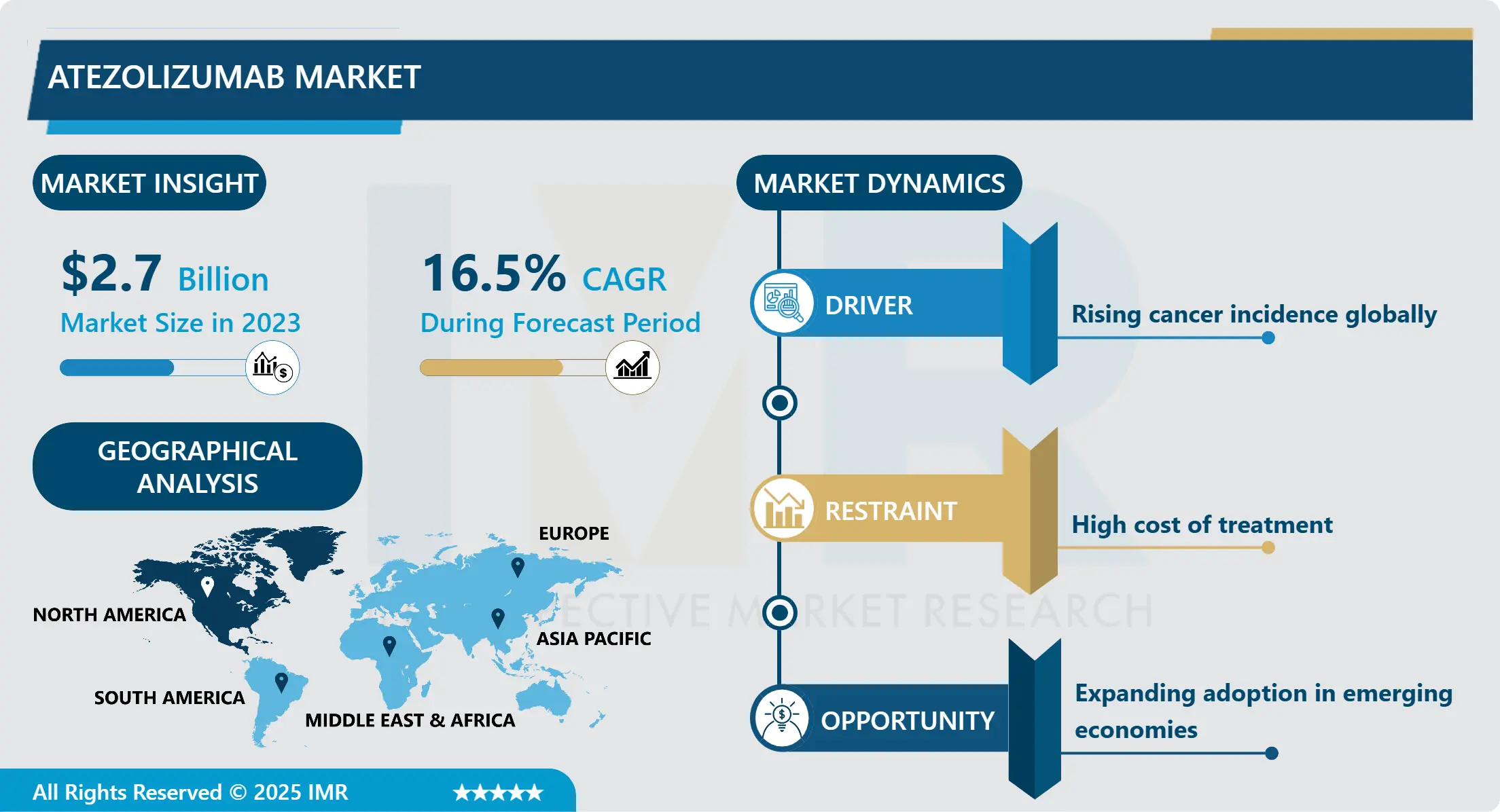
Atezolizumab Market Size Was Valued at USD 2.70 Billion in 2023, and is Projected to Reach USD 10.67 Billion by 2032, Growing at a CAGR of 16.5% From 2024-2032.
Therefore, the Atezolizumab market can be defined as the worldwide circulation and utilization of Atezolizumab, which is a humanized monoclonal antibody intended to help control programmed death-ligand 1 (PD-L1). It has been applied in cancer immunotherapy primarily for NSCLC, TNBC, and diverse other cancers. Instead, by inhibiting the PD-L1 pathway, Atezolizumab unbans the T-cells so the immune system can recognize and kill cancer cells. This market includes the designing, synthesizing, processing, distributing and usage of drugs in hospitals, clinics, institutes of research etc.
The Atezolizumab market has observed a firm growth particularly due to the increase in the cases of cancer across the globe and more importantly the awareness of Immunotherapy as a potential treatment modality. As the use of biologics has surged in oncology, Atezolizumab has carved out a valuable, and often critical, role especially for non-responders to traditional treatments. The increasing number of indications for its use that has been endorsed by regulatory authorities including the FDA and the EMA have boosted market growth. It has won the preferences of clinicians, because the drug has shown efficiency in treatment of the various types of the tumor diseases, including those in the advanced stages of development, which increases its market demand.
Also, technology improvements in biotechnology and the growing number of combination therapy research works are driving the market. New markets also becoming attractive growth markets due to better healthcare services and favourable government policies to treat cancer. The pharma major is focused on expanding the scope of Atezolizumab as the industry is spending big bucks to discover novel indications to grow the addressable market.
Atezolizumab Market Trend Analysis
Shift Towards Combination Therapies
Currently, one of the obtaining trends in the Atezolizumab market is the growth of combo treatments. A systemic review of clinical trials has demonstrated that adding atezolizumab to other cancer therapies such as bevacizumab or chemotherapy increases tumor response and survival chances in the patients. The market has become quite competitive and as such pharmaceutical companies are employing a lot of resources in these trials. Benefits of this trend are twofold: First it optimizes the drug’s effectiveness and second, it creates more demand for the drug in as many oncological applications as possible. As more combination therapies obtain regulatory approvals, this method will revolutionize cancer treatment platforms and trigger rapid market growth.
Rising Demand in Emerging Economies
Asia-Pacific and Latin America are the two promising regions for Atezolizumab market since they are newly growing markets. Population growth, higher healthcare spending and oncoming cancer diseases in an accelerated process of urbanization are becoming beneficial. Both the government and private players are focusing on the affordability of cancer treatment and entry of biosimilars will open up the gate for the same. Further, advancements in diagnosis of the above regions also means that the cancers are discovered at relatively early stages hence people demand for efficient treatment as Atezolizumab. These markets remain unexplored and can represent great opportunities for organizations that seek for internationalization.
Atezolizumab Market Segment Analysis:
Atezolizumab Market Segmented on the basis of Drug Class, Indication and Distribution Channel.
By Drug Class, PD-L1 Inhibitors segment is expected to dominate the market during the forecast period
Based on the segment type, it is forecasted that PD-L1 inhibitors segment which encompasses Atezolizumab shall be dominating the market for the forecast period owing to various factors such as high clinical efficacy and growing usage. PD-L1 inhibitors act by binding with the PD-L1 protein through which cancer cells hide from the immune system. Both, lung and breast cancers have been known to be effectively treated using atezolizumab, thus becoming an integral part of developing oncology therapeutic management strategies globally. This has also established it for concomitant use with other drugs, increasing its application in oncology hospitals and research organisations.
This segment is expected to remain leader, because of the increasing number of PD-L1 inhibitors to the market as well as research for new indications for their application. Drugs manufacturers are also aiming at enhancing the drug delivery systems as well as minimizing the side effects of the drugs to ensure possible that the patients receive the best results. Such factors will ensure that PD-L1 inhibitors segment remains on top across the forecast period.
By Indication, Lung Cancer segment expected to held the largest share
Lung cancer will continue to dominate the Atezolizumab market due to increasing global incidence of the disease and due to strong therapeutic outcomes offered by the medication in later stages of the illness. NSCLC, the largest sub-type, has been given most of the attention regarding Atezolizumab-based therapies. Real-world experience as well as clinical trials show its efficacy in increasing the survival of NSCLC patients making it a first-line therapy in many countries.
Moreover, next, combination therapies using Atezolizumab for small cell lung cancer (SCLC) have broadened its scope in this segment due to the rising therapeutic uses. The positive trend in the growth of early cancer diagnosis, the creation of more accurate diagnostic tools, guarantees a constant demand for lung cancer treatment mechanisms enforcing this segment dominance in the market.
Atezolizumab Market Outlook, 2023 and 2032: Future Outlook
Atezolizumab Market Regional Insights:
North America is Expected to Dominate the Market Over the Forecast period
North America is anticipated to account for around 40% of the global market share in 2023 because it has more developed care services, a high incidence of cancer in the population, and greater use of advanced therapies. Global oncology has shifted focus toward the United States, as both a research hub and as a producer of oncology medications. Affordable reimbursement policies and accessibility of Atezolizumab have put a firm hold on it. Furthermore, owing to the emphasis on clinical trials and precision medicine the region solidifies its leadership. Canada also play a pivotal role in funding and invests more in cancer research and provides sound health care policies for immunotherapy.
Atezolizumab Market Share, by Geography, 2023 (%)
???????
Active Key Players in the Atezolizumab Market
AbbVie (USA)
Amgen (USA)
AstraZeneca (UK)
Bayer (Germany)
BeiGene (China)
Biocon (India)
Bristol-Myers Squibb (USA)
Eli Lilly (USA)
Gilead Sciences (USA)
GlaxoSmithKline (UK)
Merck & Co. (USA)
Novartis (Switzerland)
Pfizer (USA)
Roche (Switzerland)
Sanofi (France), and Other key Players
Chapter 1: Introduction
1.1 Scope and Coverage
Chapter 2:Executive Summary
Chapter 3: Market Landscape
3.1 Market Dynamics
3.1.1 Drivers
3.1.2 Restraints
3.1.3 Opportunities
3.1.4 Challenges
3.2 Market Trend Analysis
3.3 PESTLE Analysis
3.4 Porter’s Five Forces Analysis
3.5 Industry Value Chain Analysis
3.6 Ecosystem
3.7 Regulatory Landscape
3.8 Price Trend Analysis
3.9 Patent Analysis
3.10 Technology Evolution
3.11 Investment Pockets
3.12 Import-Export Analysis
Chapter 4: Atezolizumab Market by Drug Class
4.1 Atezolizumab Market Snapshot and Growth Engine
4.2 Atezolizumab Market Overview
4.3 PD-L1 Inhibitors
4.3.1 Introduction and Market Overview
4.3.2 Historic and Forecasted Market Size in Value USD and Volume Units (2017-2032F)
4.3.3 Key Market Trends, Growth Factors and Opportunities
4.3.4 PD-L1 Inhibitors: Geographic Segmentation Analysis
4.4 PD-1 Inhibitors
4.4.1 Introduction and Market Overview
4.4.2 Historic and Forecasted Market Size in Value USD and Volume Units (2017-2032F)
4.4.3 Key Market Trends, Growth Factors and Opportunities
4.4.4 PD-1 Inhibitors: Geographic Segmentation Analysis
4.5 CTLA-4 Inhibitors
4.5.1 Introduction and Market Overview
4.5.2 Historic and Forecasted Market Size in Value USD and Volume Units (2017-2032F)
4.5.3 Key Market Trends, Growth Factors and Opportunities
4.5.4 CTLA-4 Inhibitors: Geographic Segmentation Analysis
4.6 Immunomodulators
4.6.1 Introduction and Market Overview
4.6.2 Historic and Forecasted Market Size in Value USD and Volume Units (2017-2032F)
4.6.3 Key Market Trends, Growth Factors and Opportunities
4.6.4 Immunomodulators: Geographic Segmentation Analysis
4.7 Others
4.7.1 Introduction and Market Overview
4.7.2 Historic and Forecasted Market Size in Value USD and Volume Units (2017-2032F)
4.7.3 Key Market Trends, Growth Factors and Opportunities
4.7.4 Others: Geographic Segmentation Analysis
Chapter 5: Atezolizumab Market by Indication
5.1 Atezolizumab Market Snapshot and Growth Engine
5.2 Atezolizumab Market Overview
5.3 Lung Cancer
5.3.1 Introduction and Market Overview
5.3.2 Historic and Forecasted Market Size in Value USD and Volume Units (2017-2032F)
5.3.3 Key Market Trends, Growth Factors and Opportunities
5.3.4 Lung Cancer: Geographic Segmentation Analysis
5.4 Bladder Cancer
5.4.1 Introduction and Market Overview
5.4.2 Historic and Forecasted Market Size in Value USD and Volume Units (2017-2032F)
5.4.3 Key Market Trends, Growth Factors and Opportunities
5.4.4 Bladder Cancer: Geographic Segmentation Analysis
5.5 Melanoma
5.5.1 Introduction and Market Overview
5.5.2 Historic and Forecasted Market Size in Value USD and Volume Units (2017-2032F)
5.5.3 Key Market Trends, Growth Factors and Opportunities
5.5.4 Melanoma: Geographic Segmentation Analysis
5.6 Hodgkin’s Lymphoma
5.6.1 Introduction and Market Overview
5.6.2 Historic and Forecasted Market Size in Value USD and Volume Units (2017-2032F)
5.6.3 Key Market Trends, Growth Factors and Opportunities
5.6.4 Hodgkin’s Lymphoma: Geographic Segmentation Analysis
5.7 Head and Neck Cancer
5.7.1 Introduction and Market Overview
5.7.2 Historic and Forecasted Market Size in Value USD and Volume Units (2017-2032F)
5.7.3 Key Market Trends, Growth Factors and Opportunities
5.7.4 Head and Neck Cancer: Geographic Segmentation Analysis
5.8 Others
5.8.1 Introduction and Market Overview
5.8.2 Historic and Forecasted Market Size in Value USD and Volume Units (2017-2032F)
5.8.3 Key Market Trends, Growth Factors and Opportunities
5.8.4 Others: Geographic Segmentation Analysis
Chapter 6: Atezolizumab Market by Distribution channel
6.1 Atezolizumab Market Snapshot and Growth Engine
6.2 Atezolizumab Market Overview
6.3 Hospital Pharmacies
6.3.1 Introduction and Market Overview
6.3.2 Historic and Forecasted Market Size in Value USD and Volume Units (2017-2032F)
6.3.3 Key Market Trends, Growth Factors and Opportunities
6.3.4 Hospital Pharmacies: Geographic Segmentation Analysis
6.4 Retail Pharmacies
6.4.1 Introduction and Market Overview
6.4.2 Historic and Forecasted Market Size in Value USD and Volume Units (2017-2032F)
6.4.3 Key Market Trends, Growth Factors and Opportunities
6.4.4 Retail Pharmacies: Geographic Segmentation Analysis
6.5 Online Pharmacies
6.5.1 Introduction and Market Overview
6.5.2 Historic and Forecasted Market Size in Value USD and Volume Units (2017-2032F)
6.5.3 Key Market Trends, Growth Factors and Opportunities
6.5.4 Online Pharmacies: Geographic Segmentation Analysis
Chapter 7: Company Profiles and Competitive Analysis
7.1 Competitive Landscape
7.1.1 Competitive Benchmarking
7.1.2 Atezolizumab Market Share by Manufacturer (2023)
7.1.3 Industry BCG Matrix
7.1.4 Heat Map Analysis
7.1.5 Mergers and Acquisitions
7.2 ABBVIE (USA)
7.2.1 Company Overview
7.2.2 Key Executives
7.2.3 Company Snapshot
7.2.4 Role of the Company in the Market
7.2.5 Sustainability and Social Responsibility
7.2.6 Operating Business Segments
7.2.7 Product Portfolio
7.2.8 Business Performance
7.2.9 Key Strategic Moves and Recent Developments
7.2.10 SWOT Analysis
7.3 AMGEN (USA)
7.4 ASTRAZENECA (UK)
7.5 BAYER (GERMANY)
7.6 BEIGENE (CHINA)
7.7 BIOCON (INDIA)
7.8 BRISTOL-MYERS SQUIBB (USA)
7.9 ELI LILLY (USA)
7.10 GILEAD SCIENCES (USA)
7.11 GLAXOSMITHKLINE (UK)
7.12 MERCK & CO. (USA)
7.13 NOVARTIS (SWITZERLAND)
7.14 PFIZER (USA)
7.15 ROCHE (SWITZERLAND)
7.16 SANOFI (FRANCE)
7.17 OTHER ACTIVE PLAYERS
Chapter 8: Global Atezolizumab Market By Region
8.1 Overview
8.2. North America Atezolizumab Market
8.2.1 Key Market Trends, Growth Factors and Opportunities
8.2.2 Top Key Companies
8.2.3 Historic and Forecasted Market Size by Segments
8.2.4 Historic and Forecasted Market Size By Drug Class
8.2.4.1 PD-L1 Inhibitors
8.2.4.2 PD-1 Inhibitors
8.2.4.3 CTLA-4 Inhibitors
8.2.4.4 Immunomodulators
8.2.4.5 Others
8.2.5 Historic and Forecasted Market Size By Indication
8.2.5.1 Lung Cancer
8.2.5.2 Bladder Cancer
8.2.5.3 Melanoma
8.2.5.4 Hodgkin’s Lymphoma
8.2.5.5 Head and Neck Cancer
8.2.5.6 Others
8.2.6 Historic and Forecasted Market Size By Distribution channel
8.2.6.1 Hospital Pharmacies
8.2.6.2 Retail Pharmacies
8.2.6.3 Online Pharmacies
8.2.7 Historic and Forecast Market Size by Country
8.2.7.1 US
8.2.7.2 Canada
8.2.7.3 Mexico
8.3. Eastern Europe Atezolizumab Market
8.3.1 Key Market Trends, Growth Factors and Opportunities
8.3.2 Top Key Companies
8.3.3 Historic and Forecasted Market Size by Segments
8.3.4 Historic and Forecasted Market Size By Drug Class
8.3.4.1 PD-L1 Inhibitors
8.3.4.2 PD-1 Inhibitors
8.3.4.3 CTLA-4 Inhibitors
8.3.4.4 Immunomodulators
8.3.4.5 Others
8.3.5 Historic and Forecasted Market Size By Indication
8.3.5.1 Lung Cancer
8.3.5.2 Bladder Cancer
8.3.5.3 Melanoma
8.3.5.4 Hodgkin’s Lymphoma
8.3.5.5 Head and Neck Cancer
8.3.5.6 Others
8.3.6 Historic and Forecasted Market Size By Distribution channel
8.3.6.1 Hospital Pharmacies
8.3.6.2 Retail Pharmacies
8.3.6.3 Online Pharmacies
8.3.7 Historic and Forecast Market Size by Country
8.3.7.1 Russia
8.3.7.2 Bulgaria
8.3.7.3 The Czech Republic
8.3.7.4 Hungary
8.3.7.5 Poland
8.3.7.6 Romania
8.3.7.7 Rest of Eastern Europe
8.4. Western Europe Atezolizumab Market
8.4.1 Key Market Trends, Growth Factors and Opportunities
8.4.2 Top Key Companies
8.4.3 Historic and Forecasted Market Size by Segments
8.4.4 Historic and Forecasted Market Size By Drug Class
8.4.4.1 PD-L1 Inhibitors
8.4.4.2 PD-1 Inhibitors
8.4.4.3 CTLA-4 Inhibitors
8.4.4.4 Immunomodulators
8.4.4.5 Others
8.4.5 Historic and Forecasted Market Size By Indication
8.4.5.1 Lung Cancer
8.4.5.2 Bladder Cancer
8.4.5.3 Melanoma
8.4.5.4 Hodgkin’s Lymphoma
8.4.5.5 Head and Neck Cancer
8.4.5.6 Others
8.4.6 Historic and Forecasted Market Size By Distribution channel
8.4.6.1 Hospital Pharmacies
8.4.6.2 Retail Pharmacies
8.4.6.3 Online Pharmacies
8.4.7 Historic and Forecast Market Size by Country
8.4.7.1 Germany
8.4.7.2 UK
8.4.7.3 France
8.4.7.4 The Netherlands
8.4.7.5 Italy
8.4.7.6 Spain
8.4.7.7 Rest of Western Europe
8.5. Asia Pacific Atezolizumab Market
8.5.1 Key Market Trends, Growth Factors and Opportunities
8.5.2 Top Key Companies
8.5.3 Historic and Forecasted Market Size by Segments
8.5.4 Historic and Forecasted Market Size By Drug Class
8.5.4.1 PD-L1 Inhibitors
8.5.4.2 PD-1 Inhibitors
8.5.4.3 CTLA-4 Inhibitors
8.5.4.4 Immunomodulators
8.5.4.5 Others
8.5.5 Historic and Forecasted Market Size By Indication
8.5.5.1 Lung Cancer
8.5.5.2 Bladder Cancer
8.5.5.3 Melanoma
8.5.5.4 Hodgkin’s Lymphoma
8.5.5.5 Head and Neck Cancer
8.5.5.6 Others
8.5.6 Historic and Forecasted Market Size By Distribution channel
8.5.6.1 Hospital Pharmacies
8.5.6.2 Retail Pharmacies
8.5.6.3 Online Pharmacies
8.5.7 Historic and Forecast Market Size by Country
8.5.7.1 China
8.5.7.2 India
8.5.7.3 Japan
8.5.7.4 South Korea
8.5.7.5 Malaysia
8.5.7.6 Thailand
8.5.7.7 Vietnam
8.5.7.8 The Philippines
8.5.7.9 Australia
8.5.7.10 New Zealand
8.5.7.11 Rest of APAC
8.6. Middle East & Africa Atezolizumab Market
8.6.1 Key Market Trends, Growth Factors and Opportunities
8.6.2 Top Key Companies
8.6.3 Historic and Forecasted Market Size by Segments
8.6.4 Historic and Forecasted Market Size By Drug Class
8.6.4.1 PD-L1 Inhibitors
8.6.4.2 PD-1 Inhibitors
8.6.4.3 CTLA-4 Inhibitors
8.6.4.4 Immunomodulators
8.6.4.5 Others
8.6.5 Historic and Forecasted Market Size By Indication
8.6.5.1 Lung Cancer
8.6.5.2 Bladder Cancer
8.6.5.3 Melanoma
8.6.5.4 Hodgkin’s Lymphoma
8.6.5.5 Head and Neck Cancer
8.6.5.6 Others
8.6.6 Historic and Forecasted Market Size By Distribution channel
8.6.6.1 Hospital Pharmacies
8.6.6.2 Retail Pharmacies
8.6.6.3 Online Pharmacies
8.6.7 Historic and Forecast Market Size by Country
8.6.7.1 Turkiye
8.6.7.2 Bahrain
8.6.7.3 Kuwait
8.6.7.4 Saudi Arabia
8.6.7.5 Qatar
8.6.7.6 UAE
8.6.7.7 Israel
8.6.7.8 South Africa
8.7. South America Atezolizumab Market
8.7.1 Key Market Trends, Growth Factors and Opportunities
8.7.2 Top Key Companies
8.7.3 Historic and Forecasted Market Size by Segments
8.7.4 Historic and Forecasted Market Size By Drug Class
8.7.4.1 PD-L1 Inhibitors
8.7.4.2 PD-1 Inhibitors
8.7.4.3 CTLA-4 Inhibitors
8.7.4.4 Immunomodulators
8.7.4.5 Others
8.7.5 Historic and Forecasted Market Size By Indication
8.7.5.1 Lung Cancer
8.7.5.2 Bladder Cancer
8.7.5.3 Melanoma
8.7.5.4 Hodgkin’s Lymphoma
8.7.5.5 Head and Neck Cancer
8.7.5.6 Others
8.7.6 Historic and Forecasted Market Size By Distribution channel
8.7.6.1 Hospital Pharmacies
8.7.6.2 Retail Pharmacies
8.7.6.3 Online Pharmacies
8.7.7 Historic and Forecast Market Size by Country
8.7.7.1 Brazil
8.7.7.2 Argentina
8.7.7.3 Rest of SA
Chapter 9 Analyst Viewpoint and Conclusion
9.1 Recommendations and Concluding Analysis
9.2 Potential Market Strategies
Chapter 10 Research Methodology
10.1 Research Process
10.2 Primary Research
10.3 Secondary Research
Q1: What would be the forecast period in the Atezolizumab Market research report?
A1: The forecast period in the Atezolizumab Market research report is 2024-2032.
Q2: Who are the key players in the Atezolizumab Market?
A2: AbbVie (USA), Amgen (USA), AstraZeneca (UK), Bayer (Germany), BeiGene (China), Biocon (India), Bristol-Myers Squibb (USA), Eli Lilly (USA), Gilead Sciences (USA), GlaxoSmithKline (UK), Merck & Co. (USA), Novartis (Switzerland), Pfizer (USA), Roche (Switzerland), Sanofi (France), and Other key Players.
Q3: What are the segments of the Atezolizumab Market?
A3: The Atezolizumab Market is segmented into Drug Class, Indication, Distribution Channel, and region. By Drug Class, the market is categorized into PD-L1 Inhibitors, PD-1 Inhibitors, CTLA-4 Inhibitors, Immunomodulators, and Others. By Indication, the market is categorized into Lung Cancer, Bladder Cancer, Melanoma, Hodgkin’s Lymphoma, Head and Neck Cancer, and Others. By Distribution Channel, the market is categorized into Hospital Pharmacies, Retail Pharmacies, and Online Pharmacies. By region, it is analyzed across North America (U.S., Canada, Mexico), Eastern Europe (Russia, Bulgaria, The Czech Republic, Hungary, Poland, Romania, Rest of Eastern Europe), Western Europe (Germany, UK, France, Netherlands, Italy, Spain, Rest of Western Europe), Asia Pacific (China, India, Japan, South Korea, Malaysia, Thailand, Vietnam, The Philippines, Australia, New Zealand, Rest of APAC), Middle East & Africa (Turkiye, Bahrain, Kuwait, Saudi Arabia, Qatar, UAE, Israel, South Africa), South America (Brazil, Argentina, Rest of SA).
Q4: What is the Atezolizumab Market?
A4: Therefore, the Atezolizumab market can be defined as the worldwide circulation and utilization of Atezolizumab, which is a humanized monoclonal antibody intended to help control programmed death-ligand 1 (PD-L1). It has been applied in cancer immunotherapy primarily for NSCLC, TNBC, and diverse other cancers. Instead, by inhibiting the PD-L1 pathway, Atezolizumab unbans the T-cells so the immune system can recognize and kill cancer cells. This market includes the designing, synthesizing, processing, distributing and usage of drugs in hospitals, clinics, institutes of research etc.
Q5: How big is the Atezolizumab Market?
A5: Atezolizumab Market Size Was Valued at USD 2.70 Billion in 2023, and is Projected to Reach USD 10.67 Billion by 2032, Growing at a CAGR of 16.5% From 2024-2032.
How to buy a report from Megatrends.jp
On the product page, select the license you want: Single User License or Enterprise License.
Select the report language:
- English Report
- English Report + Japanese Translation
Click the Buy Now button.
You’ll be redirected to the checkout page. Enter your company and payment details.
Click Place Order to complete your purchase.
Confirmation: You’ll receive an order confirmation email. Our team will then follow up with your report delivery.
If you have questions, fill out the contact form below or email us at sales1@megatrends.jp.
Thank you for choosing Megatrends.jp!