24時間365日サポート — いつでもお客様をサポートいたします。
お問い合わせ
CRM Analytics Market Size, Share, Growth & Forecast (2024-2032)
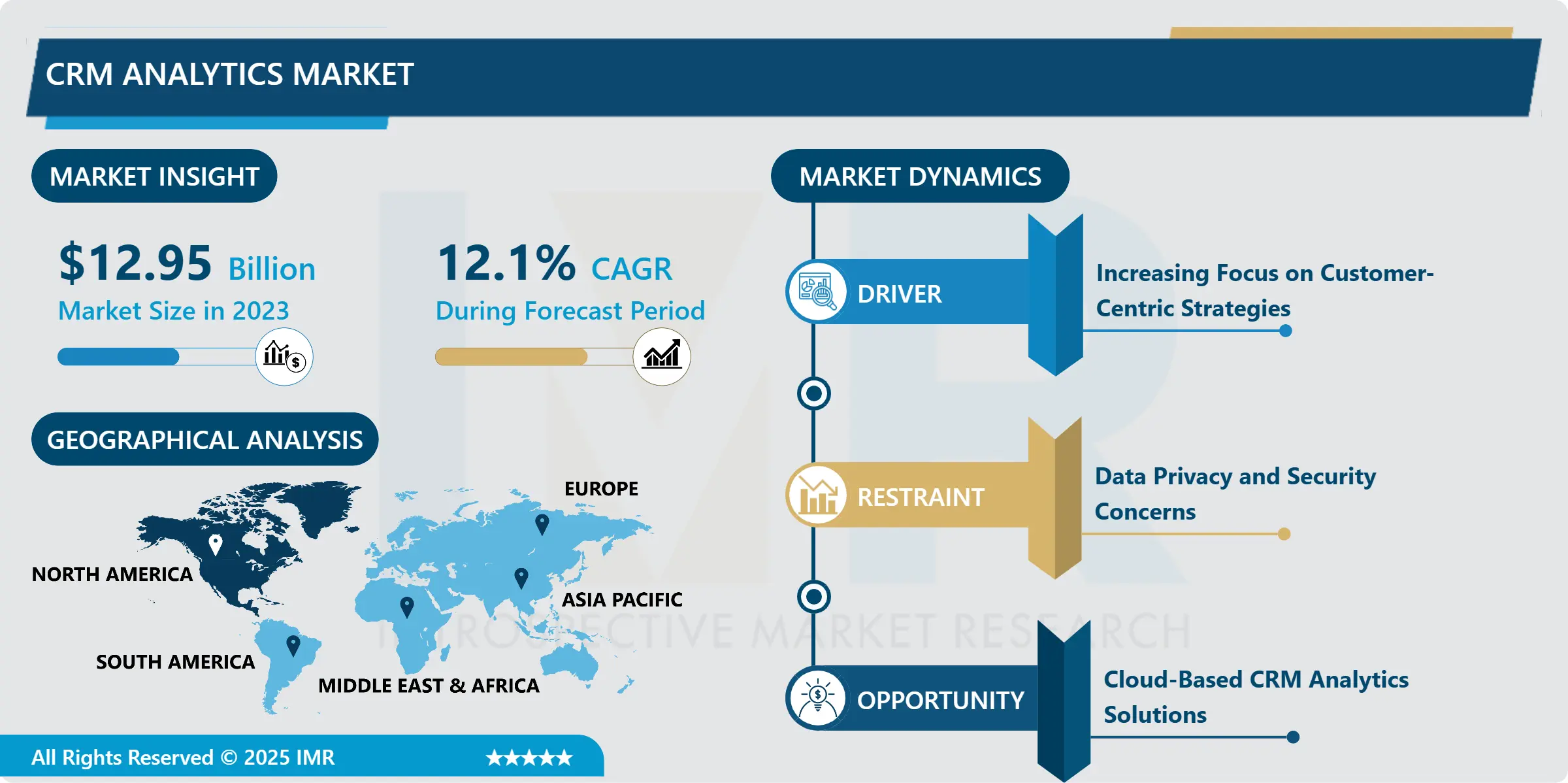
CRM Analytics Market Size Was Valued at USD 12.95 Billion in 2023, and is Projected to Reach USD 36.20 Billion by 2032, Growing at a CAGR of 12.10% From 2024-2032.

IMR
Description
CRM Analytics Market Synopsis:
CRM Analytics Market Size Was Valued at USD 12.95 Billion in 2023, and is Projected to Reach USD 36.20 Billion by 2032, Growing at a CAGR of 12.10% From 2024-2032.
CRM Analytics forms part of data analytics, which gives insight into what is happening between the company and the customers. This would help companies improve service to customers, retain existing customer bases, and increase sales and marketing efficiency. Sources include CRM systems, social media, and so many others.
The CRM Analytics market has grown significantly due to the increased need of businesses to leverage data for creating personalized customer experiences. This market connects raw customer data to strategic decision-making through the analysis of patterns, behaviors, and preferences. Enterprises from sectors such as retail, banking, healthcare, and telecommunications use CRM Analytics to gain insights into customer journeys, predict purchasing behaviors, and improve customer acquisition strategies.
Significant revolutions are made in the CRM Analytics landscape due to advancements in artificial intelligence, machine learning, and cloud computing. These technologies ease the real-time processing of data with predictive analytics and allow the automated generation of insights. Business houses work more toward a customer-centric approach rather than remaining merely competitive in times of high competition. Now, omni-channel marketing has further increased the need to integrate analytics in order to ensure smooth executions across platforms.
CRM Analytics Market Trend Analysis:
AI-Driven CRM Analytics
AI-driven CRM Analytics is one of the transformational trends in the market. Artificial intelligence provides an organization with deeper insight and makes it more effective in decision-making. AI greatly enhances predictive analytics, where businesses can predict their customer behavior and preferences with quite accurate results. Furthermore, AI tools can automate the customer segmentation, churn prediction, and sales forecasting; this helps businesses to be ahead of the market.
This integration further helps in sentiment analysis with NLP for real-time customer sentiment extraction from social media and other feedback channels. The trend it fosters into personalized marketing campaigns and proactive customer service results in customer satisfaction and loyalty. Its scalability and real-time processing are likely to redefine the boundaries of CRM Analytics and be an essential part of customer experience strategies.
Cloud-Based CRM Analytics Solutions
The transition to cloud-based CRM Analytics opens enormous growth opportunities for the market. Cloud-based solutions do away with extensive on-premises infrastructure requirements, and all types of organizations can use advanced analytics capabilities. Scalable solutions offer the possibility of adding more analytics capacity as the customer base increases.
Cloud platforms also support real-time data integration from various sources, ensuring that decision-makers stay updated with insights. They enhance collaboration by allowing secure access to analytics dashboards from anywhere, fostering cross-functional decision-making. As more and more businesses adopt remote work models and digital-first strategies, the growth of cloud-based CRM Analytics solutions is expected to be very rapid.
CRM Analytics Market Segment Analysis:
CRM Analytics Market Segmented on the basis of Deployment Type, Component, Organization Size, Industry Vertical, Application, and Region.
By Deployment Type, On-Premises segment is expected to dominate the market during the forecast period
The On-Premises segment is expected to dominate the market during the forecast period. This deployment model offers organizations full control over their CRM Analytics systems, which is critical for industries with strict data privacy and regulatory requirements, such as healthcare and banking. On-premises solutions ensure sensitive data remains within the organization’s infrastructure, reducing the risk of external breaches and enhancing compliance with industry standards. Although on-premises deployment involves higher upfront investment and ongoing maintenance costs, many businesses prioritize security, customization, and control over cost savings. As a result, organizations operating in highly regulated sectors continue to prefer this model, driving the sustained growth of the on-premises segment in the CRM Analytics market.
By Application, Sales Analytics segment expected to held the largest share
The Sales Analytics segment is expected to hold the largest share in the CRM Analytics Market during the forecast period. Sales analytics enables organizations to gain deep insights into customer behavior, sales performance, and market trends, helping businesses make data-driven decisions to boost revenue. With increasing competition and the need for personalized customer experiences, companies are leveraging CRM analytics tools to track sales metrics, forecast demand, and optimize their sales strategies. These tools help identify high-value customers, monitor sales pipelines, and improve conversion rates. As digital transformation accelerates across industries, the demand for advanced sales analytics solutions continues to rise, making this segment a key driver of growth within the broader CRM Analytics Market.
CRM Analytics Market Regional Insights:
North America is Expected to Dominate the Market Over the Forecast period
North America dominates the market for CRM Analytics due to its infrastructure of advanced technology and adoption of data-driven strategies. Most businesses in the region, specifically in the U.S. and Canada, use CRM Analytics to gain a competitive edge in saturated markets.
Additionally, the availability of top players in CRM Analytics and their constant developments speed up the growth process in the region. Government’s efforts toward digital transformation and general acceptance of cloud-based products ensure North America is firmly positioned at the top of the global market.
Active Key Players in the CRM Analytics Market:
Salesforce (USA)
Microsoft (USA)
Oracle (USA)
SAP (Germany)
Adobe (USA)
IBM (USA)
Zoho Corporation (India)
SAS Institute (USA)
HubSpot (USA)
Tableau (USA)
SugarCRM (USA)
Pegasystems (USA)
Other Active Players
Chapter 1: Introduction
1.1 Scope and Coverage
Chapter 2:Executive Summary
Chapter 3: Market Landscape
3.1 Market Dynamics
3.1.1 Drivers
3.1.2 Restraints
3.1.3 Opportunities
3.1.4 Challenges
3.2 Market Trend Analysis
3.3 PESTLE Analysis
3.4 Porter’s Five Forces Analysis
3.5 Industry Value Chain Analysis
3.6 Ecosystem
3.7 Regulatory Landscape
3.8 Price Trend Analysis
3.9 Patent Analysis
3.10 Technology Evolution
3.11 Investment Pockets
3.12 Import-Export Analysis
Chapter 4: CRM Analytics Market by Deployment Type
4.1 CRM Analytics Market Snapshot and Growth Engine
4.2 CRM Analytics Market Overview
4.3 On-Premises
4.3.1 Introduction and Market Overview
4.3.2 Historic and Forecasted Market Size in Value USD and Volume Units (2017-2032F)
4.3.3 Key Market Trends, Growth Factors and Opportunities
4.3.4 On-Premises: Geographic Segmentation Analysis
4.4 Cloud-Based
4.4.1 Introduction and Market Overview
4.4.2 Historic and Forecasted Market Size in Value USD and Volume Units (2017-2032F)
4.4.3 Key Market Trends, Growth Factors and Opportunities
4.4.4 Cloud-Based: Geographic Segmentation Analysis
Chapter 5: CRM Analytics Market by Component
5.1 CRM Analytics Market Snapshot and Growth Engine
5.2 CRM Analytics Market Overview
5.3 Software
5.3.1 Introduction and Market Overview
5.3.2 Historic and Forecasted Market Size in Value USD and Volume Units (2017-2032F)
5.3.3 Key Market Trends, Growth Factors and Opportunities
5.3.4 Software: Geographic Segmentation Analysis
5.4 Services
5.4.1 Introduction and Market Overview
5.4.2 Historic and Forecasted Market Size in Value USD and Volume Units (2017-2032F)
5.4.3 Key Market Trends, Growth Factors and Opportunities
5.4.4 Services: Geographic Segmentation Analysis
Chapter 6: CRM Analytics Market by Organization Size
6.1 CRM Analytics Market Snapshot and Growth Engine
6.2 CRM Analytics Market Overview
6.3 Small and Medium Enterprises (SMEs
6.3.1 Introduction and Market Overview
6.3.2 Historic and Forecasted Market Size in Value USD and Volume Units (2017-2032F)
6.3.3 Key Market Trends, Growth Factors and Opportunities
6.3.4 Small and Medium Enterprises (SMEs: Geographic Segmentation Analysis
6.4 Large Enterprises
6.4.1 Introduction and Market Overview
6.4.2 Historic and Forecasted Market Size in Value USD and Volume Units (2017-2032F)
6.4.3 Key Market Trends, Growth Factors and Opportunities
6.4.4 Large Enterprises: Geographic Segmentation Analysis
Chapter 7: CRM Analytics Market by Industry Vertical
7.1 CRM Analytics Market Snapshot and Growth Engine
7.2 CRM Analytics Market Overview
7.3 BFSI
7.3.1 Introduction and Market Overview
7.3.2 Historic and Forecasted Market Size in Value USD and Volume Units (2017-2032F)
7.3.3 Key Market Trends, Growth Factors and Opportunities
7.3.4 BFSI: Geographic Segmentation Analysis
7.4 Retail and E-commerce
7.4.1 Introduction and Market Overview
7.4.2 Historic and Forecasted Market Size in Value USD and Volume Units (2017-2032F)
7.4.3 Key Market Trends, Growth Factors and Opportunities
7.4.4 Retail and E-commerce: Geographic Segmentation Analysis
7.5 IT and Telecom
7.5.1 Introduction and Market Overview
7.5.2 Historic and Forecasted Market Size in Value USD and Volume Units (2017-2032F)
7.5.3 Key Market Trends, Growth Factors and Opportunities
7.5.4 IT and Telecom: Geographic Segmentation Analysis
7.6 Healthcare
7.6.1 Introduction and Market Overview
7.6.2 Historic and Forecasted Market Size in Value USD and Volume Units (2017-2032F)
7.6.3 Key Market Trends, Growth Factors and Opportunities
7.6.4 Healthcare: Geographic Segmentation Analysis
7.7 Manufacturing
7.7.1 Introduction and Market Overview
7.7.2 Historic and Forecasted Market Size in Value USD and Volume Units (2017-2032F)
7.7.3 Key Market Trends, Growth Factors and Opportunities
7.7.4 Manufacturing: Geographic Segmentation Analysis
7.8 Government
7.8.1 Introduction and Market Overview
7.8.2 Historic and Forecasted Market Size in Value USD and Volume Units (2017-2032F)
7.8.3 Key Market Trends, Growth Factors and Opportunities
7.8.4 Government: Geographic Segmentation Analysis
7.9 Media and Entertainment
7.9.1 Introduction and Market Overview
7.9.2 Historic and Forecasted Market Size in Value USD and Volume Units (2017-2032F)
7.9.3 Key Market Trends, Growth Factors and Opportunities
7.9.4 Media and Entertainment: Geographic Segmentation Analysis
7.10 Others
7.10.1 Introduction and Market Overview
7.10.2 Historic and Forecasted Market Size in Value USD and Volume Units (2017-2032F)
7.10.3 Key Market Trends, Growth Factors and Opportunities
7.10.4 Others: Geographic Segmentation Analysis
Chapter 8: CRM Analytics Market by Application
8.1 CRM Analytics Market Snapshot and Growth Engine
8.2 CRM Analytics Market Overview
8.3 Sales Analytics
8.3.1 Introduction and Market Overview
8.3.2 Historic and Forecasted Market Size in Value USD and Volume Units (2017-2032F)
8.3.3 Key Market Trends, Growth Factors and Opportunities
8.3.4 Sales Analytics: Geographic Segmentation Analysis
8.4 ing Analytics
8.4.1 Introduction and Market Overview
8.4.2 Historic and Forecasted Market Size in Value USD and Volume Units (2017-2032F)
8.4.3 Key Market Trends, Growth Factors and Opportunities
8.4.4 ing Analytics: Geographic Segmentation Analysis
8.5 Customer Service Analytics
8.5.1 Introduction and Market Overview
8.5.2 Historic and Forecasted Market Size in Value USD and Volume Units (2017-2032F)
8.5.3 Key Market Trends, Growth Factors and Opportunities
8.5.4 Customer Service Analytics: Geographic Segmentation Analysis
8.6 Contact Center Analytics
8.6.1 Introduction and Market Overview
8.6.2 Historic and Forecasted Market Size in Value USD and Volume Units (2017-2032F)
8.6.3 Key Market Trends, Growth Factors and Opportunities
8.6.4 Contact Center Analytics: Geographic Segmentation Analysis
8.7 Others
8.7.1 Introduction and Market Overview
8.7.2 Historic and Forecasted Market Size in Value USD and Volume Units (2017-2032F)
8.7.3 Key Market Trends, Growth Factors and Opportunities
8.7.4 Others: Geographic Segmentation Analysis
Chapter 9: Company Profiles and Competitive Analysis
9.1 Competitive Landscape
9.1.1 Competitive Benchmarking
9.1.2 CRM Analytics Market Share by Manufacturer (2023)
9.1.3 Industry BCG Matrix
9.1.4 Heat Map Analysis
9.1.5 Mergers and Acquisitions
9.2 SALESFORCE (USA)
9.2.1 Company Overview
9.2.2 Key Executives
9.2.3 Company Snapshot
9.2.4 Role of the Company in the Market
9.2.5 Sustainability and Social Responsibility
9.2.6 Operating Business Segments
9.2.7 Product Portfolio
9.2.8 Business Performance
9.2.9 Key Strategic Moves and Recent Developments
9.2.10 SWOT Analysis
9.3 MICROSOFT (USA)
9.4 ORACLE (USA)
9.5 SAP (GERMANY)
9.6 ADOBE (USA)
9.7 IBM (USA)
9.8 ZOHO CORPORATION (INDIA)
9.9 SAS INSTITUTE (USA)
9.10 HUBSPOT (USA)
9.11 TABLEAU (USA)
9.12 SUGARCRM (USA)
9.13 PEGASYSTEMS (USA)
9.14
9.15 OTHER ACTIVE PLAYERS
Chapter 10: Global CRM Analytics Market By Region
10.1 Overview
10.2. North America CRM Analytics Market
10.2.1 Key Market Trends, Growth Factors and Opportunities
10.2.2 Top Key Companies
10.2.3 Historic and Forecasted Market Size by Segments
10.2.4 Historic and Forecasted Market Size By Deployment Type
10.2.4.1 On-Premises
10.2.4.2 Cloud-Based
10.2.5 Historic and Forecasted Market Size By Component
10.2.5.1 Software
10.2.5.2 Services
10.2.6 Historic and Forecasted Market Size By Organization Size
10.2.6.1 Small and Medium Enterprises (SMEs
10.2.6.2 Large Enterprises
10.2.7 Historic and Forecasted Market Size By Industry Vertical
10.2.7.1 BFSI
10.2.7.2 Retail and E-commerce
10.2.7.3 IT and Telecom
10.2.7.4 Healthcare
10.2.7.5 Manufacturing
10.2.7.6 Government
10.2.7.7 Media and Entertainment
10.2.7.8 Others
10.2.8 Historic and Forecasted Market Size By Application
10.2.8.1 Sales Analytics
10.2.8.2 ing Analytics
10.2.8.3 Customer Service Analytics
10.2.8.4 Contact Center Analytics
10.2.8.5 Others
10.2.9 Historic and Forecast Market Size by Country
10.2.9.1 US
10.2.9.2 Canada
10.2.9.3 Mexico
10.3. Eastern Europe CRM Analytics Market
10.3.1 Key Market Trends, Growth Factors and Opportunities
10.3.2 Top Key Companies
10.3.3 Historic and Forecasted Market Size by Segments
10.3.4 Historic and Forecasted Market Size By Deployment Type
10.3.4.1 On-Premises
10.3.4.2 Cloud-Based
10.3.5 Historic and Forecasted Market Size By Component
10.3.5.1 Software
10.3.5.2 Services
10.3.6 Historic and Forecasted Market Size By Organization Size
10.3.6.1 Small and Medium Enterprises (SMEs
10.3.6.2 Large Enterprises
10.3.7 Historic and Forecasted Market Size By Industry Vertical
10.3.7.1 BFSI
10.3.7.2 Retail and E-commerce
10.3.7.3 IT and Telecom
10.3.7.4 Healthcare
10.3.7.5 Manufacturing
10.3.7.6 Government
10.3.7.7 Media and Entertainment
10.3.7.8 Others
10.3.8 Historic and Forecasted Market Size By Application
10.3.8.1 Sales Analytics
10.3.8.2 ing Analytics
10.3.8.3 Customer Service Analytics
10.3.8.4 Contact Center Analytics
10.3.8.5 Others
10.3.9 Historic and Forecast Market Size by Country
10.3.9.1 Russia
10.3.9.2 Bulgaria
10.3.9.3 The Czech Republic
10.3.9.4 Hungary
10.3.9.5 Poland
10.3.9.6 Romania
10.3.9.7 Rest of Eastern Europe
10.4. Western Europe CRM Analytics Market
10.4.1 Key Market Trends, Growth Factors and Opportunities
10.4.2 Top Key Companies
10.4.3 Historic and Forecasted Market Size by Segments
10.4.4 Historic and Forecasted Market Size By Deployment Type
10.4.4.1 On-Premises
10.4.4.2 Cloud-Based
10.4.5 Historic and Forecasted Market Size By Component
10.4.5.1 Software
10.4.5.2 Services
10.4.6 Historic and Forecasted Market Size By Organization Size
10.4.6.1 Small and Medium Enterprises (SMEs
10.4.6.2 Large Enterprises
10.4.7 Historic and Forecasted Market Size By Industry Vertical
10.4.7.1 BFSI
10.4.7.2 Retail and E-commerce
10.4.7.3 IT and Telecom
10.4.7.4 Healthcare
10.4.7.5 Manufacturing
10.4.7.6 Government
10.4.7.7 Media and Entertainment
10.4.7.8 Others
10.4.8 Historic and Forecasted Market Size By Application
10.4.8.1 Sales Analytics
10.4.8.2 ing Analytics
10.4.8.3 Customer Service Analytics
10.4.8.4 Contact Center Analytics
10.4.8.5 Others
10.4.9 Historic and Forecast Market Size by Country
10.4.9.1 Germany
10.4.9.2 UK
10.4.9.3 France
10.4.9.4 The Netherlands
10.4.9.5 Italy
10.4.9.6 Spain
10.4.9.7 Rest of Western Europe
10.5. Asia Pacific CRM Analytics Market
10.5.1 Key Market Trends, Growth Factors and Opportunities
10.5.2 Top Key Companies
10.5.3 Historic and Forecasted Market Size by Segments
10.5.4 Historic and Forecasted Market Size By Deployment Type
10.5.4.1 On-Premises
10.5.4.2 Cloud-Based
10.5.5 Historic and Forecasted Market Size By Component
10.5.5.1 Software
10.5.5.2 Services
10.5.6 Historic and Forecasted Market Size By Organization Size
10.5.6.1 Small and Medium Enterprises (SMEs
10.5.6.2 Large Enterprises
10.5.7 Historic and Forecasted Market Size By Industry Vertical
10.5.7.1 BFSI
10.5.7.2 Retail and E-commerce
10.5.7.3 IT and Telecom
10.5.7.4 Healthcare
10.5.7.5 Manufacturing
10.5.7.6 Government
10.5.7.7 Media and Entertainment
10.5.7.8 Others
10.5.8 Historic and Forecasted Market Size By Application
10.5.8.1 Sales Analytics
10.5.8.2 ing Analytics
10.5.8.3 Customer Service Analytics
10.5.8.4 Contact Center Analytics
10.5.8.5 Others
10.5.9 Historic and Forecast Market Size by Country
10.5.9.1 China
10.5.9.2 India
10.5.9.3 Japan
10.5.9.4 South Korea
10.5.9.5 Malaysia
10.5.9.6 Thailand
10.5.9.7 Vietnam
10.5.9.8 The Philippines
10.5.9.9 Australia
10.5.9.10 New Zealand
10.5.9.11 Rest of APAC
10.6. Middle East & Africa CRM Analytics Market
10.6.1 Key Market Trends, Growth Factors and Opportunities
10.6.2 Top Key Companies
10.6.3 Historic and Forecasted Market Size by Segments
10.6.4 Historic and Forecasted Market Size By Deployment Type
10.6.4.1 On-Premises
10.6.4.2 Cloud-Based
10.6.5 Historic and Forecasted Market Size By Component
10.6.5.1 Software
10.6.5.2 Services
10.6.6 Historic and Forecasted Market Size By Organization Size
10.6.6.1 Small and Medium Enterprises (SMEs
10.6.6.2 Large Enterprises
10.6.7 Historic and Forecasted Market Size By Industry Vertical
10.6.7.1 BFSI
10.6.7.2 Retail and E-commerce
10.6.7.3 IT and Telecom
10.6.7.4 Healthcare
10.6.7.5 Manufacturing
10.6.7.6 Government
10.6.7.7 Media and Entertainment
10.6.7.8 Others
10.6.8 Historic and Forecasted Market Size By Application
10.6.8.1 Sales Analytics
10.6.8.2 ing Analytics
10.6.8.3 Customer Service Analytics
10.6.8.4 Contact Center Analytics
10.6.8.5 Others
10.6.9 Historic and Forecast Market Size by Country
10.6.9.1 Turkiye
10.6.9.2 Bahrain
10.6.9.3 Kuwait
10.6.9.4 Saudi Arabia
10.6.9.5 Qatar
10.6.9.6 UAE
10.6.9.7 Israel
10.6.9.8 South Africa
10.7. South America CRM Analytics Market
10.7.1 Key Market Trends, Growth Factors and Opportunities
10.7.2 Top Key Companies
10.7.3 Historic and Forecasted Market Size by Segments
10.7.4 Historic and Forecasted Market Size By Deployment Type
10.7.4.1 On-Premises
10.7.4.2 Cloud-Based
10.7.5 Historic and Forecasted Market Size By Component
10.7.5.1 Software
10.7.5.2 Services
10.7.6 Historic and Forecasted Market Size By Organization Size
10.7.6.1 Small and Medium Enterprises (SMEs
10.7.6.2 Large Enterprises
10.7.7 Historic and Forecasted Market Size By Industry Vertical
10.7.7.1 BFSI
10.7.7.2 Retail and E-commerce
10.7.7.3 IT and Telecom
10.7.7.4 Healthcare
10.7.7.5 Manufacturing
10.7.7.6 Government
10.7.7.7 Media and Entertainment
10.7.7.8 Others
10.7.8 Historic and Forecasted Market Size By Application
10.7.8.1 Sales Analytics
10.7.8.2 ing Analytics
10.7.8.3 Customer Service Analytics
10.7.8.4 Contact Center Analytics
10.7.8.5 Others
10.7.9 Historic and Forecast Market Size by Country
10.7.9.1 Brazil
10.7.9.2 Argentina
10.7.9.3 Rest of SA
Chapter 11 Analyst Viewpoint and Conclusion
11.1 Recommendations and Concluding Analysis
11.2 Potential Market Strategies
Chapter 12 Research Methodology
12.1 Research Process
12.2 Primary Research
12.3 Secondary Research
Q1: What would be the forecast period in the CRM Analytics Market research report?
A1: The forecast period in the CRM Analytics Market research report is 2024-2032.
Q2: Who are the key players in the CRM Analytics Market?
A2: Salesforce (USA), Microsoft (USA), Oracle (USA), SAP (Germany), Adobe (USA), IBM (USA), Zoho Corporation (India), SAS Institute (USA), HubSpot (USA), Tableau (USA), SugarCRM (USA), Pegasystems (USA), Other Active Players.
Q3: What are the segments of the CRM Analytics Market?
A3: The CRM Analytics Market is segmented into Deployment Type, Component, Organization Size, Industry Vertical, Application and region. By Deployment Type, the market is categorized into On-Premises, Cloud-Based. By Component, the market is categorized into Software, Services. By Organization Size, the market is categorized into Small and Medium Enterprises (SMEs), Large Enterprises. By Industry Vertical (BFSI, Retail and E-commerce, IT and Telecom, Healthcare, Manufacturing, Government, Media and Entertainment, Others), By Application (Sales Analytics, Marketing Analytics, Customer Service Analytics, Contact Center Analytics, Others. By region, it is analyzed across North America (U.S.; Canada; Mexico), Eastern Europe (Russia; Bulgaria; The Czech Republic; Hungary; Poland; Romania; Rest of Eastern Europe), Western Europe (Germany; UK; France; Netherlands; Italy; Spain; Rest of Western Europe), Asia-Pacific (China; India; Japan; Southeast Asia, etc.), South America (Brazil; Argentina, etc.), Middle East & Africa (Saudi Arabia; South Africa, etc.).
Q4: What is the CRM Analytics Market?
A4: CRM Analytics forms part of data analytics, which gives insight into what is happening between the company and the customers. This would help companies improve service to customers, retain existing customer bases, and increase sales and marketing efficiency.
Q5: How big is the CRM Analytics Market?
A5: CRM Analytics Market Size Was Valued at USD 12.95 Billion in 2023, and is Projected to Reach USD 36.20 Billion by 2032, Growing at a CAGR of 12.10% From 2024-2032.
How to buy a report from Megatrends.jp
On the product page, select the license you want: Single User License or Enterprise License.
Select the report language:
- English Report
- English Report + Japanese Translation
Click the Buy Now button.
You’ll be redirected to the checkout page. Enter your company and payment details.
Click Place Order to complete your purchase.
Confirmation: You’ll receive an order confirmation email. Our team will then follow up with your report delivery.
If you have questions, fill out the contact form below or email us at sales1@megatrends.jp.
Thank you for choosing Megatrends.jp!