24時間365日サポート — いつでもお客様をサポートいたします。
お問い合わせ
Pharmacy Automation Market Size, Share, Growth & Forecast (2024-2032)
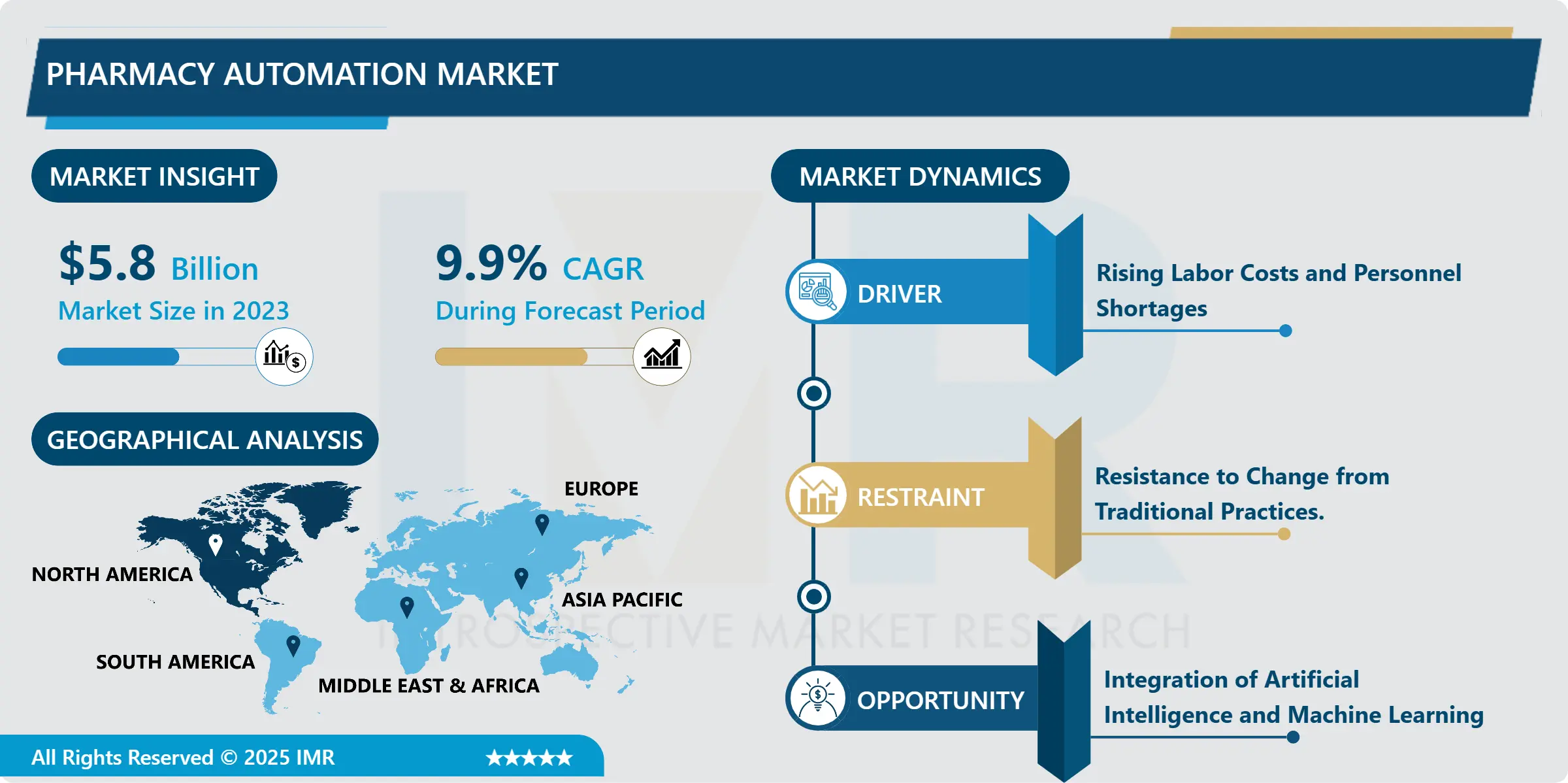
Pharmacy Automation Market Size Was Valued at USD 5.8 Billion in 2023, and is Projected to Reach USD 13.56 Billion by 2032, Growing at a CAGR of 9.90% From 2024-2032.

IMR
Description
Pharmacy Automation Market Synopsis:
Pharmacy Automation Market Size Was Valued at USD 5.8 Billion in 2023, and is Projected to Reach USD 13.56 Billion by 2032, Growing at a CAGR of 9.90% From 2024-2032.
The Pharmacy Automation Market encompasses the business segment that deals with the design and use of automated equipment and systems that help manage a pharmacy and dispense medication. These automated solutions aim to enhance the precision of work; increase throughput and decrease adverse human factors within pharmaceutical environments, therefore benefiting the security and practice of pharmacy.
Some of the major factors that have boosted growth in the Pharmacy Automation Market are Precision needed in the medication delivery process. Since the modern trend in the healthcare sector is to move more towards an integrated and personal patient care, it is becoming increasingly important for pharmacies to try and reduce the incidence of medical malpractice and deliver medication and pharmaceuticals on time. Pharmacy tasks like the use of robots in dispensing drugs and the use of software for managing the operations of the pharmacy contribute to the offering of competent service delivery to customers’ needs.
The other influence is changing costs such as increasing labour costs and scarcity of experienced pharmacy workers. As a result of the rise of the elder population combined with continued growth of chronic conditions necessitating dependable medication, pharmacies are experiencing greater customer traffic. Automation aids to overcome this challenge in that most of the routine operational activities do not demand much of pharmacy staff and more of their time can be spent on patient counseling as well as clinical services. Therefore, significant numbers of pharmacies have turned to automation as a means of improving the overall capacity for functioning and sustainability in the market.
Pharmacy Automation Market Trend Analysis:
The integration of advanced technologies such as artificial intelligence (AI) and machine learning.
As it was pointed earlier, one of the significant tendencies in the Pharmacy Automation Market is the implementation of innovative technologies among which AI and machine learning. These technologies are being adopted in many of the pharmacy automation systems as a tool to support decision making about inventory and tracking, as well as offer predictive information. The involvement of AI technology in patient data allows for the enhancement of the medication intake as well as offer recommendation of medication for individual patients which shall benefit the general patient.
Another new emerging trend implemented in pharmacies is the adoption of cloud-based pharmacy management systems. The use of the cloud is convenient and can be scaled to meet the needs of different sites – all the more effective, since the substitution of paper by digital technologies undeniably simplifies the management of a pharmacy enterprise. The utilization of cloud systems help pharmacies to ensure the right regulatory requirements and can improve organization of processes, effectiveness of collaboration between suppliers, and management of information sharing among professionals in the industry. Further, this trend is expected to extend in the future because many pharmacies are embracing change in technological advancement to boost their performance degree.
Increasing demand for automated solutions to enhance pharmacy operations and patient care.
Exploitation of fresh markets presents one of the most significant opportunities patronizing the Pharmacy Automation Market growth. As the healthcare issues in the developing world get a face-lift, the need for efficiency in the performance of the pharmacy indemnity gets felt which in return, fuels the market growth for pharmacy automation systems. Firms can then seize it to market cheap and easily accesible automation solutions that can be tailored to the needs of these emerging industries and markets hence increase their revenues.
However, there is still a significantly unexploited opportunity within the theme of increasing focus on elements of the personalized medicine approach in specific segments of the healthcare market by pharmacy automation providers. As more and more practitioners adopt precision medicine, pharmacies can incorporate the automation solutions for compound medications and person-centered delivery forms. This trend spells opportunity in regards to creating new and diverse opportunities for pharmacy automation companies and health care organizations to increase the positive impacts for patients by implementing new and more individualized therapeutic intercessions.
Pharmacy Automation Market Segment Analysis:
Pharmacy Automation Market is Segmented on the basis of Product type, Technology, Application, End User, and Region.
By Product Type, IV Robots segment is expected to dominate the market during the forecast period
Pharmacy Automation can be categorized according to type into several key segments each performing specific roles in the operations of a pharmacy. Automated Pharmacy Dispensing Systems help in making the time-consuming process of getting the right medication to patients much more efficient. Automated Storage and Retrieval Systems play a great role to improve the delivery of medicines to patients since it enables them to be stored and retrieved with little assistance from personnel. IV robots are dedicated equipment for preparing intravenous drugs in order to avoid errors in compounding or the wrong dose. By use of Tablet Counters, it becomes easier to count as well as sort out the tablets especially when working in environments with a lot of traffic. Finally, Pharmacy Management Systems combine several aspects of pharmacy operations such as inventory control, prescription flow, and patient handling to come up with an all in one package for increasing productivity and, positively impacting patient care.
By Application, Medication Dispensing segment expected to held the largest share
The Pharmacy Automation Market can also be categorized based on application referring to the various roles played by the automation technologies in the usage of pharmacies. Medication distribution is a prime category, given that all the dispensing of medicines has to be done with precision and speed to minimize the chances of patient harm from errors. Inventory management is the other key application area using automation to monitor medication stock status, ordering, and usage while ensuring that stock out situations are avoided, and wastage is kept to the bare minimum. Prescription management deals with the automation of the prescription handling and processing such as authorization of the orders, prescription refill control, and record keeping are made easier resulting in increased order. Cumulatively, formulation of customized medications is made easier through automation since it guarantees the accurate measurements and doses which makes the compounded drugs to be more standard and quality. These applications show how automation technology has brought a new generation of change in how pharmacies operate, in terms of efficiency, safety and customer care.
Pharmacy Automation Market Regional Insights:
North America is Expected to Dominate the Market Over the Forecast period
At present, North America holds the largest share in the Pharmacy Automation Market due to the enhanced facilities and significant acceptance of automations within the pharmaceutical sector. The position of key players is strong, the healthcare industry remains committed to healthcare innovation, and the government acts to advance policies to enhance the security of patients as well as healthcare quality. The rising concern for enhanced cost-effective healthcare delivery with higher quality helps build up the demand for pharmacy automation solutions in this region.
Well-development healthcare systems and the incidence of chronic ailments in North America create pressure on efficient medication management and dispensing across numerous stores and pharmacies. Since pharmacy owner wants to improve daylight operations and adhere to regulatory requirements, the use of automated systems will increase further year after year making North America as leading market for pharmacy automation technology.
Active Key Players in the Pharmacy Automation Market:
McKesson Corporation (USA)
Omnicell, Inc. (USA)
BD (Becton, Dickinson and Company) (USA)
Cerner Corporation (USA)
KUKA AG (Germany)
Parata Systems (USA)
RxSafe, LLC (USA)
ScriptPro LLC (USA)
TOSHO Co., Ltd. (Japan)
Swisslog Holding AG (Switzerland)
Other Active Players
Chapter 1: Introduction
1.1 Scope and Coverage
Chapter 2:Executive Summary
Chapter 3: Market Landscape
3.1 Market Dynamics
3.1.1 Drivers
3.1.2 Restraints
3.1.3 Opportunities
3.1.4 Challenges
3.2 Market Trend Analysis
3.3 PESTLE Analysis
3.4 Porter’s Five Forces Analysis
3.5 Industry Value Chain Analysis
3.6 Ecosystem
3.7 Regulatory Landscape
3.8 Price Trend Analysis
3.9 Patent Analysis
3.10 Technology Evolution
3.11 Investment Pockets
3.12 Import-Export Analysis
Chapter 4: Central Fill Pharmacy Automation Market by Product Type
4.1 Central Fill Pharmacy Automation Market Snapshot and Growth Engine
4.2 Central Fill Pharmacy Automation Market Overview
4.3 Robotic Prescription Dispensing Systems
4.3.1 Introduction and Market Overview
4.3.2 Historic and Forecasted Market Size in Value USD and Volume Units (2017-2032F)
4.3.3 Key Market Trends, Growth Factors and Opportunities
4.3.4 Robotic Prescription Dispensing Systems: Geographic Segmentation Analysis
4.4 Automated Packaging and Labeling Systems
4.4.1 Introduction and Market Overview
4.4.2 Historic and Forecasted Market Size in Value USD and Volume Units (2017-2032F)
4.4.3 Key Market Trends, Growth Factors and Opportunities
4.4.4 Automated Packaging and Labeling Systems: Geographic Segmentation Analysis
4.5 Centralized Pharmacy Dispensing Systems
4.5.1 Introduction and Market Overview
4.5.2 Historic and Forecasted Market Size in Value USD and Volume Units (2017-2032F)
4.5.3 Key Market Trends, Growth Factors and Opportunities
4.5.4 Centralized Pharmacy Dispensing Systems: Geographic Segmentation Analysis
4.6 Automated Storage and Retrieval Systems
4.6.1 Introduction and Market Overview
4.6.2 Historic and Forecasted Market Size in Value USD and Volume Units (2017-2032F)
4.6.3 Key Market Trends, Growth Factors and Opportunities
4.6.4 Automated Storage and Retrieval Systems: Geographic Segmentation Analysis
Chapter 5: Central Fill Pharmacy Automation Market by End User
5.1 Central Fill Pharmacy Automation Market Snapshot and Growth Engine
5.2 Central Fill Pharmacy Automation Market Overview
5.3 Retail Pharmacies
5.3.1 Introduction and Market Overview
5.3.2 Historic and Forecasted Market Size in Value USD and Volume Units (2017-2032F)
5.3.3 Key Market Trends, Growth Factors and Opportunities
5.3.4 Retail Pharmacies: Geographic Segmentation Analysis
5.4 Hospital Pharmacies
5.4.1 Introduction and Market Overview
5.4.2 Historic and Forecasted Market Size in Value USD and Volume Units (2017-2032F)
5.4.3 Key Market Trends, Growth Factors and Opportunities
5.4.4 Hospital Pharmacies: Geographic Segmentation Analysis
5.5 Mail Order Pharmacies
5.5.1 Introduction and Market Overview
5.5.2 Historic and Forecasted Market Size in Value USD and Volume Units (2017-2032F)
5.5.3 Key Market Trends, Growth Factors and Opportunities
5.5.4 Mail Order Pharmacies: Geographic Segmentation Analysis
5.6 Long-Term Care Pharmacies
5.6.1 Introduction and Market Overview
5.6.2 Historic and Forecasted Market Size in Value USD and Volume Units (2017-2032F)
5.6.3 Key Market Trends, Growth Factors and Opportunities
5.6.4 Long-Term Care Pharmacies: Geographic Segmentation Analysis
Chapter 6: Central Fill Pharmacy Automation Market by Application
6.1 Central Fill Pharmacy Automation Market Snapshot and Growth Engine
6.2 Central Fill Pharmacy Automation Market Overview
6.3 Prescription Dispensing
6.3.1 Introduction and Market Overview
6.3.2 Historic and Forecasted Market Size in Value USD and Volume Units (2017-2032F)
6.3.3 Key Market Trends, Growth Factors and Opportunities
6.3.4 Prescription Dispensing: Geographic Segmentation Analysis
6.4 Inventory Management
6.4.1 Introduction and Market Overview
6.4.2 Historic and Forecasted Market Size in Value USD and Volume Units (2017-2032F)
6.4.3 Key Market Trends, Growth Factors and Opportunities
6.4.4 Inventory Management: Geographic Segmentation Analysis
6.5 Order Processing
6.5.1 Introduction and Market Overview
6.5.2 Historic and Forecasted Market Size in Value USD and Volume Units (2017-2032F)
6.5.3 Key Market Trends, Growth Factors and Opportunities
6.5.4 Order Processing: Geographic Segmentation Analysis
6.6 Medication Storage
6.6.1 Introduction and Market Overview
6.6.2 Historic and Forecasted Market Size in Value USD and Volume Units (2017-2032F)
6.6.3 Key Market Trends, Growth Factors and Opportunities
6.6.4 Medication Storage: Geographic Segmentation Analysis
Chapter 7: Central Fill Pharmacy Automation Market by Technology
7.1 Central Fill Pharmacy Automation Market Snapshot and Growth Engine
7.2 Central Fill Pharmacy Automation Market Overview
7.3 Robotics Technology
7.3.1 Introduction and Market Overview
7.3.2 Historic and Forecasted Market Size in Value USD and Volume Units (2017-2032F)
7.3.3 Key Market Trends, Growth Factors and Opportunities
7.3.4 Robotics Technology: Geographic Segmentation Analysis
7.4 Conveyor Technology
7.4.1 Introduction and Market Overview
7.4.2 Historic and Forecasted Market Size in Value USD and Volume Units (2017-2032F)
7.4.3 Key Market Trends, Growth Factors and Opportunities
7.4.4 Conveyor Technology: Geographic Segmentation Analysis
7.5 Barcode Scanning Technology
7.5.1 Introduction and Market Overview
7.5.2 Historic and Forecasted Market Size in Value USD and Volume Units (2017-2032F)
7.5.3 Key Market Trends, Growth Factors and Opportunities
7.5.4 Barcode Scanning Technology: Geographic Segmentation Analysis
7.6 Vision Inspection Systems
7.6.1 Introduction and Market Overview
7.6.2 Historic and Forecasted Market Size in Value USD and Volume Units (2017-2032F)
7.6.3 Key Market Trends, Growth Factors and Opportunities
7.6.4 Vision Inspection Systems: Geographic Segmentation Analysis
Chapter 8: Company Profiles and Competitive Analysis
8.1 Competitive Landscape
8.1.1 Competitive Benchmarking
8.1.2 Central Fill Pharmacy Automation Market Share by Manufacturer (2023)
8.1.3 Industry BCG Matrix
8.1.4 Heat Map Analysis
8.1.5 Mergers and Acquisitions
8.2 PRODUCT TYPE::ROBOTIC PRESCRIPTION DISPENSING SYSTEMS
8.2.1 Company Overview
8.2.2 Key Executives
8.2.3 Company Snapshot
8.2.4 Role of the Company in the Market
8.2.5 Sustainability and Social Responsibility
8.2.6 Operating Business Segments
8.2.7 Product Portfolio
8.2.8 Business Performance
8.2.9 Key Strategic Moves and Recent Developments
8.2.10 SWOT Analysis
8.3 AUTOMATED PACKAGING AND LABELING SYSTEMS
8.4 CENTRALIZED PHARMACY DISPENSING SYSTEMS
8.5 AUTOMATED STORAGE AND RETRIEVAL SYSTEMS#END USER::RETAIL PHARMACIES
8.6 HOSPITAL PHARMACIES
8.7 MAIL ORDER PHARMACIES
8.8 LONG-TERM CARE PHARMACIES#APPLICATION::PRESCRIPTION DISPENSING
8.9 INVENTORY MANAGEMENT
8.10 ORDER PROCESSING
8.11 MEDICATION STORAGE#TECHNOLOGY::ROBOTICS TECHNOLOGY
8.12 CONVEYOR TECHNOLOGY
8.13 BARCODE SCANNING TECHNOLOGY
8.14 VISION INSPECTION SYSTEMS
8.15 OTHER ACTIVE PLAYERS
Chapter 9: Global Central Fill Pharmacy Automation Market By Region
9.1 Overview
9.2. North America Central Fill Pharmacy Automation Market
9.2.1 Key Market Trends, Growth Factors and Opportunities
9.2.2 Top Key Companies
9.2.3 Historic and Forecasted Market Size by Segments
9.2.4 Historic and Forecasted Market Size By Product Type
9.2.4.1 Robotic Prescription Dispensing Systems
9.2.4.2 Automated Packaging and Labeling Systems
9.2.4.3 Centralized Pharmacy Dispensing Systems
9.2.4.4 Automated Storage and Retrieval Systems
9.2.5 Historic and Forecasted Market Size By End User
9.2.5.1 Retail Pharmacies
9.2.5.2 Hospital Pharmacies
9.2.5.3 Mail Order Pharmacies
9.2.5.4 Long-Term Care Pharmacies
9.2.6 Historic and Forecasted Market Size By Application
9.2.6.1 Prescription Dispensing
9.2.6.2 Inventory Management
9.2.6.3 Order Processing
9.2.6.4 Medication Storage
9.2.7 Historic and Forecasted Market Size By Technology
9.2.7.1 Robotics Technology
9.2.7.2 Conveyor Technology
9.2.7.3 Barcode Scanning Technology
9.2.7.4 Vision Inspection Systems
9.2.8 Historic and Forecast Market Size by Country
9.2.8.1 US
9.2.8.2 Canada
9.2.8.3 Mexico
9.3. Eastern Europe Central Fill Pharmacy Automation Market
9.3.1 Key Market Trends, Growth Factors and Opportunities
9.3.2 Top Key Companies
9.3.3 Historic and Forecasted Market Size by Segments
9.3.4 Historic and Forecasted Market Size By Product Type
9.3.4.1 Robotic Prescription Dispensing Systems
9.3.4.2 Automated Packaging and Labeling Systems
9.3.4.3 Centralized Pharmacy Dispensing Systems
9.3.4.4 Automated Storage and Retrieval Systems
9.3.5 Historic and Forecasted Market Size By End User
9.3.5.1 Retail Pharmacies
9.3.5.2 Hospital Pharmacies
9.3.5.3 Mail Order Pharmacies
9.3.5.4 Long-Term Care Pharmacies
9.3.6 Historic and Forecasted Market Size By Application
9.3.6.1 Prescription Dispensing
9.3.6.2 Inventory Management
9.3.6.3 Order Processing
9.3.6.4 Medication Storage
9.3.7 Historic and Forecasted Market Size By Technology
9.3.7.1 Robotics Technology
9.3.7.2 Conveyor Technology
9.3.7.3 Barcode Scanning Technology
9.3.7.4 Vision Inspection Systems
9.3.8 Historic and Forecast Market Size by Country
9.3.8.1 Russia
9.3.8.2 Bulgaria
9.3.8.3 The Czech Republic
9.3.8.4 Hungary
9.3.8.5 Poland
9.3.8.6 Romania
9.3.8.7 Rest of Eastern Europe
9.4. Western Europe Central Fill Pharmacy Automation Market
9.4.1 Key Market Trends, Growth Factors and Opportunities
9.4.2 Top Key Companies
9.4.3 Historic and Forecasted Market Size by Segments
9.4.4 Historic and Forecasted Market Size By Product Type
9.4.4.1 Robotic Prescription Dispensing Systems
9.4.4.2 Automated Packaging and Labeling Systems
9.4.4.3 Centralized Pharmacy Dispensing Systems
9.4.4.4 Automated Storage and Retrieval Systems
9.4.5 Historic and Forecasted Market Size By End User
9.4.5.1 Retail Pharmacies
9.4.5.2 Hospital Pharmacies
9.4.5.3 Mail Order Pharmacies
9.4.5.4 Long-Term Care Pharmacies
9.4.6 Historic and Forecasted Market Size By Application
9.4.6.1 Prescription Dispensing
9.4.6.2 Inventory Management
9.4.6.3 Order Processing
9.4.6.4 Medication Storage
9.4.7 Historic and Forecasted Market Size By Technology
9.4.7.1 Robotics Technology
9.4.7.2 Conveyor Technology
9.4.7.3 Barcode Scanning Technology
9.4.7.4 Vision Inspection Systems
9.4.8 Historic and Forecast Market Size by Country
9.4.8.1 Germany
9.4.8.2 UK
9.4.8.3 France
9.4.8.4 The Netherlands
9.4.8.5 Italy
9.4.8.6 Spain
9.4.8.7 Rest of Western Europe
9.5. Asia Pacific Central Fill Pharmacy Automation Market
9.5.1 Key Market Trends, Growth Factors and Opportunities
9.5.2 Top Key Companies
9.5.3 Historic and Forecasted Market Size by Segments
9.5.4 Historic and Forecasted Market Size By Product Type
9.5.4.1 Robotic Prescription Dispensing Systems
9.5.4.2 Automated Packaging and Labeling Systems
9.5.4.3 Centralized Pharmacy Dispensing Systems
9.5.4.4 Automated Storage and Retrieval Systems
9.5.5 Historic and Forecasted Market Size By End User
9.5.5.1 Retail Pharmacies
9.5.5.2 Hospital Pharmacies
9.5.5.3 Mail Order Pharmacies
9.5.5.4 Long-Term Care Pharmacies
9.5.6 Historic and Forecasted Market Size By Application
9.5.6.1 Prescription Dispensing
9.5.6.2 Inventory Management
9.5.6.3 Order Processing
9.5.6.4 Medication Storage
9.5.7 Historic and Forecasted Market Size By Technology
9.5.7.1 Robotics Technology
9.5.7.2 Conveyor Technology
9.5.7.3 Barcode Scanning Technology
9.5.7.4 Vision Inspection Systems
9.5.8 Historic and Forecast Market Size by Country
9.5.8.1 China
9.5.8.2 India
9.5.8.3 Japan
9.5.8.4 South Korea
9.5.8.5 Malaysia
9.5.8.6 Thailand
9.5.8.7 Vietnam
9.5.8.8 The Philippines
9.5.8.9 Australia
9.5.8.10 New Zealand
9.5.8.11 Rest of APAC
9.6. Middle East & Africa Central Fill Pharmacy Automation Market
9.6.1 Key Market Trends, Growth Factors and Opportunities
9.6.2 Top Key Companies
9.6.3 Historic and Forecasted Market Size by Segments
9.6.4 Historic and Forecasted Market Size By Product Type
9.6.4.1 Robotic Prescription Dispensing Systems
9.6.4.2 Automated Packaging and Labeling Systems
9.6.4.3 Centralized Pharmacy Dispensing Systems
9.6.4.4 Automated Storage and Retrieval Systems
9.6.5 Historic and Forecasted Market Size By End User
9.6.5.1 Retail Pharmacies
9.6.5.2 Hospital Pharmacies
9.6.5.3 Mail Order Pharmacies
9.6.5.4 Long-Term Care Pharmacies
9.6.6 Historic and Forecasted Market Size By Application
9.6.6.1 Prescription Dispensing
9.6.6.2 Inventory Management
9.6.6.3 Order Processing
9.6.6.4 Medication Storage
9.6.7 Historic and Forecasted Market Size By Technology
9.6.7.1 Robotics Technology
9.6.7.2 Conveyor Technology
9.6.7.3 Barcode Scanning Technology
9.6.7.4 Vision Inspection Systems
9.6.8 Historic and Forecast Market Size by Country
9.6.8.1 Turkiye
9.6.8.2 Bahrain
9.6.8.3 Kuwait
9.6.8.4 Saudi Arabia
9.6.8.5 Qatar
9.6.8.6 UAE
9.6.8.7 Israel
9.6.8.8 South Africa
9.7. South America Central Fill Pharmacy Automation Market
9.7.1 Key Market Trends, Growth Factors and Opportunities
9.7.2 Top Key Companies
9.7.3 Historic and Forecasted Market Size by Segments
9.7.4 Historic and Forecasted Market Size By Product Type
9.7.4.1 Robotic Prescription Dispensing Systems
9.7.4.2 Automated Packaging and Labeling Systems
9.7.4.3 Centralized Pharmacy Dispensing Systems
9.7.4.4 Automated Storage and Retrieval Systems
9.7.5 Historic and Forecasted Market Size By End User
9.7.5.1 Retail Pharmacies
9.7.5.2 Hospital Pharmacies
9.7.5.3 Mail Order Pharmacies
9.7.5.4 Long-Term Care Pharmacies
9.7.6 Historic and Forecasted Market Size By Application
9.7.6.1 Prescription Dispensing
9.7.6.2 Inventory Management
9.7.6.3 Order Processing
9.7.6.4 Medication Storage
9.7.7 Historic and Forecasted Market Size By Technology
9.7.7.1 Robotics Technology
9.7.7.2 Conveyor Technology
9.7.7.3 Barcode Scanning Technology
9.7.7.4 Vision Inspection Systems
9.7.8 Historic and Forecast Market Size by Country
9.7.8.1 Brazil
9.7.8.2 Argentina
9.7.8.3 Rest of SA
Chapter 10 Analyst Viewpoint and Conclusion
10.1 Recommendations and Concluding Analysis
10.2 Potential Market Strategies
Chapter 11 Research Methodology
11.1 Research Process
11.2 Primary Research
11.3 Secondary Research
Q1: What would be the forecast period in the Pharmacy Automation Market research report?
A1: The forecast period in the Pharmacy Automation Market research report is 2024-2032.
Q2: Who are the key players in the Pharmacy Automation Market?
A2: McKesson Corporation (USA), Omnicell, Inc. (USA), BD (Becton, Dickinson and Company) (USA), Cerner Corporation (USA), KUKA AG (Germany), Parata Systems (USA), RxSafe, LLC (USA), ScriptPro LLC (USA), TOSHO Co., Ltd. (Japan), Swisslog Holding AG (Switzerland), and Other Active Players.
Q3: What are the segments of the Pharmacy Automation Market?
A3: The Pharmacy Automation Market is segmented into by Product Type, Technology, Application, End User, and Region. By Product Type, the market is categorized into Automated Pharmacy Dispensing Systems, Automated Storage and Retrieval Systems, IV Robots, Tablet Counters, and Pharmacy Management Systems. By Technology, the market is categorized into Robotics and Software Solutions. By Application, the market is categorized into Medication Dispensing, Inventory Management, Prescription Management, Compounding. By End User the market is categorized into Hospitals, Retail Pharmacies, Pharmacy Benefit Managers, Long-term Care Facilities. By region, it is analyzed across North America (U.S., Canada, Mexico), Eastern Europe (Russia, Bulgaria, The Czech Republic, Hungary, Poland, Romania, Rest of Eastern Europe), Western Europe (Germany, UK, France, Netherlands, Italy, Spain, Rest of Western Europe), Asia Pacific (China, India, Japan, South Korea, Malaysia, Thailand, Vietnam, The Philippines, Australia, New Zealand, Rest of APAC), Middle East & Africa (Turkiye, Bahrain, Kuwait, Saudi Arabia, Qatar, UAE, Israel, South Africa), South America (Brazil, Argentina, Rest of SA).
Q4: What is the Pharmacy Automation Market?
A4: The Pharmacy Automation Market encompasses the business segment that deals with the design and use of automated equipment and systems that help manage a pharmacy and dispense medication. These automated solutions aim to enhance the precision of work; increase throughput and decrease adverse human factors within pharmaceutical environments, therefore benefiting the security and practice of pharmacy.
Q5: How big is the Pharmacy Automation Market?
A5: Pharmacy Automation Market Size Was Valued at USD 5.8 Billion in 2023, and is Projected to Reach USD 13.56 Billion by 2032, Growing at a CAGR of 9.90% From 2024-2032.
How to buy a report from Megatrends.jp
On the product page, select the license you want: Single User License or Enterprise License.
Select the report language:
- English Report
- English Report + Japanese Translation
Click the Buy Now button.
You’ll be redirected to the checkout page. Enter your company and payment details.
Click Place Order to complete your purchase.
Confirmation: You’ll receive an order confirmation email. Our team will then follow up with your report delivery.
If you have questions, fill out the contact form below or email us at sales1@megatrends.jp.
Thank you for choosing Megatrends.jp!