24時間365日サポート — いつでもお客様をサポートいたします。
お問い合わせ
レンチウイルスベクター市場:詳細分析と2032年までの動向
レンチウイルスベクター市場は、遺伝子治療の進歩と、遺伝子研究および臨床応用における効率的なデリバリーシステムへの需要の高まりを背景に、近年著しい成長を遂げている。レンチウイルスに由来するレンチウイルスベクターは、宿主ゲノムに組み込まれ長期的な遺伝子発現を維持する能力により、遺伝子治療において特に有用である。この特異的な特性により、遺伝性疾患、がん、その他の複雑な疾患の治療に広く採用されており、今後10年間で世界市場は大幅な年平均成長率(CAGR)で拡大すると予測されている。

IMR
説明
レンチウイルスベクター市場概要:
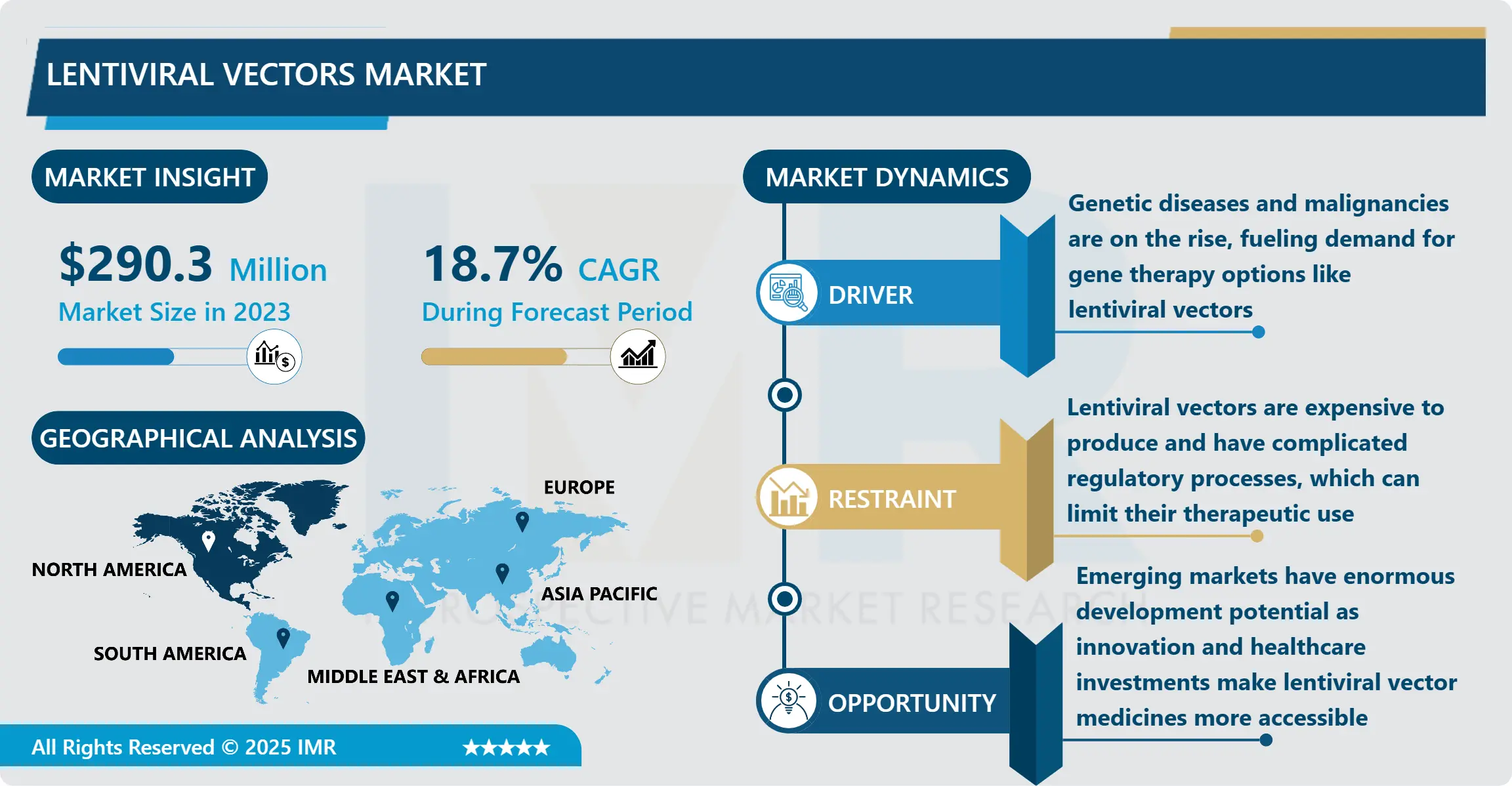
レンチウイルスベクター市場規模は2023年に2億9030万米ドルと評価され、2024年から2032年にかけて年平均成長率(CAGR)18.7%で成長し、2032年までに13億5800万米ドルに達すると予測されています。
レンチウイルスベクター市場は、遺伝子治療の進歩と、遺伝子研究および臨床応用における効率的な送達システムへの需要の高まりを背景に、近年著しい成長を遂げています。レンチウイルスに由来するレンチウイルスベクターは、宿主ゲノムに組み込まれ長期的な遺伝子発現を維持する能力により、遺伝子治療において特に有用である。この独自の特性により、遺伝性疾患、がん、その他の複雑な疾患の治療に広く採用されており、今後10年間で世界市場は大幅な年平均成長率(CAGR)で拡大すると予測されている。
レンチウイルスベクター市場の主要な推進要因の一つは、遺伝子治療および細胞治療に焦点を当てた臨床試験の増加である。これらのベクターは、がんに対するCAR-T細胞療法や、鎌状赤血球貧血や嚢胞性線維症などの遺伝性疾患の治療において有効性を示している。民間・公共セクター双方からの投資増加に伴い、製薬会社やバイオテクノロジー企業は研究努力を強化しており、生産能力の向上、ベクター設計の改善、製造コストの削減につながっている。遺伝子治療製品のパイプライン拡大は、特に規制環境が革新を促進する北米と欧州において、市場拡大に大きく寄与すると予想される。
しかしながら、大規模製造の複雑さや安全性・規制順守に関する懸念など、課題は依然として存在する。こうした課題にもかかわらず、新興市場や再生医療・ワクチン開発といった新たな応用分野において、レンチウイルスベクターの機会は拡大している。標的化能力の向上、免疫原性の低減、安全性プロファイルの強化を目的としたベクター設計の革新は、新たな成長の道を開くと期待されており、レンチウイルスベクター市場は遺伝子・細胞治療の将来における重要な構成要素として位置づけられるだろう。
レンチウイルスベクター市場動向分析:
遺伝子治療アプリケーションの採用増加
レンチウイルスベクター市場は、様々な遺伝性疾患やがんに対する遺伝子治療の採用増加に牽引され、顕著な成長傾向を示している。研究者や医療提供者が従来不治の病を治療する革新的療法の開発に注力するにつれ、レンチウイルスベクターのような効果的で信頼性の高い送達システムへの需要が高まっている。この傾向は、バイオテクノロジーの進歩と遺伝子治療製品の規制承認によって支えられ、市場の成長をさらに加速させている。
ベクター工学技術の進歩
レンチウイルスベクター市場におけるもう一つの注目すべき傾向は、ベクター工学技術の継続的な進歩である。CRISPRやその他の遺伝子編集ツールといった遺伝子改変技術の革新により、レンチウイルスベクターの有効性と安全性が向上している。こうした技術的進歩により、より標的を絞った効率的な治療戦略の開発が促進され、腫瘍学、神経学、血液学など様々な分野におけるレンチウイルスベクターの研究活動と臨床応用が増加している。
レンチウイルスベクター市場セグメント分析:
レンチウイルスベクター市場は、構成要素、タイプ、世代、ワークフロー、送達方法、疾患適応症、用途、エンドユーザー、地域に基づいてセグメント化されています。
構成要素別では、予測期間中にレンチウイルスプロモーターセグメントが市場を支配すると予想される
レンチウイルスベクター市場は、構成要素別にレンチウイルスのプロモーター、レンチウイルス融合タグ、レンチウイルスパッケージングシステム、その他の関連要素に分類できる。レンチウイルスのプロモーターは治療用遺伝子の発現を駆動する上で重要であり、遺伝子導入の有効性に大きな役割を果たす。レンチウイルス融合タグは、レンチウイルスベクターから発現したタンパク質の同定と精製を容易にし、それによって研究と治療成果を高める。レンチウイルス包装システムは、高力価レンチウイルスベクターの生産に不可欠であり、標的細胞における効率的な遺伝子導入と発現を保証する。その他の構成要素カテゴリーには、レンチウイルスベクターの開発と応用に必要となる様々な補助材料や試薬が含まれる。この区分は、遺伝子治療や分子研究における特注ソリューションへの需要の高まりを反映し、市場内の多様な応用と革新を浮き彫りにしている。
用途別では、遺伝子治療セグメントが最大のシェアを占めると予想される
レンチウイルスベクター市場は、遺伝子治療およびワクチン学における応用によって大きく影響を受けています。これらのベクターは、遺伝物質を細胞内に導入するための必須ツールとして機能します。遺伝子治療では、レンチウイルスベクターは、遺伝性疾患を修正したり、がんなどの疾患と闘うことができる治療用遺伝子を導入するために利用され、有望な治療選択肢を提供します。宿主ゲノムに組み込まれる能力により、目的の遺伝子の安定かつ長期的な発現が可能となり、治療効果を高めます。さらにワクチン学分野では、特に新興感染症やがん免疫療法において、革新的なワクチン送達システムとしてレンチウイルスベクターの研究が進められている。特定の抗原発現を促進することで強力な免疫応答を誘導できるため、次世代ワクチン開発における貴重な資産となっている。結果として、遺伝子治療とワクチン革新への関心の高まりがレンチウイルスベクターの需要を牽引し続け、研究と臨床応用における進展を促進している。
レンチウイルスベクター市場地域別分析:
予測期間において北米が市場を支配すると予想される
北米は、活発な研究開発活動、確立されたバイオテクノロジー産業、遺伝子治療イノベーションへの多額の投資が相まって、予測期間中にレンチウイルスベクター市場を支配すると予想される。同地域は、遺伝子治療研究の最先端を走る主要な学術機関や研究組織を有しており、レンチウイルスベクターのような先進的なデリバリーシステムへの需要を牽引している。さらに、政府機関や民間団体による支援的な規制枠組みや資金調達イニシアチブが、臨床試験やレンチウイルスベースの治療法の商業化を促進している。主要市場プレイヤーが北米に拠点を置くことも同地域の地位を強化しており、彼らは医療業界の増大するニーズに応えるため、最先端技術の開発と製品ラインの拡充に注力している。
レンチウイルスベクター市場における主要プレイヤー:
コブラ・バイオロジクス・リミテッド(英国)
シリオン・バイオテック社(ドイツ)
メルクKGaA(ドイツ)
フィンベクター社(フィンランド)
Oxford Biomedica(英国)
オリジーン・テクノロジーズ社(米国)
Sino Biological Inc.(中国)
セルバイオラボ社(米国)
Batavia Biosciences B.V.(オランダ)
ロンザ(スイス)
ジェンメディ(中国)
タカラバイオ株式会社(日本)
サーモフィッシャーサイエンティフィック社(米国)
ワイズマン・バイオマニュファクチャリング(米国)
サイトバ(米国)
その他の主要プレイヤー
第1章:はじめに
1.1 範囲と対象範囲
第2章:エグゼクティブサマリー
第3章:市場概況
3.1 市場動向
3.1.1 推進要因
3.1.2 抑制要因
3.1.3 機会
3.1.4 課題
3.2 市場動向分析
3.3 PESTLE分析
3.4 ポーターの5つの力分析
3.5 産業バリューチェーン分析
3.6 エコシステム
3.7 規制環境
3.8 価格動向分析
3.9 特許分析
3.10 技術進化
3.11 投資の集中領域
3.12 輸出入分析
第4章:レンチウイルスベクター市場(構成要素別)
4.1 レンチウイルスベクター市場の概況と成長エンジン
4.2 レンチウイルスベクター市場の概要
4.3 レンチウイルスプロモーター
4.3.1 概要と市場概況
4.3.2 過去および予測市場規模(金額:米ドル、数量:単位)(2017-2032F)
4.3.3 主要市場動向、成長要因および機会
4.3.4 レンチウイルスプロモーター:地域別セグメンテーション分析
4.4 レンチウイルス融合タグ
4.4.1 導入と市場概要
4.4.2 過去および予測市場規模(金額:米ドル、数量:単位)(2017-2032F)
4.4.3 主要市場動向、成長要因および機会
4.4.4 レンチウイルス融合タグ:地域別セグメンテーション分析
4.5 レンチウイルス包装システムおよびその他
4.5.1 導入と市場概要
4.5.2 過去および予測市場規模(金額:米ドル、数量:単位)(2017-2032F)
4.5.3 主要市場動向、成長要因および機会
4.5.4 レンチウイルス包装システムおよびその他:地域別セグメンテーション分析
第5章:タイプ別レンチウイルスベクター市場
5.1 レンチウイルスベクター市場の概況と成長エンジン
5.2 レンチウイルスベクター市場の概要
5.3 製品とサービス
5.3.1 概要と市場概観
5.3.2 過去および予測市場規模(金額ベース:米ドル、数量ベース:単位)(2017-2032F)
5.3.3 主要市場動向、成長要因および機会
5.3.4 製品・サービス:地域別セグメンテーション分析
第6章:世代別レンチウイルスベクター市場
6.1 レンチウイルスベクター市場の概況と成長エンジン
6.2 レンチウイルスベクター市場の概要
6.3 第4世代
6.3.1 概要と市場概況
6.3.2 過去および予測市場規模(金額:米ドル、数量:単位)(2017-2032F)
6.3.3 主要市場動向、成長要因および機会
6.3.4 第4世代:地域別セグメンテーション分析
6.4 第3世代
6.4.1 導入と市場概要
6.4.2 過去および予測市場規模(金額:米ドル、数量:単位)(2017-2032F)
6.4.3 主要市場動向、成長要因および機会
6.4.4 第3世代:地域別セグメンテーション分析
6.5 第2世代および第1世代
6.5.1 導入と市場概要
6.5.2 過去および予測市場規模(金額ベース:米ドル、数量ベース:単位)(2017-2032F)
6.5.3 主要市場動向、成長要因および機会
6.5.4 第2世代と第1世代:地域別セグメンテーション分析
第7章:ワークフロー別レンチウイルスベクター市場
7.1 レンチウイルスベクター市場の概況と成長エンジン
7.2 レンチウイルスベクター市場の概要
7.3 上流工程と下流工程
7.3.1 概要と市場概観
7.3.2 過去および予測市場規模(金額:米ドル、数量:単位)(2017-2032F)
7.3.3 主要市場動向、成長要因および機会
7.3.4 上流加工と下流加工:地域別セグメンテーション分析
第8章:送達方法別レンチウイルスベクター市場
8.1 レンチウイルスベクター市場の概況と成長エンジン
8.2 レンチウイルスベクター市場の概要
8.3 生体内および生体外
8.3.1 概要と市場概況
8.3.2 過去および予測市場規模(金額:米ドル、数量:単位)(2017-2032F)
8.3.3 主要市場動向、成長要因および機会
8.3.4 生体内(in vivo)と生体外(ex vivo):地域別セグメンテーション分析
第9章:疾患別レトロウイルスベクター市場
9.1 レンチウイルスベクター市場の概況と成長エンジン
9.2 レンチウイルスベクター市場の概要
9.3 がん
9.3.1 概要と市場概況
9.3.2 過去および予測市場規模(金額:米ドル、数量:単位)(2017-2032F)
9.3.3 主要市場動向、成長要因および機会
9.3.4 がん:地域別セグメンテーション分析
9.4 遺伝性疾患
9.4.1 概要と市場概観
9.4.2 過去および予測市場規模(金額:米ドル、数量:単位)(2017-2032F)
9.4.3 主要市場動向、成長要因および機会
9.4.4 遺伝性疾患:地域別セグメンテーション分析
9.5 感染症
9.5.1 概要と市場概観
9.5.2 過去および予測市場規模(金額:米ドル、数量:単位)(2017-2032F)
9.5.3 主要市場動向、成長要因および機会
9.5.4 感染症:地域別セグメンテーション分析
9.6 獣医学的疾患およびその他
9.6.1 導入と市場概要
9.6.2 過去及び予測市場規模(金額:米ドル、数量:単位)(2017-2032F)
9.6.3 主要市場動向、成長要因および機会
9.6.4 獣医学的疾患およびその他:地域別セグメンテーション分析
第10章:用途別レンチウイルスベクター市場
10.1 レンチウイルスベクター市場の概況と成長エンジン
10.2 レンチウイルスベクター市場の概要
10.3 遺伝子治療とワクチン学
10.3.1 概要と市場概観
10.3.2 過去および予測市場規模(金額:米ドル、数量:単位)(2017-2032F)
10.3.3 主要市場動向、成長要因および機会
10.3.4 遺伝子治療とワクチン学:地域別セグメンテーション分析
第11章:エンドユーザー別レンチウイルスベクター市場
11.1 レンチウイルスベクター市場の概況と成長エンジン
11.2 レンチウイルスベクター市場の概要
11.3 バイオテクノロジー企業
11.3.1 概要と市場概観
11.3.2 過去および予測市場規模(金額:米ドル、数量:単位)(2017-2032F)
11.3.3 主要市場動向、成長要因および機会
11.3.4 バイオテクノロジー企業:地域別セグメンテーション分析
11.4 製薬企業
11.4.1 概要と市場概観
11.4.2 過去および予測市場規模(金額ベース:米ドル、数量ベース:単位)(2017-2032F)
11.4.3 主要市場動向、成長要因および機会
11.4.4 製薬企業:地域別セグメンテーション分析
11.5 受託研究機関
11.5.1 概要と市場概観
11.5.2 過去および予測市場規模(金額:米ドル、数量:単位)(2017-2032F)
11.5.3 主要市場動向、成長要因および機会
11.5.4 受託研究機関(CRO):地域別セグメント分析
11.6 受託開発製造機関(CDMO)および学術・研究機関
11.6.1 概要と市場概観
11.6.2 過去および予測市場規模(金額:米ドル、数量:単位)(2017-2032F)
11.6.3 主要市場動向、成長要因および機会
11.6.4 受託開発製造機関(CDMO)および学術・研究機関:地域別セグメント分析
第12章:企業プロファイルと競争分析
12.1 競争環境
12.1.1 競合ベンチマーキング
12.1.2 製造業者別レンチウイルスベクター市場シェア(2023年)
12.1.3 業界BCGマトリックス
12.1.4 ヒートマップ分析
12.1.5 合併と買収
12.2 コブラ・バイオロジクス・リミテッド(英国)
12.2.1 会社概要
12.2.2 主要幹部
12.2.3 会社概要
12.2.4 市場における当社の役割
12.2.5 持続可能性と社会的責任
12.2.6 事業セグメント
12.2.7 製品ポートフォリオ
12.2.8 事業実績
12.2.9 主要な戦略的施策と最近の動向
12.2.10 SWOT分析
12.3 シリオン・バイオテック社(ドイツ)
12.4 メルク KGAA(ドイツ)
12.5 フィンベクター OY(フィンランド)
12.6 オックスフォード・バイオメディカ(英国)
12.7 オリジーン・テクノロジーズ社(米国)
12.8 シノ・バイオロジカル社(中国)
12.9 セル・バイオラボ社(米国)
12.10 バタビア・バイオサイエンシズ B.V.(オランダ)
12.11 ロンザ(スイス)
12.12 ジェンメディ(中国)
12.13 タカラバイオ株式会社(日本)
12.14 サーモフィッシャーサイエンティフィック社(米国)
12.15 ワイズマン・バイオマニュファクチャリング(米国)
12.16 CYTIVA(米国)
12.17 その他の主要プレイヤー
第13章:地域別グローバルレンチウイルスベクター市場
13.1 概要
13.2 北米レンチウイルスベクター市場
13.2.1 主要市場動向、成長要因および機会
13.2.2 主要企業
13.2.3 セグメント別 過去及び予測市場規模
13.2.4 構成要素別 過去及び予測市場規模
13.2.4.1 レンチウイルスプロモーター
13.2.4.2 レンチウイルス融合タグ
13.2.4.3 レンチウイルスパッケージングシステムおよびその他
13.2.5 タイプ別 過去及び予測市場規模
13.2.5.1 製品およびサービス
13.2.6 世代別 過去および予測市場規模
13.2.6.1 第4世代
13.2.6.2 第3世代
13.2.6.3 第2世代および第1世代
13.2.7 ワークフロー別 過去及び予測市場規模
13.2.7.1 上流処理と下流処理
13.2.8 配送方法別の過去および予測市場規模
13.2.8.1 生体内および生体外
13.2.9 疾患別市場規模(過去実績と予測)
13.2.9.1 がん
13.2.9.2 遺伝性疾患
13.2.9.3 感染症
13.2.9.4 獣医学的疾患およびその他
13.2.10 用途別 過去及び予測市場規模
13.2.10.1 遺伝子治療とワクチン学
13.2.11 エンドユーザー別 過去および予測市場規模
13.2.11.1 バイオテクノロジー企業
13.2.11.2 製薬会社
13.2.11.3 受託研究機関
13.2.11.4 開発製造受託機関(CDMO)および学術・研究機関
13.2.12 国別 過去及び予測市場規模
13.2.12.1 米国
13.2.12.2 カナダ
13.2.12.3 メキシコ
13.3. 東欧のレンチウイルスベクター市場
13.3.1 主要市場動向、成長要因および機会
13.3.2 主要企業
13.3.3 セグメント別 過去及び予測市場規模
13.3.4 構成要素別 過去及び予測市場規模
13.3.4.1 レンチウイルスプロモーター
13.3.4.2 レンチウイルス融合タグ
13.3.4.3 レンチウイルスパッケージングシステムおよびその他
13.3.5 タイプ別 過去及び予測市場規模
13.3.5.1 製品およびサービス
13.3.6 世代別 過去および予測市場規模
13.3.6.1 第4世代
13.3.6.2 第3世代
13.3.6.3 第2世代および第1世代
13.3.7 ワークフロー別 過去及び予測市場規模
13.3.7.1 上流処理と下流処理
13.3.8 配送方法別の過去および予測市場規模
13.3.8.1 生体内および生体外
13.3.9 疾患別市場規模(過去実績と予測)
13.3.9.1 がん
13.3.9.2 遺伝性疾患
13.3.9.3 感染症
13.3.9.4 獣医学的疾患およびその他
13.3.10 用途別 過去及び予測市場規模
13.3.10.1 遺伝子治療とワクチン学
13.3.11 エンドユーザー別 過去および予測市場規模
13.3.11.1 バイオテクノロジー企業
13.3.11.2 製薬会社
13.3.11.3 受託研究機関
13.3.11.4 受託開発製造機関(CDMO)および学術・研究機関
13.3.12 国別 過去及び予測市場規模
13.3.12.1 ロシア
13.3.12.2 ブルガリア
13.3.12.3 チェコ共和国
13.3.12.4 ハンガリー
13.3.12.5 ポーランド
13.3.12.6 ルーマニア
13.3.12.7 東欧その他
13.4. 西ヨーロッパのレンチウイルスベクター市場
13.4.1 主要市場動向、成長要因および機会
13.4.2 主要企業
13.4.3 セグメント別 過去及び予測市場規模
13.4.4 構成要素別 過去及び予測市場規模
13.4.4.1 レンチウイルスプロモーター
13.4.4.2 レンチウイルス融合タグ
13.4.4.3 レンチウイルスパッケージングシステムおよびその他
13.4.5 タイプ別 過去及び予測市場規模
13.4.5.1 製品およびサービス
13.4.6 世代別 過去および予測市場規模
13.4.6.1 第4世代
13.4.6.2 第3世代
13.4.6.3 第2世代および第1世代
13.4.7 ワークフロー別 過去及び予測市場規模
13.4.7.1 上流処理と下流処理
13.4.8 配送方法別の過去および予測市場規模
13.4.8.1 生体内および生体外
13.4.9 疾患別市場規模(過去実績と予測)
13.4.9.1 がん
13.4.9.2 遺伝性疾患
13.4.9.3 感染症
13.4.9.4 獣医学的疾患およびその他
13.4.10 用途別 過去及び予測市場規模
13.4.10.1 遺伝子治療とワクチン学
13.4.11 エンドユーザー別 過去および予測市場規模
13.4.11.1 バイオテクノロジー企業
13.4.11.2 製薬会社
13.4.11.3 受託研究機関
13.4.11.4 開発製造受託機関(CDMO)および学術・研究機関
13.4.12 国別 過去及び予測市場規模
13.4.12.1 ドイツ
13.4.12.2 イギリス
13.4.12.3 フランス
13.4.12.4 オランダ
13.4.12.5 イタリア
13.4.12.6 スペイン
13.4.12.7 西ヨーロッパその他
13.5. アジア太平洋地域レンチウイルスベクター市場
13.5.1 主要市場動向、成長要因および機会
13.5.2 主要企業
13.5.3 セグメント別 過去及び予測市場規模
13.5.4 構成要素別 過去及び予測市場規模
13.5.4.1 レンチウイルスプロモーター
13.5.4.2 レンチウイルス融合タグ
13.5.4.3 レンチウイルスパッケージングシステムおよびその他
13.5.5 タイプ別 過去及び予測市場規模
13.5.5.1 製品およびサービス
13.5.6 世代別 過去および予測市場規模
13.5.6.1 第4世代
13.5.6.2 第3世代
13.5.6.3 第2世代および第1世代
13.5.7 ワークフロー別 過去及び予測市場規模
13.5.7.1 上流処理と下流処理
13.5.8 配送方法別の過去および予測市場規模
13.5.8.1 生体内および生体外
13.5.9 疾患別市場規模(過去実績と予測)
13.5.9.1 がん
13.5.9.2 遺伝性疾患
13.5.9.3 感染症
13.5.9.4 獣医学的疾患およびその他
13.5.10 用途別 過去及び予測市場規模
13.5.10.1 遺伝子治療とワクチン学
13.5.11 エンドユーザー別 過去および予測市場規模
13.5.11.1 バイオテクノロジー企業
13.5.11.2 製薬会社
13.5.11.3 受託研究機関
13.5.11.4 受託開発製造機関(CDMO)および学術・研究機関
13.5.12 国別 過去及び予測市場規模
13.5.12.1 中国
13.5.12.2 インド
13.5.12.3 日本
13.5.12.4 韓国
13.5.12.5 マレーシア
13.5.12.6 タイ
13.5.12.7 ベトナム
13.5.12.8 フィリピン
13.5.12.9 オーストラリア
13.5.12.10 ニュージーランド
13.5.12.11 アジア太平洋地域その他
13.6. 中東・アフリカ レンチウイルスベクター市場
13.6.1 主要市場動向、成長要因および機会
13.6.2 主要企業
13.6.3 セグメント別 過去及び予測市場規模
13.6.4 構成要素別 過去及び予測市場規模
13.6.4.1 レンチウイルスプロモーター
13.6.4.2 レンチウイルス融合タグ
13.6.4.3 レンチウイルスパッケージングシステムおよびその他
13.6.5 タイプ別 過去及び予測市場規模
13.6.5.1 製品およびサービス
13.6.6 世代別 過去および予測市場規模
13.6.6.1 第4世代
13.6.6.2 第3世代
13.6.6.3 第2世代および第1世代
13.6.7 ワークフロー別 過去及び予測市場規模
13.6.7.1 上流処理と下流処理
13.6.8 配送方法別 過去および予測市場規模
13.6.8.1 生体内および生体外
13.6.9 疾患別市場規模(過去実績と予測)
13.6.9.1 がん
13.6.9.2 遺伝性疾患
13.6.9.3 感染症
13.6.9.4 獣医学的疾患およびその他
13.6.10 用途別 過去及び予測市場規模
13.6.10.1 遺伝子治療とワクチン学
13.6.11 エンドユーザー別 過去および予測市場規模
13.6.11.1 バイオテクノロジー企業
13.6.11.2 製薬会社
13.6.11.3 受託研究機関
13.6.11.4 受託開発製造機関(CDMO)および学術・研究機関
13.6.12 国別 過去及び予測市場規模
13.6.12.1 トルコ
13.6.12.2 バーレーン
13.6.12.3 クウェート
13.6.12.4 サウジアラビア
13.6.12.5 カタール
13.6.12.6 アラブ首長国連邦
13.6.12.7 イスラエル
13.6.12.8 南アフリカ
13.7. 南米のレンチウイルスベクター市場
13.7.1 主要市場動向、成長要因および機会
13.7.2 主要企業
13.7.3 セグメント別 過去及び予測市場規模
13.7.4 構成要素別 過去及び予測市場規模
13.7.4.1 レンチウイルスプロモーター
13.7.4.2 レンチウイルス融合タグ
13.7.4.3 レンチウイルスパッケージングシステムおよびその他
13.7.5 タイプ別 過去及び予測市場規模
13.7.5.1 製品およびサービス
13.7.6 世代別 過去および予測市場規模
13.7.6.1 第4世代
13.7.6.2 第3世代
13.7.6.3 第2世代および第1世代
13.7.7 ワークフロー別 過去及び予測市場規模
13.7.7.1 上流処理と下流処理
13.7.8 配送方法別の過去および予測市場規模
13.7.8.1 生体内および生体外
13.7.9 疾患別市場規模(過去実績と予測)
13.7.9.1 がん
13.7.9.2 遺伝性疾患
13.7.9.3 感染症
13.7.9.4 獣医学的疾患およびその他
13.7.10 用途別 過去及び予測市場規模
13.7.10.1 遺伝子治療とワクチン学
13.7.11 エンドユーザー別 過去および予測市場規模
13.7.11.1 バイオテクノロジー企業
13.7.11.2 製薬会社
13.7.11.3 受託研究機関
13.7.11.4 受託開発製造機関(CDMO)および学術・研究機関
13.7.12 国別 過去及び予測市場規模
13.7.12.1 ブラジル
13.7.12.2 アルゼンチン
13.7.12.3 南米その他
第14章 アナリストの見解と結論
14.1 提言と総括的分析
14.2 潜在的な市場戦略
第15章 研究方法論
15.1 研究プロセス
15.2 主要調査
15.3 二次調査
Q1: レンチウイルスベクター市場調査レポートにおける予測期間はどの程度ですか?
A1: レンチウイルスベクター市場調査レポートにおける予測期間は2024年から2032年です。
Q2: レンチウイルスベクター市場の主要プレイヤーは誰ですか?
A2: コブラ・バイオロジクス・リミテッド(英国)、シリオン・バイオテック社(ドイツ)、メルクKGaA(ドイツ)、フィンベクター社(フィンランド)、オックスフォード・バイオメディカ社(英国)、オリジーン・テクノロジーズ社(米国)、シノ・バイオロジカル社(中国)、セル・バイオラボ社(米国)、Batavia Biosciences B.V.(オランダ)、Lonza(スイス)、GENEMEDI(中国)、Takara Bio Inc.(日本)、Thermo Fisher Scientific Inc.(米国)、Waisman Biomanufacturing(米国)、Cytiva(米国)、その他主要企業。
Q3: レンチウイルスベクター市場のセグメントは?
A3: レンチウイルスベクター市場は、構成要素別、タイプ別、世代別、ワークフロー別、送達方法別、疾患適応症別、用途別、エンドユーザー別、地域別にセグメント化されています。構成要素別(レンチウイルスプロモーター、レンチウイルス融合タグ、レンチウイルスパッケージングシステム、その他)、タイプ別(製品とサービス)、世代別(第4世代、第3世代、第2世代、第1世代)、ワークフロー別(上流工程と下流工程)、デリバリー方法別(生体内と生体外)、疾患適応症(がん、遺伝性疾患、感染症、獣医学的疾患、その他)、用途(遺伝子治療、ワクチン学)、エンドユーザー(バイオテクノロジー企業、製薬企業、CRO、CDMO、学術/研究機関)地域別では、北米(米国、カナダ、メキシコ)、東欧(ロシア、ブルガリア、チェコ共和国、ハンガリー、ポーランド、ルーマニア、その他東欧)、西欧(ドイツ、英国、フランス、オランダ、イタリア、スペイン、西ヨーロッパその他)、アジア太平洋(中国、インド、日本、韓国、マレーシア、タイ、ベトナム、フィリピン、オーストラリア、ニュージーランド、アジア太平洋その他)、中東・アフリカ(トルコ、バーレーン、クウェート、サウジアラビア、カタール、UAE、イスラエル、南アフリカ)、南アメリカ(ブラジル、アルゼンチン、南アメリカその他)で分析されています。
Q4: レンチウイルスベクター市場とは何ですか?
A4: レンチウイルスベクターは、レンチウイルスに由来するウイルスベクターの一種です。レンチウイルスはレトロウイルスのサブグループであり、分裂細胞および非分裂細胞のゲノムに遺伝物質を安定的に組み込む能力で知られています。これらのベクターは、遺伝子治療、ワクチン開発、遺伝子組み換え生物の生産など、様々な用途向けに治療用遺伝子を送り込むよう設計されています。多様な細胞タイプへのトランスデューション能力とトランスジーンの長期発現という特性を有するため、遺伝性疾患、がん、その他の疾患の治療において特に有用です。改変型レンチウイルスを利用することで、研究者は安全性と有効性を向上させ、病原性のリスクを最小限に抑えながら標的遺伝子導入を実現できます。
Q5: レンチウイルスベクター市場の規模は?
A5: レンチウイルスベクター市場規模は2023年に2億9030万米ドルと評価され、2024年から2032年にかけて年平均成長率(CAGR)18.7%で成長し、2032年までに13億5800万米ドルに達すると予測されています。
Chapter 1: Introduction
1.1 Scope and Coverage
Chapter 2:Executive Summary
Chapter 3: Market Landscape
3.1 Market Dynamics
3.1.1 Drivers
3.1.2 Restraints
3.1.3 Opportunities
3.1.4 Challenges
3.2 Market Trend Analysis
3.3 PESTLE Analysis
3.4 Porter’s Five Forces Analysis
3.5 Industry Value Chain Analysis
3.6 Ecosystem
3.7 Regulatory Landscape
3.8 Price Trend Analysis
3.9 Patent Analysis
3.10 Technology Evolution
3.11 Investment Pockets
3.12 Import-Export Analysis
Chapter 4: Lentiviral Vectors Market by Component
4.1 Lentiviral Vectors Market Snapshot and Growth Engine
4.2 Lentiviral Vectors Market Overview
4.3 Lentiviral promoter
4.3.1 Introduction and Market Overview
4.3.2 Historic and Forecasted Market Size in Value USD and Volume Units (2017-2032F)
4.3.3 Key Market Trends, Growth Factors and Opportunities
4.3.4 Lentiviral promoter: Geographic Segmentation Analysis
4.4 Lentiviral fusion tags
4.4.1 Introduction and Market Overview
4.4.2 Historic and Forecasted Market Size in Value USD and Volume Units (2017-2032F)
4.4.3 Key Market Trends, Growth Factors and Opportunities
4.4.4 Lentiviral fusion tags: Geographic Segmentation Analysis
4.5 Lentivirus packaging systems and Other
4.5.1 Introduction and Market Overview
4.5.2 Historic and Forecasted Market Size in Value USD and Volume Units (2017-2032F)
4.5.3 Key Market Trends, Growth Factors and Opportunities
4.5.4 Lentivirus packaging systems and Other: Geographic Segmentation Analysis
Chapter 5: Lentiviral Vectors Market by Type
5.1 Lentiviral Vectors Market Snapshot and Growth Engine
5.2 Lentiviral Vectors Market Overview
5.3 Product and Services
5.3.1 Introduction and Market Overview
5.3.2 Historic and Forecasted Market Size in Value USD and Volume Units (2017-2032F)
5.3.3 Key Market Trends, Growth Factors and Opportunities
5.3.4 Product and Services: Geographic Segmentation Analysis
Chapter 6: Lentiviral Vectors Market by Generation
6.1 Lentiviral Vectors Market Snapshot and Growth Engine
6.2 Lentiviral Vectors Market Overview
6.3 4th-generation
6.3.1 Introduction and Market Overview
6.3.2 Historic and Forecasted Market Size in Value USD and Volume Units (2017-2032F)
6.3.3 Key Market Trends, Growth Factors and Opportunities
6.3.4 4th-generation: Geographic Segmentation Analysis
6.4 3rd-generation
6.4.1 Introduction and Market Overview
6.4.2 Historic and Forecasted Market Size in Value USD and Volume Units (2017-2032F)
6.4.3 Key Market Trends, Growth Factors and Opportunities
6.4.4 3rd-generation: Geographic Segmentation Analysis
6.5 2nd-generation and 1st-generation
6.5.1 Introduction and Market Overview
6.5.2 Historic and Forecasted Market Size in Value USD and Volume Units (2017-2032F)
6.5.3 Key Market Trends, Growth Factors and Opportunities
6.5.4 2nd-generation and 1st-generation: Geographic Segmentation Analysis
Chapter 7: Lentiviral Vectors Market by Workflow
7.1 Lentiviral Vectors Market Snapshot and Growth Engine
7.2 Lentiviral Vectors Market Overview
7.3 Upstream Processing And Downstream Processing
7.3.1 Introduction and Market Overview
7.3.2 Historic and Forecasted Market Size in Value USD and Volume Units (2017-2032F)
7.3.3 Key Market Trends, Growth Factors and Opportunities
7.3.4 Upstream Processing And Downstream Processing: Geographic Segmentation Analysis
Chapter 8: Lentiviral Vectors Market by Delivery Method
8.1 Lentiviral Vectors Market Snapshot and Growth Engine
8.2 Lentiviral Vectors Market Overview
8.3 In Vivo and Ex Vivo
8.3.1 Introduction and Market Overview
8.3.2 Historic and Forecasted Market Size in Value USD and Volume Units (2017-2032F)
8.3.3 Key Market Trends, Growth Factors and Opportunities
8.3.4 In Vivo and Ex Vivo: Geographic Segmentation Analysis
Chapter 9: Lentiviral Vectors Market by Disease Indication
9.1 Lentiviral Vectors Market Snapshot and Growth Engine
9.2 Lentiviral Vectors Market Overview
9.3 Cancer
9.3.1 Introduction and Market Overview
9.3.2 Historic and Forecasted Market Size in Value USD and Volume Units (2017-2032F)
9.3.3 Key Market Trends, Growth Factors and Opportunities
9.3.4 Cancer: Geographic Segmentation Analysis
9.4 Genetic Disorders
9.4.1 Introduction and Market Overview
9.4.2 Historic and Forecasted Market Size in Value USD and Volume Units (2017-2032F)
9.4.3 Key Market Trends, Growth Factors and Opportunities
9.4.4 Genetic Disorders: Geographic Segmentation Analysis
9.5 Infectious Diseases
9.5.1 Introduction and Market Overview
9.5.2 Historic and Forecasted Market Size in Value USD and Volume Units (2017-2032F)
9.5.3 Key Market Trends, Growth Factors and Opportunities
9.5.4 Infectious Diseases: Geographic Segmentation Analysis
9.6 Veterinary Disease And Other
9.6.1 Introduction and Market Overview
9.6.2 Historic and Forecasted Market Size in Value USD and Volume Units (2017-2032F)
9.6.3 Key Market Trends, Growth Factors and Opportunities
9.6.4 Veterinary Disease And Other: Geographic Segmentation Analysis
Chapter 10: Lentiviral Vectors Market by Application
10.1 Lentiviral Vectors Market Snapshot and Growth Engine
10.2 Lentiviral Vectors Market Overview
10.3 Gene Therapy And Vaccinology
10.3.1 Introduction and Market Overview
10.3.2 Historic and Forecasted Market Size in Value USD and Volume Units (2017-2032F)
10.3.3 Key Market Trends, Growth Factors and Opportunities
10.3.4 Gene Therapy And Vaccinology: Geographic Segmentation Analysis
Chapter 11: Lentiviral Vectors Market by End User
11.1 Lentiviral Vectors Market Snapshot and Growth Engine
11.2 Lentiviral Vectors Market Overview
11.3 Biotechnology Companies
11.3.1 Introduction and Market Overview
11.3.2 Historic and Forecasted Market Size in Value USD and Volume Units (2017-2032F)
11.3.3 Key Market Trends, Growth Factors and Opportunities
11.3.4 Biotechnology Companies: Geographic Segmentation Analysis
11.4 Pharmaceutical Companies
11.4.1 Introduction and Market Overview
11.4.2 Historic and Forecasted Market Size in Value USD and Volume Units (2017-2032F)
11.4.3 Key Market Trends, Growth Factors and Opportunities
11.4.4 Pharmaceutical Companies: Geographic Segmentation Analysis
11.5 Contract Research Organizations
11.5.1 Introduction and Market Overview
11.5.2 Historic and Forecasted Market Size in Value USD and Volume Units (2017-2032F)
11.5.3 Key Market Trends, Growth Factors and Opportunities
11.5.4 Contract Research Organizations: Geographic Segmentation Analysis
11.6 Contract Development and Manufacturing Organization (CDMO) and Academic/Research Institutes
11.6.1 Introduction and Market Overview
11.6.2 Historic and Forecasted Market Size in Value USD and Volume Units (2017-2032F)
11.6.3 Key Market Trends, Growth Factors and Opportunities
11.6.4 Contract Development and Manufacturing Organization (CDMO) and Academic/Research Institutes: Geographic Segmentation Analysis
Chapter 12: Company Profiles and Competitive Analysis
12.1 Competitive Landscape
12.1.1 Competitive Benchmarking
12.1.2 Lentiviral Vectors Market Share by Manufacturer (2023)
12.1.3 Industry BCG Matrix
12.1.4 Heat Map Analysis
12.1.5 Mergers and Acquisitions
12.2 COBRA BIOLOGICS LIMITED (U.K.)
12.2.1 Company Overview
12.2.2 Key Executives
12.2.3 Company Snapshot
12.2.4 Role of the Company in the Market
12.2.5 Sustainability and Social Responsibility
12.2.6 Operating Business Segments
12.2.7 Product Portfolio
12.2.8 Business Performance
12.2.9 Key Strategic Moves and Recent Developments
12.2.10 SWOT Analysis
12.3 SIRION-BIOTECH GMBH (GERMANY)
12.4 MERCK KGAA (GERMANY)
12.5 FINVECTOR OY (FINLAND)
12.6 OXFORD BIOMEDICA (U.K.)
12.7 ORIGENE TECHNOLOGIES INC. (U.S.)
12.8 SINO BIOLOGICAL INC. (CHINA)
12.9 CELL BIOLABS INC. (U.S.)
12.10 BATAVIA BIOSCIENCES B.V. (NETHERLANDS)
12.11 LONZA (SWITZERLAND)
12.12 GENEMEDI (CHINA)
12.13 TAKARA BIO INC. (JAPAN)
12.14 THERMO FISHER SCIENTIFIC INC. (U.S.)
12.15 WAISMAN BIOMANUFACTURING (U.S.)
12.16 CYTIVA (U.S.)
12.17 OTHER ACTIVE PLAYERS
Chapter 13: Global Lentiviral Vectors Market By Region
13.1 Overview
13.2. North America Lentiviral Vectors Market
13.2.1 Key Market Trends, Growth Factors and Opportunities
13.2.2 Top Key Companies
13.2.3 Historic and Forecasted Market Size by Segments
13.2.4 Historic and Forecasted Market Size By Component
13.2.4.1 Lentiviral promoter
13.2.4.2 Lentiviral fusion tags
13.2.4.3 Lentivirus packaging systems and Other
13.2.5 Historic and Forecasted Market Size By Type
13.2.5.1 Product and Services
13.2.6 Historic and Forecasted Market Size By Generation
13.2.6.1 4th-generation
13.2.6.2 3rd-generation
13.2.6.3 2nd-generation and 1st-generation
13.2.7 Historic and Forecasted Market Size By Workflow
13.2.7.1 Upstream Processing And Downstream Processing
13.2.8 Historic and Forecasted Market Size By Delivery Method
13.2.8.1 In Vivo and Ex Vivo
13.2.9 Historic and Forecasted Market Size By Disease Indication
13.2.9.1 Cancer
13.2.9.2 Genetic Disorders
13.2.9.3 Infectious Diseases
13.2.9.4 Veterinary Disease And Other
13.2.10 Historic and Forecasted Market Size By Application
13.2.10.1 Gene Therapy And Vaccinology
13.2.11 Historic and Forecasted Market Size By End User
13.2.11.1 Biotechnology Companies
13.2.11.2 Pharmaceutical Companies
13.2.11.3 Contract Research Organizations
13.2.11.4 Contract Development and Manufacturing Organization (CDMO) and Academic/Research Institutes
13.2.12 Historic and Forecast Market Size by Country
13.2.12.1 US
13.2.12.2 Canada
13.2.12.3 Mexico
13.3. Eastern Europe Lentiviral Vectors Market
13.3.1 Key Market Trends, Growth Factors and Opportunities
13.3.2 Top Key Companies
13.3.3 Historic and Forecasted Market Size by Segments
13.3.4 Historic and Forecasted Market Size By Component
13.3.4.1 Lentiviral promoter
13.3.4.2 Lentiviral fusion tags
13.3.4.3 Lentivirus packaging systems and Other
13.3.5 Historic and Forecasted Market Size By Type
13.3.5.1 Product and Services
13.3.6 Historic and Forecasted Market Size By Generation
13.3.6.1 4th-generation
13.3.6.2 3rd-generation
13.3.6.3 2nd-generation and 1st-generation
13.3.7 Historic and Forecasted Market Size By Workflow
13.3.7.1 Upstream Processing And Downstream Processing
13.3.8 Historic and Forecasted Market Size By Delivery Method
13.3.8.1 In Vivo and Ex Vivo
13.3.9 Historic and Forecasted Market Size By Disease Indication
13.3.9.1 Cancer
13.3.9.2 Genetic Disorders
13.3.9.3 Infectious Diseases
13.3.9.4 Veterinary Disease And Other
13.3.10 Historic and Forecasted Market Size By Application
13.3.10.1 Gene Therapy And Vaccinology
13.3.11 Historic and Forecasted Market Size By End User
13.3.11.1 Biotechnology Companies
13.3.11.2 Pharmaceutical Companies
13.3.11.3 Contract Research Organizations
13.3.11.4 Contract Development and Manufacturing Organization (CDMO) and Academic/Research Institutes
13.3.12 Historic and Forecast Market Size by Country
13.3.12.1 Russia
13.3.12.2 Bulgaria
13.3.12.3 The Czech Republic
13.3.12.4 Hungary
13.3.12.5 Poland
13.3.12.6 Romania
13.3.12.7 Rest of Eastern Europe
13.4. Western Europe Lentiviral Vectors Market
13.4.1 Key Market Trends, Growth Factors and Opportunities
13.4.2 Top Key Companies
13.4.3 Historic and Forecasted Market Size by Segments
13.4.4 Historic and Forecasted Market Size By Component
13.4.4.1 Lentiviral promoter
13.4.4.2 Lentiviral fusion tags
13.4.4.3 Lentivirus packaging systems and Other
13.4.5 Historic and Forecasted Market Size By Type
13.4.5.1 Product and Services
13.4.6 Historic and Forecasted Market Size By Generation
13.4.6.1 4th-generation
13.4.6.2 3rd-generation
13.4.6.3 2nd-generation and 1st-generation
13.4.7 Historic and Forecasted Market Size By Workflow
13.4.7.1 Upstream Processing And Downstream Processing
13.4.8 Historic and Forecasted Market Size By Delivery Method
13.4.8.1 In Vivo and Ex Vivo
13.4.9 Historic and Forecasted Market Size By Disease Indication
13.4.9.1 Cancer
13.4.9.2 Genetic Disorders
13.4.9.3 Infectious Diseases
13.4.9.4 Veterinary Disease And Other
13.4.10 Historic and Forecasted Market Size By Application
13.4.10.1 Gene Therapy And Vaccinology
13.4.11 Historic and Forecasted Market Size By End User
13.4.11.1 Biotechnology Companies
13.4.11.2 Pharmaceutical Companies
13.4.11.3 Contract Research Organizations
13.4.11.4 Contract Development and Manufacturing Organization (CDMO) and Academic/Research Institutes
13.4.12 Historic and Forecast Market Size by Country
13.4.12.1 Germany
13.4.12.2 UK
13.4.12.3 France
13.4.12.4 The Netherlands
13.4.12.5 Italy
13.4.12.6 Spain
13.4.12.7 Rest of Western Europe
13.5. Asia Pacific Lentiviral Vectors Market
13.5.1 Key Market Trends, Growth Factors and Opportunities
13.5.2 Top Key Companies
13.5.3 Historic and Forecasted Market Size by Segments
13.5.4 Historic and Forecasted Market Size By Component
13.5.4.1 Lentiviral promoter
13.5.4.2 Lentiviral fusion tags
13.5.4.3 Lentivirus packaging systems and Other
13.5.5 Historic and Forecasted Market Size By Type
13.5.5.1 Product and Services
13.5.6 Historic and Forecasted Market Size By Generation
13.5.6.1 4th-generation
13.5.6.2 3rd-generation
13.5.6.3 2nd-generation and 1st-generation
13.5.7 Historic and Forecasted Market Size By Workflow
13.5.7.1 Upstream Processing And Downstream Processing
13.5.8 Historic and Forecasted Market Size By Delivery Method
13.5.8.1 In Vivo and Ex Vivo
13.5.9 Historic and Forecasted Market Size By Disease Indication
13.5.9.1 Cancer
13.5.9.2 Genetic Disorders
13.5.9.3 Infectious Diseases
13.5.9.4 Veterinary Disease And Other
13.5.10 Historic and Forecasted Market Size By Application
13.5.10.1 Gene Therapy And Vaccinology
13.5.11 Historic and Forecasted Market Size By End User
13.5.11.1 Biotechnology Companies
13.5.11.2 Pharmaceutical Companies
13.5.11.3 Contract Research Organizations
13.5.11.4 Contract Development and Manufacturing Organization (CDMO) and Academic/Research Institutes
13.5.12 Historic and Forecast Market Size by Country
13.5.12.1 China
13.5.12.2 India
13.5.12.3 Japan
13.5.12.4 South Korea
13.5.12.5 Malaysia
13.5.12.6 Thailand
13.5.12.7 Vietnam
13.5.12.8 The Philippines
13.5.12.9 Australia
13.5.12.10 New Zealand
13.5.12.11 Rest of APAC
13.6. Middle East & Africa Lentiviral Vectors Market
13.6.1 Key Market Trends, Growth Factors and Opportunities
13.6.2 Top Key Companies
13.6.3 Historic and Forecasted Market Size by Segments
13.6.4 Historic and Forecasted Market Size By Component
13.6.4.1 Lentiviral promoter
13.6.4.2 Lentiviral fusion tags
13.6.4.3 Lentivirus packaging systems and Other
13.6.5 Historic and Forecasted Market Size By Type
13.6.5.1 Product and Services
13.6.6 Historic and Forecasted Market Size By Generation
13.6.6.1 4th-generation
13.6.6.2 3rd-generation
13.6.6.3 2nd-generation and 1st-generation
13.6.7 Historic and Forecasted Market Size By Workflow
13.6.7.1 Upstream Processing And Downstream Processing
13.6.8 Historic and Forecasted Market Size By Delivery Method
13.6.8.1 In Vivo and Ex Vivo
13.6.9 Historic and Forecasted Market Size By Disease Indication
13.6.9.1 Cancer
13.6.9.2 Genetic Disorders
13.6.9.3 Infectious Diseases
13.6.9.4 Veterinary Disease And Other
13.6.10 Historic and Forecasted Market Size By Application
13.6.10.1 Gene Therapy And Vaccinology
13.6.11 Historic and Forecasted Market Size By End User
13.6.11.1 Biotechnology Companies
13.6.11.2 Pharmaceutical Companies
13.6.11.3 Contract Research Organizations
13.6.11.4 Contract Development and Manufacturing Organization (CDMO) and Academic/Research Institutes
13.6.12 Historic and Forecast Market Size by Country
13.6.12.1 Turkiye
13.6.12.2 Bahrain
13.6.12.3 Kuwait
13.6.12.4 Saudi Arabia
13.6.12.5 Qatar
13.6.12.6 UAE
13.6.12.7 Israel
13.6.12.8 South Africa
13.7. South America Lentiviral Vectors Market
13.7.1 Key Market Trends, Growth Factors and Opportunities
13.7.2 Top Key Companies
13.7.3 Historic and Forecasted Market Size by Segments
13.7.4 Historic and Forecasted Market Size By Component
13.7.4.1 Lentiviral promoter
13.7.4.2 Lentiviral fusion tags
13.7.4.3 Lentivirus packaging systems and Other
13.7.5 Historic and Forecasted Market Size By Type
13.7.5.1 Product and Services
13.7.6 Historic and Forecasted Market Size By Generation
13.7.6.1 4th-generation
13.7.6.2 3rd-generation
13.7.6.3 2nd-generation and 1st-generation
13.7.7 Historic and Forecasted Market Size By Workflow
13.7.7.1 Upstream Processing And Downstream Processing
13.7.8 Historic and Forecasted Market Size By Delivery Method
13.7.8.1 In Vivo and Ex Vivo
13.7.9 Historic and Forecasted Market Size By Disease Indication
13.7.9.1 Cancer
13.7.9.2 Genetic Disorders
13.7.9.3 Infectious Diseases
13.7.9.4 Veterinary Disease And Other
13.7.10 Historic and Forecasted Market Size By Application
13.7.10.1 Gene Therapy And Vaccinology
13.7.11 Historic and Forecasted Market Size By End User
13.7.11.1 Biotechnology Companies
13.7.11.2 Pharmaceutical Companies
13.7.11.3 Contract Research Organizations
13.7.11.4 Contract Development and Manufacturing Organization (CDMO) and Academic/Research Institutes
13.7.12 Historic and Forecast Market Size by Country
13.7.12.1 Brazil
13.7.12.2 Argentina
13.7.12.3 Rest of SA
Chapter 14 Analyst Viewpoint and Conclusion
14.1 Recommendations and Concluding Analysis
14.2 Potential Market Strategies
Chapter 15 Research Methodology
15.1 Research Process
15.2 Primary Research
15.3 Secondary Research
Megatrends.jpからレポートを購入する方法
製品ページで、ご希望のライセンスを選択してください:シングルユーザーライセンス または エンタープライズライセンス。
レポートの言語を選択してください:
- 英語レポート
- 英語レポート+日本語訳
今すぐ購入ボタンをクリックしてください。
チェックアウトページにリダイレクトされます。会社情報と支払い情報を入力してください。
注文を確定をクリックして購入を完了してください。
確認: ご注文確認メールをお送りします。その後、当社チームがレポートの納品についてご連絡いたします。
ご質問がある場合は、以下の問い合わせフォームにご記入いただくか、メールでお問い合わせください。 sales1@megatrends.jp.
Megatrends.jpをお選びいただき、誠にありがとうございます!
関連レポート