24時間365日サポート — いつでもお客様をサポートいたします。
お問い合わせ
インビトロ毒性試験市場 – 最新の進歩と将来の動向(2024-2032)
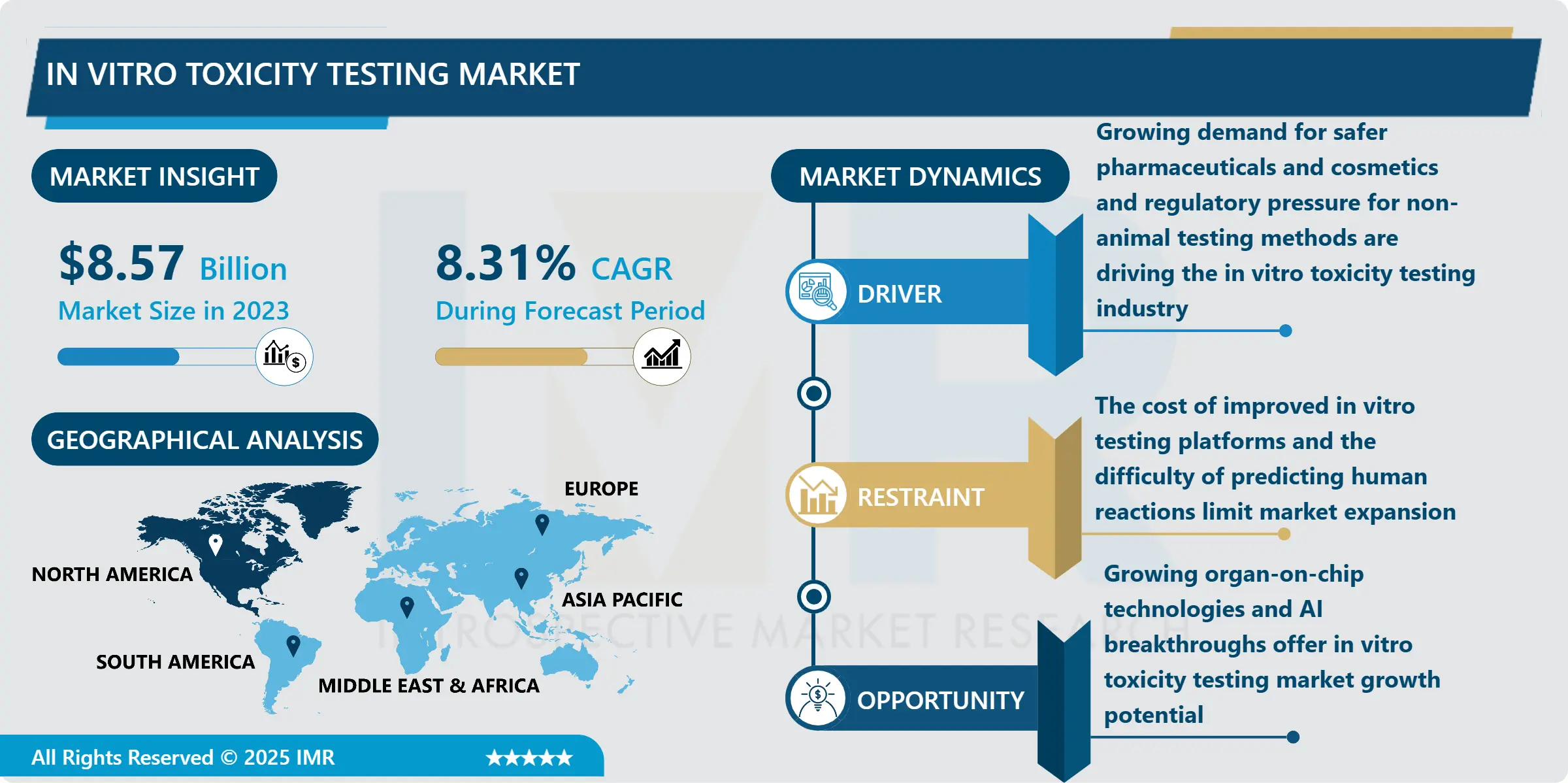
2023年のin vitro毒性試験市場規模は85億7000万米ドルと評価され、2024年から2032年にかけて年平均成長率(CAGR)8.31%で成長し、2032年までに175億8000万米ドルに達すると予測されています。

IMR
説明
試験管内毒性試験市場概要:
2023年のin vitro毒性試験市場規模は85億7,000万米ドルと評価され、2024年から2032年にかけて年平均成長率(CAGR)8.31%で成長し、2032年までに175億8,000万米ドルに達すると予測される
in vitro毒性試験市場とは、化学物質、医薬品、環境物質などの毒性を評価するために、生きた動物を使用せずに実験室ベースの試験を用いることを指します。この市場は、より倫理的で費用対効果が高く、規制ガイドラインに準拠した代替試験方法への需要が高まっていることから、大きな注目を集めています。in vitro試験は、製品が市場に投入される前にその安全性と有効性を評価するため、製薬、化粧品、化学産業でますます採用されています。
in vitro毒性試験市場の主要な推進要因は、動物実験の削減を重視する規制枠組みへの移行が進んでいることです。REACH(化学物質の登録、評価、認可、制限)などの国際規制やその他の安全性評価ガイドラインは、業界に非動物試験法の採用を義務付けています。in vitro試験は化学物質や医薬品の安全性プロファイルをより正確かつ効率的に予測することを可能にし、製品開発の信頼性を高めます。
さらに、細胞ベースアッセイ、マイクロ流体デバイス、臓器オンチップモデルなどの技術進歩が、in vitro毒性試験市場の拡大に大きく貢献している。これらの革新により、より正確で高スループットな試験が可能となり、低コスト化、迅速な結果取得、ヒト反応に対する予測精度の向上が実現している。様々な分野でこうした先進的試験手法への需要が拡大し続ける中、in vitro毒性試験市場は今後数年にわたり持続的な成長が見込まれる。
試験管内毒性試験市場の動向分析:
3D細胞培養および臓器オンチップモデルの採用増加
in vitro毒性試験市場を牽引する重要なトレンドの一つは、3D細胞培養および臓器オンチップモデルの活用拡大である。これらの技術は従来の2D細胞培養よりも生体内環境を正確に模倣し、物質がヒト組織に及ぼす潜在的な毒性作用の理解を深める。3D細胞培養と臓器オンチッププラットフォームはより現実的な毒性評価を可能とし、医薬品開発や安全性試験において普及が進んでいる。これらの技術が進化を続けるにつれ、予測精度が向上し、動物実験の必要性を低減できるため、規制基準や倫理基準との整合性がさらに高まっています。
毒性予測のための人工知能(AI)と機械学習の統合
in vitro毒性試験市場におけるもう一つの新たな潮流は、毒性結果を予測するための人工知能(AI)と機械学習(ML)の統合である。AIとMLアルゴリズムはin vitro試験からの大規模なデータセットを分析でき、毒性評価の速度と精度を向上させる。これらの技術は、分子構造に基づいて化学物質や医薬品の毒性学的影響を特定し予測するのに役立ち、より効率的なリスク評価を提供する。AIとMLの活用は試験プロセスの加速化だけでなく、より堅牢な予測モデルの開発を支援し、医薬品、化粧品、化学品などの産業における安全な製品開発に貢献している。
in vitro毒性試験市場セグメント分析:
製品・サービス、毒性エンドポイントと試験、技術、方法、産業、流通チャネル、地域に基づくin vitro毒性試験市場のセグメント化
製品・サービス別では、予測期間中に消耗品セグメントが市場を支配すると予想される
in vitro毒性試験市場は、製品・サービス別に消耗品、サービス、アッセイ、機器、ソフトウェアに分類される。消耗品には、毒性試験の実施に不可欠な試薬、培養培地、実験室用品が含まれる。サービスは、受託研究機関(CRO)やその他のプロバイダーが提供する試験・コンサルティングサービスで構成される。アッセイは細胞培養に対する物質の毒性効果を評価する標準化された試験であり、機器には自動化細胞培養システム、毒性試験キット、分析ツールなどの専用装置が含まれる。ソフトウェアはデータ解析において重要な役割を果たし、毒性結果の予測と解釈を強化する計算モデルやデータベースを提供する。試験手法の進歩、より安全な製品への需要増加、動物実験代替を促進する規制変更に牽引され、これらの各セグメントが市場の成長に寄与している。
流通チャネル別では、直接入札セグメントが最大のシェアを占めると予想される
体外毒性試験市場における流通チャネルは、主に直接入札、小売販売、その他に分類される。直接入札は、研究機関、製薬会社、規制当局に対して試験サービスや製品を直接販売する形態であり、契約に基づく取引が一般的である。このチャネルは、大規模研究や医薬品開発プログラム向けに安定的かつターゲットを絞った供給を保証する。小売販売は、研究所や診療所などの小規模な個別顧客を対象とし、既製の毒性試験キットや機器を提供します。さらに、その他の流通チャネルには、オンライン販売、販売代理店との提携、契約研究機関(CRO)との協業が含まれ、化粧品、化学品、バイオテクノロジーなど様々な分野にin vitro毒性試験ソリューションの普及範囲を拡大しています。これらの多様な流通チャネルにより、企業は市場の異なるセグメントに参入し、特定の顧客ニーズに対応することが可能となります。
in vitro毒性試験市場の地域別分析:
予測期間において北米が市場を支配すると予想される
北米は、製薬、バイオテクノロジー、化学産業における先進的な試験手法への需要増加を背景に、予測期間においてin vitro毒性試験市場を支配すると予想される。同地域の堅固な医療インフラ、高い研究開発活動水準、代替試験手法に対する規制面の支援が、市場リーダーシップを支える主要因である。さらに、3D細胞培養、臓器オンチップモデル、AI駆動型予測ツールなどの先進技術の採用拡大が、北米における市場成長をさらに加速させている。主要企業の存在と動物実験削減を推進する政府の取り組みも、同地域のグローバル市場における地位を強化している。
in vitro毒性試験市場における主要企業:
チャールズリバーラボラトリーズ(米国)、
コバンス(米国)、
サーモフィッシャーサイエンティフィック(米国)、
ユーロフィン・サイエンティフィック(ルクセンブルク)、
SGS SA(スイス)、
メルクKGaA(ドイツ)、
サイプロテックス(英国)、
プロメガ・コーポレーション(米国)、
ジェントロニクス・リミテッド(英国)、
バイオリライアンス・コーポレーション(米国)
その他の主要プレイヤー
第1章:はじめに
1.1 範囲と対象範囲
第2章:エグゼクティブサマリー
第3章:市場概況
3.1 市場動向
3.1.1 推進要因
3.1.2 抑制要因
3.1.3 機会
3.1.4 課題
3.2 市場動向分析
3.3 PESTLE分析
3.4 ポーターの5つの力分析
3.5 産業バリューチェーン分析
3.6 エコシステム
3.7 規制環境
3.8 価格動向分析
3.9 特許分析
3.10 技術進化
3.11 投資の集中領域
3.12 輸出入分析
第4章:製品・サービス別インビトロ毒性試験市場
4.1 試験管内毒性試験市場の概況と成長エンジン
4.2 試験管内毒性試験市場の概要
4.3 消耗品
4.3.1 概要と市場概況
4.3.2 過去および予測市場規模(金額:米ドル、数量:単位)(2017-2032F)
4.3.3 主要市場動向、成長要因および機会
4.3.4 消耗品:地域別セグメンテーション分析
4.4 サービス
4.4.1 導入と市場概要
4.4.2 過去および予測市場規模(金額:米ドル、数量:単位)(2017-2032F)
4.4.3 主要市場動向、成長要因および機会
4.4.4 サービス:地域別セグメンテーション分析
4.5 アッセイ
4.5.1 導入と市場概要
4.5.2 過去および予測市場規模(金額:米ドル、数量:単位)(2017-2032F)
4.5.3 主要市場動向、成長要因および機会
4.5.4 アッセイ:地域別セグメンテーション分析
4.6 機器
4.6.1 導入と市場概要
4.6.2 過去および予測市場規模(金額:米ドル、数量:単位)(2017-2032F)
4.6.3 主要市場動向、成長要因および機会
4.6.4 機器:地域別セグメンテーション分析
4.7 およびソフトウェア
4.7.1 導入と市場概要
4.7.2 過去および予測市場規模(金額ベース:米ドル、数量ベース:単位)(2017-2032F)
4.7.3 主要市場動向、成長要因および機会
4.7.4 ソフトウェア:地域別セグメンテーション分析
第5章:毒性学エンドポイントおよび試験法別インビトロ毒性試験市場
5.1 試験管内毒性試験市場の概況と成長エンジン
5.2 試験管内毒性試験市場の概要
5.3 ADME(吸収
5.3.1 概要と市場概況
5.3.2 過去および予測市場規模(金額:米ドル、数量:単位)(2017-2032F)
5.3.3 主要市場動向、成長要因および機会
5.3.4 ADME(吸収・分布・代謝・排泄)分析:地域別セグメンテーション分析
5.4 流通
5.4.1 はじめにおよび市場概要
5.4.2 過去および予測市場規模(金額:米ドル、数量:単位)(2017-2032F)
5.4.3 主要な市場動向、成長要因および機会
5.4.4 流通:地域別セグメンテーション分析
5.5 代謝
5.5.1 導入と市場概要
5.5.2 過去および予測市場規模(金額:米ドル、数量:単位)(2017-2032F)
5.5.3 主要な市場動向、成長要因および機会
5.5.4 市場セグメンテーション分析:地域別
5.6 & 排泄)試験
5.6.1 導入と市場概要
5.6.2 過去および予測市場規模(金額:米ドル、数量:単位)(2017-2032F)
5.6.3 主要な市場動向、成長要因および機会
5.6.4 排泄物検査:地域別セグメンテーション分析
5.7 細胞毒性試験
5.7.1 導入と市場概要
5.7.2 過去および予測市場規模(金額:米ドル、数量:単位)(2017-2032F)
5.7.3 主要市場動向、成長要因および機会
5.7.4 細胞毒性試験:地域別セグメンテーション分析
5.8 遺伝毒性試験
5.8.1 導入と市場概要
5.8.2 過去および予測市場規模(金額:米ドル、数量:単位)(2017-2032F)
5.8.3 主要市場動向、成長要因および機会
5.8.4 遺伝毒性試験:地域別セグメンテーション分析
5.9 皮膚毒性試験
5.9.1 導入と市場概要
5.9.2 過去および予測市場規模(金額:米ドル、数量:単位)(2017-2032F)
5.9.3 主要な市場動向、成長要因および機会
5.9.4 皮膚毒性試験:地域別セグメンテーション分析
5.10 眼毒性試験
5.10.1 導入と市場概要
5.10.2 過去および予測市場規模(金額:米ドル、数量:単位)(2017-2032F)
5.10.3 主要な市場動向、成長要因および機会
5.10.4 眼毒性試験:地域別セグメンテーション分析
5.11 臓器毒性試験
5.11.1 導入と市場概要
5.11.2 過去および予測市場規模(金額:米ドル、数量:単位)(2017-2032F)
5.11.3 主要市場動向、成長要因および機会
5.11.4 臓器毒性試験:地域別セグメンテーション分析
5.12 皮膚刺激性
5.12.1 導入と市場概要
5.12.2 過去および予測市場規模(金額:米ドル、数量:単位)(2017-2032F)
5.12.3 主要市場動向、成長要因および機会
5.12.4 皮膚刺激:地域別セグメンテーション分析
5.13 腐食
5.13.1 導入と市場概要
5.13.2 過去および予測市場規模(金額:米ドル、数量:単位)(2017-2032F)
5.13.3 主要市場動向、成長要因および機会
5.13.4 腐食:地域別セグメンテーション分析
5.14 & 感作性試験
5.14.1 導入と市場概要
5.14.2 過去および予測市場規模(金額:米ドル、数量:単位)(2017-2032F)
5.14.3 主要な市場動向、成長要因および機会
5.14.4 感作性試験:地域別セグメンテーション分析
5.15 光毒性試験
5.15.1 導入と市場概観
5.15.2 過去および予測市場規模(金額:米ドル、数量:単位)(2017-2032F)
5.15.3 主要市場動向、成長要因および機会
5.15.4 光毒性試験:地域別セグメンテーション分析
5.16 その他の毒性エンドポイント及び試験
5.16.1 導入と市場概要
5.16.2 過去および予測市場規模(金額:米ドル、数量:単位)(2017-2032F)
5.16.3 主要な市場動向、成長要因および機会
5.16.4 その他の毒性エンドポイント及び試験:地域別セグメンテーション分析
第6章:技術別インビトロ毒性試験市場
6.1 試験管内毒性試験市場の概況と成長エンジン
6.2 試験管内毒性試験市場の概要
6.3 細胞培養技術
6.3.1 概要と市場概況
6.3.2 過去および予測市場規模(金額:米ドル、数量:単位)(2017-2032F)
6.3.3 主要市場動向、成長要因および機会
6.3.4 細胞培養技術:地域別セグメンテーション分析
6.4 ハイスループット技術
6.4.1 概要と市場概観
6.4.2 過去および予測市場規模(金額:米ドル、数量:単位)(2017-2032F)
6.4.3 主要市場動向、成長要因および機会
6.4.4 高スループット技術:地域別セグメンテーション分析
6.5 分子イメージング
6.5.1 導入と市場概要
6.5.2 過去および予測市場規模(金額:米ドル、数量:単位)(2017-2032F)
6.5.3 主要な市場動向、成長要因および機会
6.5.4 分子イメージング:地域別セグメンテーション分析
6.6 およびオミクス技術
6.6.1 概要と市場概観
6.6.2 過去および予測市場規模(金額:米ドル、数量:単位)(2017-2032F)
6.6.3 主要市場動向、成長要因および機会
6.6.4 オミクス技術:地域別セグメンテーション分析
第7章:方法別インビトロ毒性試験市場
7.1 試験管内毒性試験市場の概況と成長エンジン
7.2 試験管内毒性試験市場の概要
7.3 細胞アッセイ
7.3.1 概要と市場概況
7.3.2 過去および予測市場規模(金額:米ドル、数量:単位)(2017-2032F)
7.3.3 主要市場動向、成長要因および機会
7.3.4 細胞アッセイ:地域別セグメンテーション分析
7.4 生化学的アッセイ
7.4.1 導入と市場概要
7.4.2 過去および予測市場規模(金額:米ドル、数量:単位)(2017-2032F)
7.4.3 主要市場動向、成長要因および機会
7.4.4 生化学的アッセイ:地域別セグメンテーション分析
7.5 体外モデル
7.5.1 導入と市場概要
7.5.2 過去および予測市場規模(金額:米ドル、数量:単位)(2017-2032F)
7.5.3 主要市場動向、成長要因および機会
7.5.4 体外モデル:地域別セグメンテーション分析
7.6 インシリコモデル
7.6.1 導入と市場概要
7.6.2 過去および予測市場規模(金額:米ドル、数量:単位)(2017-2032F)
7.6.3 主要な市場動向、成長要因および機会
7.6.4 インシリコモデル:地域別セグメンテーション分析
第8章:業界別インビトロ毒性試験市場
8.1 試験管内毒性試験市場の概況と成長エンジン
8.2 試験管内毒性試験市場の概要
8.3 製薬・バイオ医薬品企業
8.3.1 概要と市場概観
8.3.2 過去および予測市場規模(金額:米ドル、数量:単位)(2017-2032F)
8.3.3 主要市場動向、成長要因および機会
8.3.4 製薬・バイオ医薬品企業:地域別セグメンテーション分析
8.4 診断
8.4.1 導入と市場概要
8.4.2 過去および予測市場規模(金額:米ドル、数量:単位)(2017-2032F)
8.4.3 主要市場動向、成長要因および機会
8.4.4 診断:地域別セグメンテーション分析
8.5 食品
8.5.1 導入と市場概要
8.5.2 過去および予測市場規模(金額:米ドル、数量:単位)(2017-2032F)
8.5.3 主要市場動向、成長要因および機会
8.5.4 食品:地域別セグメンテーション分析
8.6 化学品
8.6.1 導入と市場概要
8.6.2 過去および予測市場規模(金額:米ドル、数量:単位)(2017-2032F)
8.6.3 主要な市場動向、成長要因および機会
8.6.4 化学品:地域別セグメンテーション分析
8.7 化粧品・家庭用品
8.7.1 はじめにおよび市場概要
8.7.2 過去および予測市場規模(金額ベース:米ドル、数量ベース)(2017-2032F)
8.7.3 主要な市場動向、成長要因および機会
8.7.4 化粧品・家庭用品:地域別セグメント分析
第9章:流通チャネル別インビトロ毒性試験市場
9.1 試験管内毒性試験市場の概況と成長エンジン
9.2 試験管内毒性試験市場の概要
9.3 直接入札
9.3.1 概要と市場概観
9.3.2 過去および予測市場規模(金額:米ドル、数量:単位)(2017-2032F)
9.3.3 主要市場動向、成長要因および機会
9.3.4 直接入札:地域別セグメンテーション分析
9.4 小売売上高
9.4.1 はじめにおよび市場概要
9.4.2 過去及び予測市場規模(金額ベース/数量ベース、2017-2032F)
9.4.3 主要市場動向、成長要因および機会
9.4.4 小売売上高:地域別セグメンテーション分析
9.5 その他
9.5.1 はじめにおよび市場概要
9.5.2 過去および予測市場規模(金額:米ドル、数量:単位)(2017-2032F)
9.5.3 主要な市場動向、成長要因および機会
9.5.4 その他:地域別セグメンテーション分析
第10章:企業プロファイルと競合分析
10.1 競争環境
10.1.1 競合ベンチマーキング
10.1.2 メーカー別インビトロ毒性試験市場シェア(2023年)
10.1.3 業界BCGマトリックス
10.1.4 ヒートマップ分析
10.1.5 合併と買収
10.2 チャールズ・リバー・ラボラトリーズ(米国)
10.2.1 会社概要
10.2.2 主要幹部
10.2.3 会社概要
10.2.4 市場における当社の役割
10.2.5 持続可能性と社会的責任
10.2.6 事業セグメント
10.2.7 製品ポートフォリオ
10.2.8 事業実績
10.2.9 主要な戦略的施策と最近の動向
10.2.10 SWOT分析
10.3 コバンス(米国)
10.4 サーモフィッシャーサイエンティフィック(米国)
10.5 ユーロフィンズ・サイエンティフィック(ルクセンブルク)
10.6 SGS SA(スイス)
10.7 メルク KGAA(ドイツ)
10.8 サイプロテックス(英国)
10.9 プロメガ・コーポレーション(アメリカ)
10.10 ジェントロニクス・リミテッド(英国)
10.11 バイオリライアンス社(米国)
10.12 その他の主要プレイヤー
第11章:地域別グローバル体外毒性試験市場
11.1 概要
11.2 北米におけるin vitro毒性試験市場
11.2.1 主要市場動向、成長要因および機会
11.2.2 主要企業
11.2.3 セグメント別 過去及び予測市場規模
11.2.4 製品・サービス別 過去及び予測市場規模
11.2.4.1 消耗品
11.2.4.2 サービス
11.2.4.3 分析
11.2.4.4 装置
11.2.4.5 およびソフトウェア
11.2.5 毒性学エンドポイントおよび試験法別の過去および予測市場規模
11.2.5.1 ADME(吸収
11.2.5.2 分布
11.2.5.3 代謝
11.2.5.4 及び排泄)試験
11.2.5.5 細胞毒性試験
11.2.5.6 遺伝毒性試験
11.2.5.7 皮膚毒性試験
11.2.5.8 眼毒性試験
11.2.5.9 臓器毒性試験
11.2.5.10 皮膚刺激性
11.2.5.11 腐食
11.2.5.12 及び感作性試験
11.2.5.13 光毒性試験
11.2.5.14 その他の毒性エンドポイント及び試験
11.2.6 技術別 過去及び予測市場規模
11.2.6.1 細胞培養技術
11.2.6.2 ハイスループット技術
11.2.6.3 分子イメージング
11.2.6.4 およびオミクス技術
11.2.7 方法別 過去及び予測市場規模
11.2.7.1 細胞アッセイ
11.2.7.2 生化学的アッセイ
11.2.7.3 体外モデル
11.2.7.4 および in silico モデル
11.2.8 産業別 過去及び予測市場規模
11.2.8.1 製薬・バイオ医薬品企業
11.2.8.2 診断薬
11.2.8.3 食品
11.2.8.4 化学物質
11.2.8.5 化粧品及び家庭用品
11.2.9 流通チャネル別 過去及び予測市場規模
11.2.9.1 直接入札
11.2.9.2 小売販売
11.2.9.3 その他
11.2.10 国別歴史的及び予測市場規模
11.2.10.1 米国
11.2.10.2 カナダ
11.2.10.3 メキシコ
11.3. 東欧におけるin vitro毒性試験市場
11.3.1 主要市場動向、成長要因および機会
11.3.2 主要企業
11.3.3 セグメント別 過去及び予測市場規模
11.3.4 製品・サービス別 過去及び予測市場規模
11.3.4.1 消耗品
11.3.4.2 サービス
11.3.4.3 分析
11.3.4.4 装置
11.3.4.5 およびソフトウェア
11.3.5 毒性学エンドポイントおよび試験法別の過去および予測市場規模
11.3.5.1 ADME(吸収
11.3.5.2 分布
11.3.5.3 代謝
11.3.5.4 及び排泄)試験
11.3.5.5 細胞毒性試験
11.3.5.6 遺伝毒性試験
11.3.5.7 皮膚毒性試験
11.3.5.8 眼毒性試験
11.3.5.9 臓器毒性試験
11.3.5.10 皮膚刺激性
11.3.5.11 腐食
11.3.5.12 及び感作性試験
11.3.5.13 光毒性試験
11.3.5.14 その他の毒性エンドポイント及び試験
11.3.6 技術別 過去及び予測市場規模
11.3.6.1 細胞培養技術
11.3.6.2 ハイスループット技術
11.3.6.3 分子イメージング
11.3.6.4 およびオミクス技術
11.3.7 方法別 過去及び予測市場規模
11.3.7.1 細胞アッセイ
11.3.7.2 生化学的アッセイ
11.3.7.3 体外モデル
11.3.7.4 および in silico モデル
11.3.8 産業別 過去及び予測市場規模
11.3.8.1 製薬・バイオ医薬品企業
11.3.8.2 診断薬
11.3.8.3 食品
11.3.8.4 化学物質
11.3.8.5 化粧品及び家庭用品
11.3.9 流通チャネル別 過去及び予測市場規模
11.3.9.1 直接入札
11.3.9.2 小売販売
11.3.9.3 その他
11.3.10 国別 過去及び予測市場規模
11.3.10.1 ロシア
11.3.10.2 ブルガリア
11.3.10.3 チェコ共和国
11.3.10.4 ハンガリー
11.3.10.5 ポーランド
11.3.10.6 ルーマニア
11.3.10.7 東欧その他
11.4. 西ヨーロッパにおけるin vitro毒性試験市場
11.4.1 主要市場動向、成長要因および機会
11.4.2 主要企業
11.4.3 セグメント別 過去及び予測市場規模
11.4.4 製品・サービス別 過去及び予測市場規模
11.4.4.1 消耗品
11.4.4.2 サービス
11.4.4.3 分析
11.4.4.4 装置
11.4.4.5 およびソフトウェア
11.4.5 毒性学エンドポイントおよび試験法別の過去および予測市場規模
11.4.5.1 ADME(吸収
11.4.5.2 分布
11.4.5.3 代謝
11.4.5.4 及び排泄)試験
11.4.5.5 細胞毒性試験
11.4.5.6 遺伝毒性試験
11.4.5.7 皮膚毒性試験
11.4.5.8 眼毒性試験
11.4.5.9 臓器毒性試験
11.4.5.10 皮膚刺激性
11.4.5.11 腐食
11.4.5.12 及び感作性試験
11.4.5.13 光毒性試験
11.4.5.14 その他の毒性エンドポイント及び試験
11.4.6 技術別 過去及び予測市場規模
11.4.6.1 細胞培養技術
11.4.6.2 ハイスループット技術
11.4.6.3 分子イメージング
11.4.6.4 およびオミクス技術
11.4.7 方法別 過去及び予測市場規模
11.4.7.1 細胞アッセイ
11.4.7.2 生化学的アッセイ
11.4.7.3 体外モデル
11.4.7.4 および in silico モデル
11.4.8 産業別 過去及び予測市場規模
11.4.8.1 製薬・バイオ医薬品企業
11.4.8.2 診断薬
11.4.8.3 食品
11.4.8.4 化学物質
11.4.8.5 化粧品及び家庭用品
11.4.9 流通チャネル別 過去及び予測市場規模
11.4.9.1 直接入札
11.4.9.2 小売販売
11.4.9.3 その他
11.4.10 国別歴史的及び予測市場規模
11.4.10.1 ドイツ
11.4.10.2 イギリス
11.4.10.3 フランス
11.4.10.4 オランダ
11.4.10.5 イタリア
11.4.10.6 スペイン
11.4.10.7 西ヨーロッパその他
11.5. アジア太平洋地域の体外毒性試験市場
11.5.1 主要市場動向、成長要因および機会
11.5.2 主要企業
11.5.3 セグメント別 過去及び予測市場規模
11.5.4 製品・サービス別 過去及び予測市場規模
11.5.4.1 消耗品
11.5.4.2 サービス
11.5.4.3 分析
11.5.4.4 装置
11.5.4.5 およびソフトウェア
11.5.5 毒性学エンドポイントおよび試験法別の過去および予測市場規模
11.5.5.1 ADME(吸収
11.5.5.2 分布
11.5.5.3 代謝
11.5.5.4 及び排泄)検査
11.5.5.5 細胞毒性試験
11.5.5.6 遺伝毒性試験
11.5.5.7 皮膚毒性試験
11.5.5.8 眼毒性試験
11.5.5.9 臓器毒性試験
11.5.5.10 皮膚刺激性
11.5.5.11 腐食
11.5.5.12 感作性試験
11.5.5.13 光毒性試験
11.5.5.14 その他の毒性エンドポイント及び試験
11.5.6 技術別 過去及び予測市場規模
11.5.6.1 細胞培養技術
11.5.6.2 ハイスループット技術
11.5.6.3 分子イメージング
11.5.6.4 およびオミクス技術
11.5.7 方法別 過去及び予測市場規模
11.5.7.1 細胞アッセイ
11.5.7.2 生化学的アッセイ
11.5.7.3 体外モデル
11.5.7.4 および in silico モデル
11.5.8 産業別 過去及び予測市場規模
11.5.8.1 製薬・バイオ医薬品企業
11.5.8.2 診断薬
11.5.8.3 食品
11.5.8.4 化学物質
11.5.8.5 化粧品及び家庭用品
11.5.9 流通チャネル別 過去及び予測市場規模
11.5.9.1 直接入札
11.5.9.2 小売販売
11.5.9.3 その他
11.5.10 国別歴史的及び予測市場規模
11.5.10.1 中国
11.5.10.2 インド
11.5.10.3 日本
11.5.10.4 韓国
11.5.10.5 マレーシア
11.5.10.6 タイ
11.5.10.7 ベトナム
11.5.10.8 フィリピン
11.5.10.9 オーストラリア
11.5.10.10 ニュージーランド
11.5.10.11 アジア太平洋地域その他
11.6. 中東・アフリカ 試験管内毒性試験市場
11.6.1 主要市場動向、成長要因および機会
11.6.2 主要企業
11.6.3 セグメント別 過去及び予測市場規模
11.6.4 製品・サービス別 過去及び予測市場規模
11.6.4.1 消耗品
11.6.4.2 サービス
11.6.4.3 分析
11.6.4.4 装置
11.6.4.5 およびソフトウェア
11.6.5 毒性学エンドポイントおよび試験法別の過去および予測市場規模
11.6.5.1 ADME(吸収
11.6.5.2 分布
11.6.5.3 代謝
11.6.5.4 及び排泄)検査
11.6.5.5 細胞毒性試験
11.6.5.6 遺伝毒性試験
11.6.5.7 皮膚毒性試験
11.6.5.8 眼毒性試験
11.6.5.9 臓器毒性試験
11.6.5.10 皮膚刺激性
11.6.5.11 腐食
11.6.5.12 感作性試験
11.6.5.13 光毒性試験
11.6.5.14 その他の毒性エンドポイント及び試験
11.6.6 技術別 過去及び予測市場規模
11.6.6.1 細胞培養技術
11.6.6.2 ハイスループット技術
11.6.6.3 分子イメージング
11.6.6.4 およびオミクス技術
11.6.7 方法別 過去及び予測市場規模
11.6.7.1 細胞アッセイ
11.6.7.2 生化学的アッセイ
11.6.7.3 体外モデル
11.6.7.4 および in silico モデル
11.6.8 産業別 過去及び予測市場規模
11.6.8.1 製薬・バイオ医薬品企業
11.6.8.2 診断薬
11.6.8.3 食品
11.6.8.4 化学物質
11.6.8.5 化粧品及び家庭用品
11.6.9 流通チャネル別 過去及び予測市場規模
11.6.9.1 直接入札
11.6.9.2 小売販売
11.6.9.3 その他
11.6.10 国別 過去及び予測市場規模
11.6.10.1 トルコ
11.6.10.2 バーレーン
11.6.10.3 クウェート
11.6.10.4 サウジアラビア
11.6.10.5 カタール
11.6.10.6 アラブ首長国連邦
11.6.10.7 イスラエル
11.6.10.8 南アフリカ
11.7. 南米の体外毒性試験市場
11.7.1 主要市場動向、成長要因および機会
11.7.2 主要企業
11.7.3 セグメント別 過去及び予測市場規模
11.7.4 製品・サービス別 過去及び予測市場規模
11.7.4.1 消耗品
11.7.4.2 サービス
11.7.4.3 分析
11.7.4.4 装置
11.7.4.5 およびソフトウェア
11.7.5 毒性学エンドポイントおよび試験法別の過去および予測市場規模
11.7.5.1 ADME(吸収
11.7.5.2 分布
11.7.5.3 代謝
11.7.5.4 及び排泄)検査
11.7.5.5 細胞毒性試験
11.7.5.6 遺伝毒性試験
11.7.5.7 皮膚毒性試験
11.7.5.8 眼毒性試験
11.7.5.9 臓器毒性試験
11.7.5.10 皮膚刺激性
11.7.5.11 腐食
11.7.5.12 感作性試験
11.7.5.13 光毒性試験
11.7.5.14 その他の毒性エンドポイント及び試験
11.7.6 技術別 過去及び予測市場規模
11.7.6.1 細胞培養技術
11.7.6.2 ハイスループット技術
11.7.6.3 分子イメージング
11.7.6.4 およびオミクス技術
11.7.7 方法別 過去及び予測市場規模
11.7.7.1 細胞アッセイ
11.7.7.2 生化学的アッセイ
11.7.7.3 体外モデル
11.7.7.4 および in silico モデル
11.7.8 産業別 過去及び予測市場規模
11.7.8.1 製薬・バイオ医薬品企業
11.7.8.2 診断薬
11.7.8.3 食品
11.7.8.4 化学物質
11.7.8.5 化粧品及び家庭用品
11.7.9 流通チャネル別 過去及び予測市場規模
11.7.9.1 直接入札
11.7.9.2 小売販売
11.7.9.3 その他
11.7.10 国別歴史的及び予測市場規模
11.7.10.1 ブラジル
11.7.10.2 アルゼンチン
11.7.10.3 南米その他
第12章 アナリストの見解と結論
12.1 提言と総括的分析
12.2 潜在的な市場戦略
第13章 研究方法論
13.1 研究プロセス
13.2 主要調査
13.3 二次調査
Q1: 試験管内毒性試験市場調査レポートにおける予測期間はどの程度ですか?
A1: 試験管内毒性試験市場調査レポートにおける予測期間は2024年から2032年です。
Q2: 試験管内毒性試験市場の主要企業は?
A2: チャールズリバーラボラトリーズ(米国)、コバンス(米国)、サーモフィッシャーサイエンティフィック(米国)、ユーロフィンズサイエンティフィック(ルクセンブルク)、SGS SA(スイス)、メルクKGaA(ドイツ)、サイプロテックス(英国)、プロメガ・コーポレーション(米国)、ジェントロニックス・リミテッド(英国)、バイオリライアンス・コーポレーション(米国)、その他の主要企業。
Q3: 試験管内毒性試験市場のセグメントは何ですか?
A3: 試験管内毒性試験市場は、製品・サービス別、毒性学エンドポイント・試験別、技術別、方法別、産業別、流通チャネル別、地域別に区分されます。製品・サービス別(消耗品、サービス、アッセイ、機器、ソフトウェア)、毒性学エンドポイント・試験別(ADME(吸収、分布、代謝、排泄)試験、細胞毒性試験、遺伝毒性試験、皮膚毒性試験、眼毒性試験、臓器毒性試験、皮膚刺激性・腐食性・感作性試験、光毒性試験、その他の毒性エンドポイント及び試験)、技術(細胞培養技術、ハイスループット技術、分子イメージング、オミクス技術)、方法(細胞アッセイ、生化学アッセイ、エクシビオモデル、インシリコモデル)、産業(製薬・バイオ医薬品企業、診断薬、食品、化学品、化粧品・家庭用品)、流通経路(直接入札、小売販売、その他)。地域別では、北米(米国、カナダ、メキシコ)、東欧(ロシア、ブルガリア、チェコ共和国、ハンガリー、ポーランド、ルーマニア、その他東欧)、西欧(ドイツ、英国、フランス、オランダ、イタリア、スペイン、西欧その他)、アジア太平洋(中国、インド、日本、韓国、マレーシア、タイ、ベトナム、フィリピン、オーストラリア、ニュージーランド、アジア太平洋その他)、中東・アフリカ(トルコ、バーレーン、クウェート、サウジアラビア、カタール、UAE、イスラエル、南アフリカ)、南米(ブラジル、アルゼンチン、南米その他)に分類して分析しています。
Q4: 試験管内毒性試験市場とは何ですか?
A4: 試験管内毒性試験とは、培養細胞や組織を用いて、化学物質、医薬品、その他の化合物が自然の生体環境外で生物に及ぼす潜在的な有害影響を評価するための実験室手法を指します。これらの試験は、細胞生存率、遺伝毒性、および毒性や有害反応を示す可能性のあるその他の細胞応答などの要因を評価するために設計されています。in vitro試験は動物実験に代わる選択肢として、安全性および環境影響評価に関する規制基準を遵守しつつ、より倫理的で費用対効果の高いアプローチを提供します。医薬品開発、環境試験、消費者製品の安全性確保において重要な役割を果たしています。
Q5: 試験管内毒性試験市場の規模はどのくらいですか?
A5: 2023年のin vitro毒性試験市場規模は85億7,000万米ドルと評価され、2024年から2032年にかけて年平均成長率(CAGR)8.31%で成長し、2032年までに175億8,000万米ドルに達すると予測されています。
Chapter 1: Introduction
1.1 Scope and Coverage
Chapter 2:Executive Summary
Chapter 3: Market Landscape
3.1 Market Dynamics
3.1.1 Drivers
3.1.2 Restraints
3.1.3 Opportunities
3.1.4 Challenges
3.2 Market Trend Analysis
3.3 PESTLE Analysis
3.4 Porter’s Five Forces Analysis
3.5 Industry Value Chain Analysis
3.6 Ecosystem
3.7 Regulatory Landscape
3.8 Price Trend Analysis
3.9 Patent Analysis
3.10 Technology Evolution
3.11 Investment Pockets
3.12 Import-Export Analysis
Chapter 4: In Vitro Toxicity Testing Market by Product and Service
4.1 In Vitro Toxicity Testing Market Snapshot and Growth Engine
4.2 In Vitro Toxicity Testing Market Overview
4.3 Consumables
4.3.1 Introduction and Market Overview
4.3.2 Historic and Forecasted Market Size in Value USD and Volume Units (2017-2032F)
4.3.3 Key Market Trends, Growth Factors and Opportunities
4.3.4 Consumables: Geographic Segmentation Analysis
4.4 Services
4.4.1 Introduction and Market Overview
4.4.2 Historic and Forecasted Market Size in Value USD and Volume Units (2017-2032F)
4.4.3 Key Market Trends, Growth Factors and Opportunities
4.4.4 Services: Geographic Segmentation Analysis
4.5 Assays
4.5.1 Introduction and Market Overview
4.5.2 Historic and Forecasted Market Size in Value USD and Volume Units (2017-2032F)
4.5.3 Key Market Trends, Growth Factors and Opportunities
4.5.4 Assays: Geographic Segmentation Analysis
4.6 Equipments
4.6.1 Introduction and Market Overview
4.6.2 Historic and Forecasted Market Size in Value USD and Volume Units (2017-2032F)
4.6.3 Key Market Trends, Growth Factors and Opportunities
4.6.4 Equipments: Geographic Segmentation Analysis
4.7 and Software
4.7.1 Introduction and Market Overview
4.7.2 Historic and Forecasted Market Size in Value USD and Volume Units (2017-2032F)
4.7.3 Key Market Trends, Growth Factors and Opportunities
4.7.4 and Software: Geographic Segmentation Analysis
Chapter 5: In Vitro Toxicity Testing Market by Toxicology End Point and Test
5.1 In Vitro Toxicity Testing Market Snapshot and Growth Engine
5.2 In Vitro Toxicity Testing Market Overview
5.3 ADME (Absorption
5.3.1 Introduction and Market Overview
5.3.2 Historic and Forecasted Market Size in Value USD and Volume Units (2017-2032F)
5.3.3 Key Market Trends, Growth Factors and Opportunities
5.3.4 ADME (Absorption: Geographic Segmentation Analysis
5.4 Distribution
5.4.1 Introduction and Market Overview
5.4.2 Historic and Forecasted Market Size in Value USD and Volume Units (2017-2032F)
5.4.3 Key Market Trends, Growth Factors and Opportunities
5.4.4 Distribution: Geographic Segmentation Analysis
5.5 Metabolism
5.5.1 Introduction and Market Overview
5.5.2 Historic and Forecasted Market Size in Value USD and Volume Units (2017-2032F)
5.5.3 Key Market Trends, Growth Factors and Opportunities
5.5.4 Metabolism: Geographic Segmentation Analysis
5.6 & Excretion) Testing
5.6.1 Introduction and Market Overview
5.6.2 Historic and Forecasted Market Size in Value USD and Volume Units (2017-2032F)
5.6.3 Key Market Trends, Growth Factors and Opportunities
5.6.4 & Excretion) Testing: Geographic Segmentation Analysis
5.7 Cytotoxicity Testing
5.7.1 Introduction and Market Overview
5.7.2 Historic and Forecasted Market Size in Value USD and Volume Units (2017-2032F)
5.7.3 Key Market Trends, Growth Factors and Opportunities
5.7.4 Cytotoxicity Testing: Geographic Segmentation Analysis
5.8 Genotoxicity Testing
5.8.1 Introduction and Market Overview
5.8.2 Historic and Forecasted Market Size in Value USD and Volume Units (2017-2032F)
5.8.3 Key Market Trends, Growth Factors and Opportunities
5.8.4 Genotoxicity Testing: Geographic Segmentation Analysis
5.9 Dermal Toxicity Testing
5.9.1 Introduction and Market Overview
5.9.2 Historic and Forecasted Market Size in Value USD and Volume Units (2017-2032F)
5.9.3 Key Market Trends, Growth Factors and Opportunities
5.9.4 Dermal Toxicity Testing: Geographic Segmentation Analysis
5.10 Ocular Toxicity Testing
5.10.1 Introduction and Market Overview
5.10.2 Historic and Forecasted Market Size in Value USD and Volume Units (2017-2032F)
5.10.3 Key Market Trends, Growth Factors and Opportunities
5.10.4 Ocular Toxicity Testing: Geographic Segmentation Analysis
5.11 Organ Toxicity Testing
5.11.1 Introduction and Market Overview
5.11.2 Historic and Forecasted Market Size in Value USD and Volume Units (2017-2032F)
5.11.3 Key Market Trends, Growth Factors and Opportunities
5.11.4 Organ Toxicity Testing: Geographic Segmentation Analysis
5.12 Skin Irritation
5.12.1 Introduction and Market Overview
5.12.2 Historic and Forecasted Market Size in Value USD and Volume Units (2017-2032F)
5.12.3 Key Market Trends, Growth Factors and Opportunities
5.12.4 Skin Irritation: Geographic Segmentation Analysis
5.13 Corrosion
5.13.1 Introduction and Market Overview
5.13.2 Historic and Forecasted Market Size in Value USD and Volume Units (2017-2032F)
5.13.3 Key Market Trends, Growth Factors and Opportunities
5.13.4 Corrosion: Geographic Segmentation Analysis
5.14 & Sensitization Testing
5.14.1 Introduction and Market Overview
5.14.2 Historic and Forecasted Market Size in Value USD and Volume Units (2017-2032F)
5.14.3 Key Market Trends, Growth Factors and Opportunities
5.14.4 & Sensitization Testing: Geographic Segmentation Analysis
5.15 Phototoxicity Testing
5.15.1 Introduction and Market Overview
5.15.2 Historic and Forecasted Market Size in Value USD and Volume Units (2017-2032F)
5.15.3 Key Market Trends, Growth Factors and Opportunities
5.15.4 Phototoxicity Testing: Geographic Segmentation Analysis
5.16 and Other Toxicity Endpoints & Tests
5.16.1 Introduction and Market Overview
5.16.2 Historic and Forecasted Market Size in Value USD and Volume Units (2017-2032F)
5.16.3 Key Market Trends, Growth Factors and Opportunities
5.16.4 and Other Toxicity Endpoints & Tests: Geographic Segmentation Analysis
Chapter 6: In Vitro Toxicity Testing Market by Technology
6.1 In Vitro Toxicity Testing Market Snapshot and Growth Engine
6.2 In Vitro Toxicity Testing Market Overview
6.3 Cell Culture Technologies
6.3.1 Introduction and Market Overview
6.3.2 Historic and Forecasted Market Size in Value USD and Volume Units (2017-2032F)
6.3.3 Key Market Trends, Growth Factors and Opportunities
6.3.4 Cell Culture Technologies: Geographic Segmentation Analysis
6.4 High-Throughput Technologies
6.4.1 Introduction and Market Overview
6.4.2 Historic and Forecasted Market Size in Value USD and Volume Units (2017-2032F)
6.4.3 Key Market Trends, Growth Factors and Opportunities
6.4.4 High-Throughput Technologies: Geographic Segmentation Analysis
6.5 Molecular Imaging
6.5.1 Introduction and Market Overview
6.5.2 Historic and Forecasted Market Size in Value USD and Volume Units (2017-2032F)
6.5.3 Key Market Trends, Growth Factors and Opportunities
6.5.4 Molecular Imaging: Geographic Segmentation Analysis
6.6 and Omics Technology
6.6.1 Introduction and Market Overview
6.6.2 Historic and Forecasted Market Size in Value USD and Volume Units (2017-2032F)
6.6.3 Key Market Trends, Growth Factors and Opportunities
6.6.4 and Omics Technology: Geographic Segmentation Analysis
Chapter 7: In Vitro Toxicity Testing Market by Method
7.1 In Vitro Toxicity Testing Market Snapshot and Growth Engine
7.2 In Vitro Toxicity Testing Market Overview
7.3 Cellular Assays
7.3.1 Introduction and Market Overview
7.3.2 Historic and Forecasted Market Size in Value USD and Volume Units (2017-2032F)
7.3.3 Key Market Trends, Growth Factors and Opportunities
7.3.4 Cellular Assays: Geographic Segmentation Analysis
7.4 Biochemical Assays
7.4.1 Introduction and Market Overview
7.4.2 Historic and Forecasted Market Size in Value USD and Volume Units (2017-2032F)
7.4.3 Key Market Trends, Growth Factors and Opportunities
7.4.4 Biochemical Assays: Geographic Segmentation Analysis
7.5 Ex-Vivo Models
7.5.1 Introduction and Market Overview
7.5.2 Historic and Forecasted Market Size in Value USD and Volume Units (2017-2032F)
7.5.3 Key Market Trends, Growth Factors and Opportunities
7.5.4 Ex-Vivo Models: Geographic Segmentation Analysis
7.6 and In Silico Models
7.6.1 Introduction and Market Overview
7.6.2 Historic and Forecasted Market Size in Value USD and Volume Units (2017-2032F)
7.6.3 Key Market Trends, Growth Factors and Opportunities
7.6.4 and In Silico Models: Geographic Segmentation Analysis
Chapter 8: In Vitro Toxicity Testing Market by Industry
8.1 In Vitro Toxicity Testing Market Snapshot and Growth Engine
8.2 In Vitro Toxicity Testing Market Overview
8.3 Pharmaceutical & Biopharmaceutical Companies
8.3.1 Introduction and Market Overview
8.3.2 Historic and Forecasted Market Size in Value USD and Volume Units (2017-2032F)
8.3.3 Key Market Trends, Growth Factors and Opportunities
8.3.4 Pharmaceutical & Biopharmaceutical Companies: Geographic Segmentation Analysis
8.4 Diagnostics
8.4.1 Introduction and Market Overview
8.4.2 Historic and Forecasted Market Size in Value USD and Volume Units (2017-2032F)
8.4.3 Key Market Trends, Growth Factors and Opportunities
8.4.4 Diagnostics: Geographic Segmentation Analysis
8.5 Food
8.5.1 Introduction and Market Overview
8.5.2 Historic and Forecasted Market Size in Value USD and Volume Units (2017-2032F)
8.5.3 Key Market Trends, Growth Factors and Opportunities
8.5.4 Food: Geographic Segmentation Analysis
8.6 Chemicals
8.6.1 Introduction and Market Overview
8.6.2 Historic and Forecasted Market Size in Value USD and Volume Units (2017-2032F)
8.6.3 Key Market Trends, Growth Factors and Opportunities
8.6.4 Chemicals: Geographic Segmentation Analysis
8.7 Cosmetics & Household Products
8.7.1 Introduction and Market Overview
8.7.2 Historic and Forecasted Market Size in Value USD and Volume Units (2017-2032F)
8.7.3 Key Market Trends, Growth Factors and Opportunities
8.7.4 Cosmetics & Household Products: Geographic Segmentation Analysis
Chapter 9: In Vitro Toxicity Testing Market by Distribution Channel
9.1 In Vitro Toxicity Testing Market Snapshot and Growth Engine
9.2 In Vitro Toxicity Testing Market Overview
9.3 Direct Tender
9.3.1 Introduction and Market Overview
9.3.2 Historic and Forecasted Market Size in Value USD and Volume Units (2017-2032F)
9.3.3 Key Market Trends, Growth Factors and Opportunities
9.3.4 Direct Tender: Geographic Segmentation Analysis
9.4 Retail Sales
9.4.1 Introduction and Market Overview
9.4.2 Historic and Forecasted Market Size in Value USD and Volume Units (2017-2032F)
9.4.3 Key Market Trends, Growth Factors and Opportunities
9.4.4 Retail Sales: Geographic Segmentation Analysis
9.5 and Others
9.5.1 Introduction and Market Overview
9.5.2 Historic and Forecasted Market Size in Value USD and Volume Units (2017-2032F)
9.5.3 Key Market Trends, Growth Factors and Opportunities
9.5.4 and Others: Geographic Segmentation Analysis
Chapter 10: Company Profiles and Competitive Analysis
10.1 Competitive Landscape
10.1.1 Competitive Benchmarking
10.1.2 In Vitro Toxicity Testing Market Share by Manufacturer (2023)
10.1.3 Industry BCG Matrix
10.1.4 Heat Map Analysis
10.1.5 Mergers and Acquisitions
10.2 CHARLES RIVER LABORATORIES (USA)
10.2.1 Company Overview
10.2.2 Key Executives
10.2.3 Company Snapshot
10.2.4 Role of the Company in the Market
10.2.5 Sustainability and Social Responsibility
10.2.6 Operating Business Segments
10.2.7 Product Portfolio
10.2.8 Business Performance
10.2.9 Key Strategic Moves and Recent Developments
10.2.10 SWOT Analysis
10.3 COVANCE (USA)
10.4 THERMO FISHER SCIENTIFIC (USA)
10.5 EUROFINS SCIENTIFIC (LUXEMBOURG)
10.6 SGS SA (SWITZERLAND)
10.7 MERCK KGAA (GERMANY)
10.8 CYPROTEX (UK)
10.9 PROMEGA CORPORATION (USA)
10.10 GENTRONIX LIMITED (UK)
10.11 BIORELIANCE CORPORATION (USA)
10.12 OTHER ACTIVE PLAYERS
Chapter 11: Global In Vitro Toxicity Testing Market By Region
11.1 Overview
11.2. North America In Vitro Toxicity Testing Market
11.2.1 Key Market Trends, Growth Factors and Opportunities
11.2.2 Top Key Companies
11.2.3 Historic and Forecasted Market Size by Segments
11.2.4 Historic and Forecasted Market Size By Product and Service
11.2.4.1 Consumables
11.2.4.2 Services
11.2.4.3 Assays
11.2.4.4 Equipments
11.2.4.5 and Software
11.2.5 Historic and Forecasted Market Size By Toxicology End Point and Test
11.2.5.1 ADME (Absorption
11.2.5.2 Distribution
11.2.5.3 Metabolism
11.2.5.4 & Excretion) Testing
11.2.5.5 Cytotoxicity Testing
11.2.5.6 Genotoxicity Testing
11.2.5.7 Dermal Toxicity Testing
11.2.5.8 Ocular Toxicity Testing
11.2.5.9 Organ Toxicity Testing
11.2.5.10 Skin Irritation
11.2.5.11 Corrosion
11.2.5.12 & Sensitization Testing
11.2.5.13 Phototoxicity Testing
11.2.5.14 and Other Toxicity Endpoints & Tests
11.2.6 Historic and Forecasted Market Size By Technology
11.2.6.1 Cell Culture Technologies
11.2.6.2 High-Throughput Technologies
11.2.6.3 Molecular Imaging
11.2.6.4 and Omics Technology
11.2.7 Historic and Forecasted Market Size By Method
11.2.7.1 Cellular Assays
11.2.7.2 Biochemical Assays
11.2.7.3 Ex-Vivo Models
11.2.7.4 and In Silico Models
11.2.8 Historic and Forecasted Market Size By Industry
11.2.8.1 Pharmaceutical & Biopharmaceutical Companies
11.2.8.2 Diagnostics
11.2.8.3 Food
11.2.8.4 Chemicals
11.2.8.5 Cosmetics & Household Products
11.2.9 Historic and Forecasted Market Size By Distribution Channel
11.2.9.1 Direct Tender
11.2.9.2 Retail Sales
11.2.9.3 and Others
11.2.10 Historic and Forecast Market Size by Country
11.2.10.1 US
11.2.10.2 Canada
11.2.10.3 Mexico
11.3. Eastern Europe In Vitro Toxicity Testing Market
11.3.1 Key Market Trends, Growth Factors and Opportunities
11.3.2 Top Key Companies
11.3.3 Historic and Forecasted Market Size by Segments
11.3.4 Historic and Forecasted Market Size By Product and Service
11.3.4.1 Consumables
11.3.4.2 Services
11.3.4.3 Assays
11.3.4.4 Equipments
11.3.4.5 and Software
11.3.5 Historic and Forecasted Market Size By Toxicology End Point and Test
11.3.5.1 ADME (Absorption
11.3.5.2 Distribution
11.3.5.3 Metabolism
11.3.5.4 & Excretion) Testing
11.3.5.5 Cytotoxicity Testing
11.3.5.6 Genotoxicity Testing
11.3.5.7 Dermal Toxicity Testing
11.3.5.8 Ocular Toxicity Testing
11.3.5.9 Organ Toxicity Testing
11.3.5.10 Skin Irritation
11.3.5.11 Corrosion
11.3.5.12 & Sensitization Testing
11.3.5.13 Phototoxicity Testing
11.3.5.14 and Other Toxicity Endpoints & Tests
11.3.6 Historic and Forecasted Market Size By Technology
11.3.6.1 Cell Culture Technologies
11.3.6.2 High-Throughput Technologies
11.3.6.3 Molecular Imaging
11.3.6.4 and Omics Technology
11.3.7 Historic and Forecasted Market Size By Method
11.3.7.1 Cellular Assays
11.3.7.2 Biochemical Assays
11.3.7.3 Ex-Vivo Models
11.3.7.4 and In Silico Models
11.3.8 Historic and Forecasted Market Size By Industry
11.3.8.1 Pharmaceutical & Biopharmaceutical Companies
11.3.8.2 Diagnostics
11.3.8.3 Food
11.3.8.4 Chemicals
11.3.8.5 Cosmetics & Household Products
11.3.9 Historic and Forecasted Market Size By Distribution Channel
11.3.9.1 Direct Tender
11.3.9.2 Retail Sales
11.3.9.3 and Others
11.3.10 Historic and Forecast Market Size by Country
11.3.10.1 Russia
11.3.10.2 Bulgaria
11.3.10.3 The Czech Republic
11.3.10.4 Hungary
11.3.10.5 Poland
11.3.10.6 Romania
11.3.10.7 Rest of Eastern Europe
11.4. Western Europe In Vitro Toxicity Testing Market
11.4.1 Key Market Trends, Growth Factors and Opportunities
11.4.2 Top Key Companies
11.4.3 Historic and Forecasted Market Size by Segments
11.4.4 Historic and Forecasted Market Size By Product and Service
11.4.4.1 Consumables
11.4.4.2 Services
11.4.4.3 Assays
11.4.4.4 Equipments
11.4.4.5 and Software
11.4.5 Historic and Forecasted Market Size By Toxicology End Point and Test
11.4.5.1 ADME (Absorption
11.4.5.2 Distribution
11.4.5.3 Metabolism
11.4.5.4 & Excretion) Testing
11.4.5.5 Cytotoxicity Testing
11.4.5.6 Genotoxicity Testing
11.4.5.7 Dermal Toxicity Testing
11.4.5.8 Ocular Toxicity Testing
11.4.5.9 Organ Toxicity Testing
11.4.5.10 Skin Irritation
11.4.5.11 Corrosion
11.4.5.12 & Sensitization Testing
11.4.5.13 Phototoxicity Testing
11.4.5.14 and Other Toxicity Endpoints & Tests
11.4.6 Historic and Forecasted Market Size By Technology
11.4.6.1 Cell Culture Technologies
11.4.6.2 High-Throughput Technologies
11.4.6.3 Molecular Imaging
11.4.6.4 and Omics Technology
11.4.7 Historic and Forecasted Market Size By Method
11.4.7.1 Cellular Assays
11.4.7.2 Biochemical Assays
11.4.7.3 Ex-Vivo Models
11.4.7.4 and In Silico Models
11.4.8 Historic and Forecasted Market Size By Industry
11.4.8.1 Pharmaceutical & Biopharmaceutical Companies
11.4.8.2 Diagnostics
11.4.8.3 Food
11.4.8.4 Chemicals
11.4.8.5 Cosmetics & Household Products
11.4.9 Historic and Forecasted Market Size By Distribution Channel
11.4.9.1 Direct Tender
11.4.9.2 Retail Sales
11.4.9.3 and Others
11.4.10 Historic and Forecast Market Size by Country
11.4.10.1 Germany
11.4.10.2 UK
11.4.10.3 France
11.4.10.4 The Netherlands
11.4.10.5 Italy
11.4.10.6 Spain
11.4.10.7 Rest of Western Europe
11.5. Asia Pacific In Vitro Toxicity Testing Market
11.5.1 Key Market Trends, Growth Factors and Opportunities
11.5.2 Top Key Companies
11.5.3 Historic and Forecasted Market Size by Segments
11.5.4 Historic and Forecasted Market Size By Product and Service
11.5.4.1 Consumables
11.5.4.2 Services
11.5.4.3 Assays
11.5.4.4 Equipments
11.5.4.5 and Software
11.5.5 Historic and Forecasted Market Size By Toxicology End Point and Test
11.5.5.1 ADME (Absorption
11.5.5.2 Distribution
11.5.5.3 Metabolism
11.5.5.4 & Excretion) Testing
11.5.5.5 Cytotoxicity Testing
11.5.5.6 Genotoxicity Testing
11.5.5.7 Dermal Toxicity Testing
11.5.5.8 Ocular Toxicity Testing
11.5.5.9 Organ Toxicity Testing
11.5.5.10 Skin Irritation
11.5.5.11 Corrosion
11.5.5.12 & Sensitization Testing
11.5.5.13 Phototoxicity Testing
11.5.5.14 and Other Toxicity Endpoints & Tests
11.5.6 Historic and Forecasted Market Size By Technology
11.5.6.1 Cell Culture Technologies
11.5.6.2 High-Throughput Technologies
11.5.6.3 Molecular Imaging
11.5.6.4 and Omics Technology
11.5.7 Historic and Forecasted Market Size By Method
11.5.7.1 Cellular Assays
11.5.7.2 Biochemical Assays
11.5.7.3 Ex-Vivo Models
11.5.7.4 and In Silico Models
11.5.8 Historic and Forecasted Market Size By Industry
11.5.8.1 Pharmaceutical & Biopharmaceutical Companies
11.5.8.2 Diagnostics
11.5.8.3 Food
11.5.8.4 Chemicals
11.5.8.5 Cosmetics & Household Products
11.5.9 Historic and Forecasted Market Size By Distribution Channel
11.5.9.1 Direct Tender
11.5.9.2 Retail Sales
11.5.9.3 and Others
11.5.10 Historic and Forecast Market Size by Country
11.5.10.1 China
11.5.10.2 India
11.5.10.3 Japan
11.5.10.4 South Korea
11.5.10.5 Malaysia
11.5.10.6 Thailand
11.5.10.7 Vietnam
11.5.10.8 The Philippines
11.5.10.9 Australia
11.5.10.10 New Zealand
11.5.10.11 Rest of APAC
11.6. Middle East & Africa In Vitro Toxicity Testing Market
11.6.1 Key Market Trends, Growth Factors and Opportunities
11.6.2 Top Key Companies
11.6.3 Historic and Forecasted Market Size by Segments
11.6.4 Historic and Forecasted Market Size By Product and Service
11.6.4.1 Consumables
11.6.4.2 Services
11.6.4.3 Assays
11.6.4.4 Equipments
11.6.4.5 and Software
11.6.5 Historic and Forecasted Market Size By Toxicology End Point and Test
11.6.5.1 ADME (Absorption
11.6.5.2 Distribution
11.6.5.3 Metabolism
11.6.5.4 & Excretion) Testing
11.6.5.5 Cytotoxicity Testing
11.6.5.6 Genotoxicity Testing
11.6.5.7 Dermal Toxicity Testing
11.6.5.8 Ocular Toxicity Testing
11.6.5.9 Organ Toxicity Testing
11.6.5.10 Skin Irritation
11.6.5.11 Corrosion
11.6.5.12 & Sensitization Testing
11.6.5.13 Phototoxicity Testing
11.6.5.14 and Other Toxicity Endpoints & Tests
11.6.6 Historic and Forecasted Market Size By Technology
11.6.6.1 Cell Culture Technologies
11.6.6.2 High-Throughput Technologies
11.6.6.3 Molecular Imaging
11.6.6.4 and Omics Technology
11.6.7 Historic and Forecasted Market Size By Method
11.6.7.1 Cellular Assays
11.6.7.2 Biochemical Assays
11.6.7.3 Ex-Vivo Models
11.6.7.4 and In Silico Models
11.6.8 Historic and Forecasted Market Size By Industry
11.6.8.1 Pharmaceutical & Biopharmaceutical Companies
11.6.8.2 Diagnostics
11.6.8.3 Food
11.6.8.4 Chemicals
11.6.8.5 Cosmetics & Household Products
11.6.9 Historic and Forecasted Market Size By Distribution Channel
11.6.9.1 Direct Tender
11.6.9.2 Retail Sales
11.6.9.3 and Others
11.6.10 Historic and Forecast Market Size by Country
11.6.10.1 Turkiye
11.6.10.2 Bahrain
11.6.10.3 Kuwait
11.6.10.4 Saudi Arabia
11.6.10.5 Qatar
11.6.10.6 UAE
11.6.10.7 Israel
11.6.10.8 South Africa
11.7. South America In Vitro Toxicity Testing Market
11.7.1 Key Market Trends, Growth Factors and Opportunities
11.7.2 Top Key Companies
11.7.3 Historic and Forecasted Market Size by Segments
11.7.4 Historic and Forecasted Market Size By Product and Service
11.7.4.1 Consumables
11.7.4.2 Services
11.7.4.3 Assays
11.7.4.4 Equipments
11.7.4.5 and Software
11.7.5 Historic and Forecasted Market Size By Toxicology End Point and Test
11.7.5.1 ADME (Absorption
11.7.5.2 Distribution
11.7.5.3 Metabolism
11.7.5.4 & Excretion) Testing
11.7.5.5 Cytotoxicity Testing
11.7.5.6 Genotoxicity Testing
11.7.5.7 Dermal Toxicity Testing
11.7.5.8 Ocular Toxicity Testing
11.7.5.9 Organ Toxicity Testing
11.7.5.10 Skin Irritation
11.7.5.11 Corrosion
11.7.5.12 & Sensitization Testing
11.7.5.13 Phototoxicity Testing
11.7.5.14 and Other Toxicity Endpoints & Tests
11.7.6 Historic and Forecasted Market Size By Technology
11.7.6.1 Cell Culture Technologies
11.7.6.2 High-Throughput Technologies
11.7.6.3 Molecular Imaging
11.7.6.4 and Omics Technology
11.7.7 Historic and Forecasted Market Size By Method
11.7.7.1 Cellular Assays
11.7.7.2 Biochemical Assays
11.7.7.3 Ex-Vivo Models
11.7.7.4 and In Silico Models
11.7.8 Historic and Forecasted Market Size By Industry
11.7.8.1 Pharmaceutical & Biopharmaceutical Companies
11.7.8.2 Diagnostics
11.7.8.3 Food
11.7.8.4 Chemicals
11.7.8.5 Cosmetics & Household Products
11.7.9 Historic and Forecasted Market Size By Distribution Channel
11.7.9.1 Direct Tender
11.7.9.2 Retail Sales
11.7.9.3 and Others
11.7.10 Historic and Forecast Market Size by Country
11.7.10.1 Brazil
11.7.10.2 Argentina
11.7.10.3 Rest of SA
Chapter 12 Analyst Viewpoint and Conclusion
12.1 Recommendations and Concluding Analysis
12.2 Potential Market Strategies
Chapter 13 Research Methodology
13.1 Research Process
13.2 Primary Research
13.3 Secondary Research
Megatrends.jpからレポートを購入する方法
製品ページで、ご希望のライセンスを選択してください:シングルユーザーライセンス または エンタープライズライセンス。
レポートの言語を選択してください:
- 英語レポート
- 英語レポート+日本語訳
今すぐ購入ボタンをクリックしてください。
チェックアウトページにリダイレクトされます。会社情報と支払い情報を入力してください。
注文を確定をクリックして購入を完了してください。
確認: ご注文確認メールをお送りします。その後、当社チームがレポートの納品についてご連絡いたします。
ご質問がある場合は、以下の問い合わせフォームにご記入いただくか、メールでお問い合わせください。 sales1@megatrends.jp.
Megatrends.jpをお選びいただき、誠にありがとうございます!