24時間365日サポート — いつでもお客様をサポートいたします。
お問い合わせ

説明
自動車用熱管理市場概要:
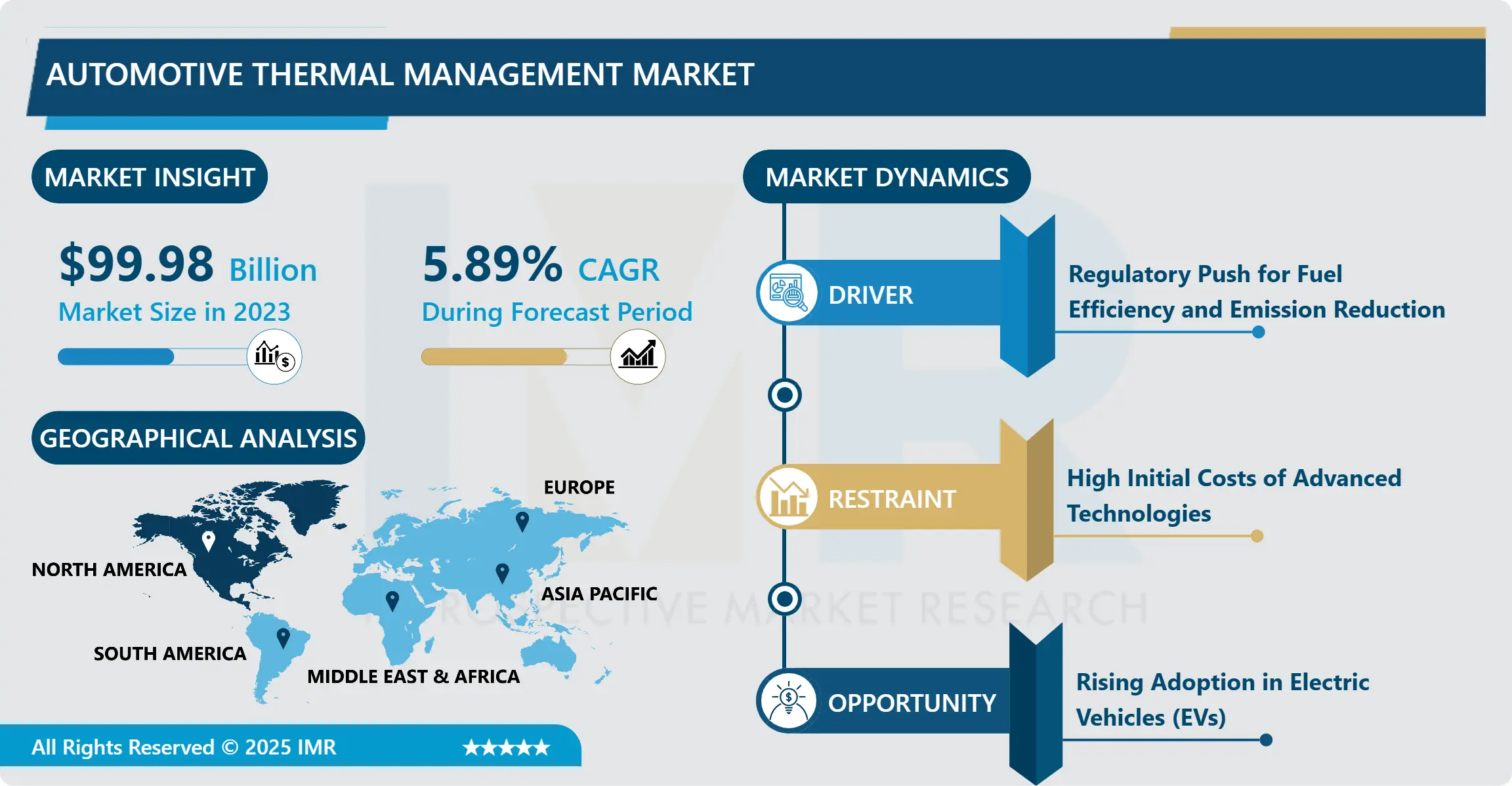
自動車用熱管理市場規模は2023年に999億8,000万米ドルと評価され、2032年までに1,673億4,000万米ドルに達すると予測されており、2024年から2032年にかけて年平均成長率(CAGR)5.89%で成長する見込みです。
自動車用熱管理システムは、車内の温度管理に関連する技術を取り扱い、エンジン、トランスミッション、エアコンの性能向上を図る。このようなシステムには、ラジエーター、排気ガス再循環システム、その他の暖房・換気・空調システムが含まれ、エネルギー効率、排出ガスの制御、自動車の稼働寿命全体の向上に寄与する。
自動車熱管理市場は、燃料消費の最適化、排出ガスの低減、性能向上に貢献するため、現在の自動車製造において重要なサブセクターである。電力の利用可能性、特に燃料消費効率の基準が厳格化する中、現代の熱管理技術は大きな変革を遂げた。従来のソリューションが直接熱伝達技術に基づいていたのに対し、現代の複雑なシステムにはデジタル制御、センサー、人工知能が組み込まれている。
内燃機関(ICE)は排出ガス規制の強化対象となるため、熱管理技術は規制要件を満たす上で戦略的に重要である。電気自動車(EV)やハイブリッド電気自動車(HEV)において、熱管理はバッテリーの寿命を延ばすだけでなく、極寒時や酷暑時の車両性能も向上させる。廃熱回収システムの統合は、この分野における新たな進展と言える。
アクティブトランスミッションウォームアップや排気ガス再循環(EGR)といった能動的熱管理技術の増加が主な要因である。これらの革新技術は全て、エンジンの暖機時間短縮、燃料効率向上、低排出ガス化に貢献する。さらに、排出ガスと燃費への懸念が高まる中、車両重量を軽減するため熱管理システム向け軽量材料の開発が進められている。
自動車用熱管理市場の動向分析:
スマート熱管理システムへの移行
熱システム向けの便利で効率的な解決策は、接続技術と人工知能技術により、スマート熱管理システムの開発へと発展しつつある。これらの知能システムは、センサーから収集したリアルタイム情報に基づき、エンジン、バッテリー、HVACなど車両の各種要素の最適性能に沿って熱管理を適応させるものである。
例えば電気自動車では、スマートシステムが充電温度を許容範囲内に制御し、リチウムイオン電池の熱劣化や凍結を防止することで電池寿命を延長します。さらに、車載環境制御・エンターテインメントシステムにおいては、AI制御のHVACシステムが乗員の好みや外気温に応じて車内環境を最適化します。この進化はエネルギー効率、車両自律性、コネクテッドモビリティ戦略に有益であるだけでなく、
電気自動車(EV)における普及拡大
電気モビリティへの一般的な移行は、熱管理分野のプレイヤーにとって大きなチャンスである。バッテリー熱管理は、性能、安全性、バッテリー寿命に直接関わるため、EVにとって極めて重要な要素だ。急速充電において重要な要素の一つが熱管理である。高温はバッテリーセルに損傷を与えるためだ。
さらに、EVにおける廃熱回収の高度な応用機会も生み出しています。例えば補助システムの充電や車内の暖房などが挙げられます。EVメーカーの普及拡大、特にグリーンエネルギー利用を推進する地域において、高性能な熱制御技術への需要は大幅な成長が見込まれ、市場発展の大きな可能性を秘めています。
自動車用熱管理市場セグメント分析:
自動車用熱管理市場は、システムタイプ、技術、コンポーネント、用途、車種、地域に基づいてセグメント化されています。
技術別では、予測期間中にアクティブトランスミッションウォームアップセグメントが市場を支配すると予想される
アクティブトランスミッションウォームアップや排気ガス再循環(EGR)といった技術により、市場をリードしています。アクティブトランスミッションウォームアップは、トランスミッションが望ましい温度に素早く到達することを可能にし、それによって熱損失を最小限に抑え、燃費を向上させます。一方、EGRシステムは排気ガスをエンジン内に再循環させることで、大気中に排出される窒素酸化物(NOx)の量を削減し、環境保護の概念を推進しています……
エンジン熱質量の低減とHVACシステム負荷の軽減も、車両全体の性能向上において重要な要素です。軽量素材の採用と冷却システムの高度化により、両者ともエンジンの軽量化とエネルギー消費の削減に貢献します。これらの革新技術は総合的に、統合型および/または環境に配慮したシステムへの市場の収束が進んでいることを示しています。
用途別では、エンジン冷却セグメントが最大のシェアを占めると予想される
熱管理システムの主な応用分野には、エンジン冷却と車内快適性が含まれます。エンジン冷却とは、エンジンの温度を適切に制御し、効率が著しく低下するほどの高温化を防ぐことを意味します。電気自動車(EV)では、バッテリーパックの温度管理も対象となるため、寒冷地では加熱機能が必要となります。車内快適性は、外部環境とは対照的に、HVACシステムによって車内の最適な快適性を提供します。
トランスミッションシステムと廃熱回収は、応用開発の段階にあります。トランスミッションシステムは燃料効率向上のための熱管理ソリューションによって支えられている一方、廃熱回収は不要な熱を有用な電力にリサイクルします。これは、外部エネルギー源を求める前に持続可能性アプローチを採用するハイブリッド車や電気自動車にとって非常に重要です。
自動車用熱管理市場における地域別インサイト:
予測期間において北米が市場を支配すると予想される
北米は自動車産業が高度に発達し、排出ガスに関する法的要件があるため、自動車用熱管理市場で最大のシェアを占めています。この地域では、エネルギー使用における効率性と持続可能性が革新的な熱管理技術の促進につながっています。
主要自動車メーカーと技術進歩が北米市場の地位を向上させています。さらに、政府が推進する電気自動車やハイブリッド車の普及により、高度な熱管理システムの活用が拡大し、市場での優位性を維持しています。
自動車用熱管理市場の主要プレイヤー:
ボルグワーナー社(米国)
カルソニックカンセイ株式会社(日本)
コンチネンタルAG(ドイツ)
デンソー株式会社(日本)
ジェンサーム・インコーポレイテッド(米国)
グレイソン・サーマル・システムズ(英国)
ハノン・システムズ(韓国)
MAHLE GmbH(ドイツ)
モディーン・マニュファクチャリング・カンパニー(米国)
Robert Bosch GmbH(ドイツ)
サンデンホールディングス株式会社(日本)
ヴァレオ(フランス)
その他の主要プレイヤー
自動車用熱管理市場における主要な業界動向:
2024年6月、ミシガン州オーバーンヒルズに新設されたTI Fluid Systemsのe-Mobility Innovation Center(eMIC)が正式に開所した。この4,460平方メートルの施設は、流体処理と温度管理を目的として設計され、北米向けハイブリッド車、プラグインハイブリッド車、バッテリー電気自動車向けの熱管理システム開発の効率化と顧客連携の促進を図る。
2024年4月、先進的な駆動系技術と電動化ソリューションの主要プロバイダーであるVitesco Technologiesは、自動車用熱管理技術の主要事業者であるSanden International(ヨーロッパ)と提携を結んだ。Vitesco Technologiesは以前、著名なドイツのティア1企業Continentalから、バッテリー電気自動車(BEV)向けに特別設計された熱管理システム事業部門をスピンオフしていた。両社は統合型熱管理システムを開発する。
第1章:はじめに
1.1 範囲と対象範囲
第2章:エグゼクティブサマリー
第3章:市場概況
3.1 市場動向
3.1.1 推進要因
3.1.2 抑制要因
3.1.3 機会
3.1.4 課題
3.2 市場動向分析
3.3 PESTLE分析
3.4 ポーターの5つの力分析
3.5 産業バリューチェーン分析
3.6 エコシステム
3.7 規制環境
3.8 価格動向分析
3.9 特許分析
3.10 技術進化
3.11 投資の集中領域
3.12 輸出入分析
第4章:システムタイプ別自動車用熱管理市場
4.1 自動車用熱管理市場の概況と成長要因
4.2 自動車用熱管理市場の概要
4.3 HVAC(暖房
4.3.1 概要と市場概況
4.3.2 過去および予測市場規模(金額ベース:米ドル、数量ベース)(2017-2032F)
4.3.3 主要市場動向、成長要因および機会
4.3.4 HVAC(暖房):地域別セグメント分析
4.4 換気
4.4.1 導入と市場概要
4.4.2 過去および予測市場規模(金額:米ドル、数量:単位)(2017-2032F)
4.4.3 主要市場動向、成長要因および機会
4.4.4 分割:地域別セグメンテーション分析
4.5 空調)
4.5.1 導入と市場概要
4.5.2 過去および予測市場規模(金額ベース:米ドル、数量ベース:単位)(2017-2032F)
4.5.3 主要市場動向、成長要因および機会
4.5.4 空調分野における地理的セグメント分析
4.6 パワートレイン冷却
4.6.1 導入と市場概要
4.6.2 過去および予測市場規模(金額:米ドル、数量:台数)(2017-2032F)
4.6.3 主要な市場動向、成長要因および機会
4.6.4 パワートレイン冷却:地域別セグメンテーション分析
4.7 バッテリー熱管理
4.7.1 概要と市場概観
4.7.2 過去および予測市場規模(金額:米ドル、数量:台数)(2017-2032F)
4.7.3 主要市場動向、成長要因および機会
4.7.4 バッテリー熱管理:地域別セグメンテーション分析
4.8 廃熱回収
4.8.1 概要と市場概観
4.8.2 過去および予測市場規模(金額:米ドル、数量:単位)(2017-2032F)
4.8.3 主要市場動向、成長要因および機会
4.8.4 廃熱回収:地域別セグメンテーション分析
第5章:技術別自動車用熱管理市場
5.1 自動車用熱管理市場の概況と成長エンジン
5.2 自動車用熱管理市場の概要
5.3 アクティブトランスミッションウォームアップ
5.3.1 概要と市場概況
5.3.2 過去および予測市場規模(金額:米ドル、数量:単位)(2017-2032F)
5.3.3 主要市場動向、成長要因および機会
5.3.4 アクティブ伝送ウォームアップ:地域別セグメンテーション分析
5.4 排気ガス再循環(EGR)
5.4.1 概要と市場概観
5.4.2 過去および予測市場規模(金額:米ドル、数量:台数)(2017-2032F)
5.4.3 主要市場動向、成長要因および機会
5.4.4 排気ガス再循環(EGR):地域別セグメンテーション分析
5.5 エンジン熱質量の低減
5.5.1 概要と市場概況
5.5.2 過去および予測市場規模(金額:米ドル、数量:単位)(2017-2032F)
5.5.3 主要な市場動向、成長要因および機会
5.5.4 エンジン熱質量削減:地域別セグメンテーション分析
5.6 HVACシステムの負荷低減
5.6.1 導入と市場概要
5.6.2 過去および予測市場規模(金額:米ドル、数量:単位)(2017-2032F)
5.6.3 主要市場動向、成長要因および機会
5.6.4 空調システム負荷の低減:地域別セグメンテーション分析
第6章:自動車用熱管理市場(コンポーネント別)
6.1 自動車用熱管理市場の概況と成長エンジン
6.2 自動車用熱管理市場の概要
6.3 コンプレッサー
6.3.1 概要と市場概況
6.3.2 過去および予測市場規模(金額:米ドル、数量:単位)(2017-2032F)
6.3.3 主要市場動向、成長要因および機会
6.3.4 コンプレッサー:地域別セグメンテーション分析
6.4 熱交換器
6.4.1 概要と市場概観
6.4.2 過去および予測市場規模(金額:米ドル、数量:単位)(2017-2032F)
6.4.3 主要市場動向、成長要因および機会
6.4.4 熱交換器:地域別セグメンテーション分析
6.5 熱電発電機
6.5.1 概要と市場概況
6.5.2 過去および予測市場規模(金額:米ドル、数量:単位)(2017-2032F)
6.5.3 主要市場動向、成長要因および機会
6.5.4 熱電発電機:地域別セグメンテーション分析
6.6 制御弁およびアクチュエータ
6.6.1 概要と市場概況
6.6.2 過去および予測市場規模(金額:米ドル、数量:単位)(2017-2032F)
6.6.3 主要な市場動向、成長要因および機会
6.6.4 制御弁とアクチュエータ:地域別セグメンテーション分析
第7章:車種別自動車熱管理市場
7.1 自動車用熱管理市場の概況と成長エンジン
7.2 自動車用熱管理市場の概要
7.3 乗用車
7.3.1 概要と市場概況
7.3.2 過去および予測市場規模(金額:米ドル、数量:台数)(2017-2032F)
7.3.3 主要市場動向、成長要因および機会
7.3.4 乗用車:地域別セグメンテーション分析
7.4 軽商用車
7.4.1 概要と市場概観
7.4.2 過去および予測市場規模(金額:米ドル、数量:台数)(2017-2032F)
7.4.3 主要市場動向、成長要因および機会
7.4.4 軽商用車:地域別セグメント分析
7.5 大型商用車
7.5.1 はじめにおよび市場概要
7.5.2 過去および予測市場規模(金額:米ドル、数量:台数)(2017-2032F)
7.5.3 主要な市場動向、成長要因および機会
7.5.4 大型商用車:地域別セグメント分析
7.6 電気自動車
7.6.1 概要と市場概観
7.6.2 過去および予測市場規模(金額:米ドル、数量:台数)(2017-2032F)
7.6.3 主要な市場動向、成長要因および機会
7.6.4 電気自動車:地域別セグメンテーション分析
第8章:用途別自動車用熱管理市場
8.1 自動車用熱管理市場の概況と成長エンジン
8.2 自動車用熱管理市場の概要
8.3 エンジン冷却
8.3.1 概要と市場概況
8.3.2 過去および予測市場規模(金額:米ドル、数量:単位)(2017-2032F)
8.3.3 主要市場動向、成長要因および機会
8.3.4 エンジン冷却:地域別セグメント分析
8.4 客室快適性
8.4.1 はじめにおよび市場概要
8.4.2 過去および予測市場規模(金額ベース:米ドル、数量ベース:台数)(2017-2032F)
8.4.3 主要市場動向、成長要因および機会
8.4.4 客室快適性:地域別セグメンテーション分析
8.5 伝送システム
8.5.1 導入と市場概要
8.5.2 過去および予測市場規模(金額:米ドル、数量:単位)(2017-2032F)
8.5.3 主要市場動向、成長要因および機会
8.5.4 送電システム:地域別セグメンテーション分析
8.6 廃熱回収
8.6.1 概要と市場概観
8.6.2 過去および予測市場規模(金額:米ドル、数量:単位)(2017-2032F)
8.6.3 主要市場動向、成長要因および機会
8.6.4 廃熱回収:地域別セグメンテーション分析
第9章:企業プロファイルと競合分析
9.1 競争環境
9.1.1 競合ベンチマーキング
9.1.2 メーカー別自動車用熱管理市場シェア(2023年)
9.1.3 業界BCGマトリックス
9.1.4 ヒートマップ分析
9.1.5 合併と買収
9.2 ボルグワーナー社(米国)
9.2.1 会社概要
9.2.2 主要幹部
9.2.3 会社概要
9.2.4 市場における当社の役割
9.2.5 持続可能性と社会的責任
9.2.6 事業セグメント
9.2.7 製品ポートフォリオ
9.2.8 事業実績
9.2.9 主要な戦略的施策と最近の動向
9.2.10 SWOT分析
9.3 株式会社デンソー(日本)
9.4 ヴァレオ(フランス)
9.5 マレ社(ドイツ)
9.6 コンチネンタルAG(ドイツ)
9.7 ジェンサーム・インコーポレイテッド(アメリカ)
9.8 ハノンシステムズ(韓国)
9.9 ロバート・ボッシュGmbH(ドイツ)
9.10 モディーン・マニュファクチャリング・カンパニー(アメリカ)
9.11 グレイソン・サーマル・システムズ(英国)
9.12 サンデンホールディングス株式会社(日本)
9.13 カルソニックカンセイ株式会社(日本)
9.14 その他の主要企業
第10章:地域別グローバル自動車用熱管理市場
10.1 概要
10.2 北米自動車用熱管理市場
10.2.1 主要市場動向、成長要因および機会
10.2.2 主要企業
10.2.3 セグメント別 過去及び予測市場規模
10.2.4 システムタイプ別 過去及び予測市場規模
10.2.4.1 HVAC(暖房
10.2.4.2 換気
10.2.4.3 および空調)
10.2.4.4 パワートレイン冷却
10.2.4.5 バッテリー熱管理
10.2.4.6 廃熱回収
10.2.5 技術別 過去及び予測市場規模
10.2.5.1 アクティブ伝送ウォームアップ
10.2.5.2 排気ガス再循環(EGR)
10.2.5.3 エンジン熱質量低減
10.2.5.4 HVACシステムの負荷低減
10.2.6 構成要素別 過去及び予測市場規模
10.2.6.1 コンプレッサー
10.2.6.2 熱交換器
10.2.6.3 熱電発電機
10.2.6.4 制御弁とアクチュエータ
10.2.7 車両タイプ別 過去及び予測市場規模
10.2.7.1 乗用車
10.2.7.2 軽商用車
10.2.7.3 大型商用車
10.2.7.4 電気自動車
10.2.8 用途別 過去及び予測市場規模
10.2.8.1 エンジン冷却
10.2.8.2 客室快適性
10.2.8.3 トランスミッションシステム
10.2.8.4 廃熱回収
10.2.9 国別歴史的及び予測市場規模
10.2.9.1 米国
10.2.9.2 カナダ
10.2.9.3 メキシコ
10.3. 東欧自動車用熱管理市場
10.3.1 主要市場動向、成長要因および機会
10.3.2 主要企業
10.3.3 セグメント別 過去及び予測市場規模
10.3.4 システムタイプ別 過去及び予測市場規模
10.3.4.1 HVAC(暖房
10.3.4.2 換気
10.3.4.3 および空調)
10.3.4.4 パワートレイン冷却
10.3.4.5 バッテリー熱管理
10.3.4.6 廃熱回収
10.3.5 技術別 過去及び予測市場規模
10.3.5.1 アクティブ伝送ウォームアップ
10.3.5.2 排気ガス再循環(EGR)
10.3.5.3 エンジン熱質量低減
10.3.5.4 HVACシステムの負荷低減
10.3.6 構成要素別 過去及び予測市場規模
10.3.6.1 コンプレッサー
10.3.6.2 熱交換器
10.3.6.3 熱電発電機
10.3.6.4 制御弁とアクチュエータ
10.3.7 車両タイプ別 過去及び予測市場規模
10.3.7.1 乗用車
10.3.7.2 軽商用車
10.3.7.3 大型商用車
10.3.7.4 電気自動車
10.3.8 用途別 過去及び予測市場規模
10.3.8.1 エンジン冷却
10.3.8.2 客室快適性
10.3.8.3 トランスミッションシステム
10.3.8.4 廃熱回収
10.3.9 国別歴史的及び予測市場規模
10.3.9.1 ロシア
10.3.9.2 ブルガリア
10.3.9.3 チェコ共和国
10.3.9.4 ハンガリー
10.3.9.5 ポーランド
10.3.9.6 ルーマニア
10.3.9.7 東欧その他
10.4. 西ヨーロッパ自動車用熱管理市場
10.4.1 主要市場動向、成長要因および機会
10.4.2 主要企業
10.4.3 セグメント別 過去及び予測市場規模
10.4.4 システムタイプ別 過去及び予測市場規模
10.4.4.1 HVAC(暖房
10.4.4.2 換気
10.4.4.3 および空調)
10.4.4.4 パワートレイン冷却
10.4.4.5 バッテリ熱管理
10.4.4.6 廃熱回収
10.4.5 技術別 過去及び予測市場規模
10.4.5.1 アクティブ伝送ウォームアップ
10.4.5.2 排気ガス再循環(EGR)
10.4.5.3 エンジン熱質量低減
10.4.5.4 HVACシステムの負荷低減
10.4.6 構成要素別 過去及び予測市場規模
10.4.6.1 コンプレッサー
10.4.6.2 熱交換器
10.4.6.3 熱電発電機
10.4.6.4 制御弁とアクチュエータ
10.4.7 車両タイプ別 過去及び予測市場規模
10.4.7.1 乗用車
10.4.7.2 軽商用車
10.4.7.3 大型商用車
10.4.7.4 電気自動車
10.4.8 用途別 過去及び予測市場規模
10.4.8.1 エンジン冷却
10.4.8.2 客室快適性
10.4.8.3 トランスミッションシステム
10.4.8.4 廃熱回収
10.4.9 国別歴史的及び予測市場規模
10.4.9.1 ドイツ
10.4.9.2 イギリス
10.4.9.3 フランス
10.4.9.4 オランダ
10.4.9.5 イタリア
10.4.9.6 スペイン
10.4.9.7 西ヨーロッパその他
10.5. アジア太平洋地域の自動車用熱管理市場
10.5.1 主要市場動向、成長要因および機会
10.5.2 主要企業
10.5.3 セグメント別 過去及び予測市場規模
10.5.4 システムタイプ別 過去及び予測市場規模
10.5.4.1 HVAC(暖房
10.5.4.2 換気
10.5.4.3 および空調)
10.5.4.4 パワートレイン冷却
10.5.4.5 バッテリー熱管理
10.5.4.6 廃熱回収
10.5.5 技術別 過去及び予測市場規模
10.5.5.1 アクティブ伝送ウォームアップ
10.5.5.2 排気ガス再循環(EGR)
10.5.5.3 エンジン熱質量低減
10.5.5.4 HVACシステムの負荷低減
10.5.6 構成要素別 過去及び予測市場規模
10.5.6.1 コンプレッサー
10.5.6.2 熱交換器
10.5.6.3 熱電発電機
10.5.6.4 制御弁とアクチュエータ
10.5.7 車両タイプ別 過去及び予測市場規模
10.5.7.1 乗用車
10.5.7.2 軽商用車
10.5.7.3 大型商用車
10.5.7.4 電気自動車
10.5.8 用途別 過去及び予測市場規模
10.5.8.1 エンジン冷却
10.5.8.2 客室快適性
10.5.8.3 トランスミッションシステム
10.5.8.4 廃熱回収
10.5.9 国別歴史的及び予測市場規模
10.5.9.1 中国
10.5.9.2 インド
10.5.9.3 日本
10.5.9.4 韓国
10.5.9.5 マレーシア
10.5.9.6 タイ
10.5.9.7 ベトナム
10.5.9.8 フィリピン
10.5.9.9 オーストラリア
10.5.9.10 ニュージーランド
10.5.9.11 アジア太平洋地域その他
10.6. 中東・アフリカ自動車用熱管理市場
10.6.1 主要市場動向、成長要因および機会
10.6.2 主要企業
10.6.3 セグメント別 過去及び予測市場規模
10.6.4 システムタイプ別 過去及び予測市場規模
10.6.4.1 HVAC(暖房
10.6.4.2 換気
10.6.4.3 および空調)
10.6.4.4 パワートレイン冷却
10.6.4.5 バッテリー熱管理
10.6.4.6 廃熱回収
10.6.5 技術別 過去及び予測市場規模
10.6.5.1 アクティブ伝送ウォームアップ
10.6.5.2 排気ガス再循環(EGR)
10.6.5.3 エンジン熱質量低減
10.6.5.4 HVACシステムの負荷低減
10.6.6 構成要素別 過去及び予測市場規模
10.6.6.1 コンプレッサー
10.6.6.2 熱交換器
10.6.6.3 熱電発電機
10.6.6.4 制御弁とアクチュエータ
10.6.7 車両タイプ別 過去及び予測市場規模
10.6.7.1 乗用車
10.6.7.2 軽商用車
10.6.7.3 大型商用車
10.6.7.4 電気自動車
10.6.8 用途別 過去及び予測市場規模
10.6.8.1 エンジン冷却
10.6.8.2 客室快適性
10.6.8.3 トランスミッションシステム
10.6.8.4 廃熱回収
10.6.9 国別歴史的及び予測市場規模
10.6.9.1 トルコ
10.6.9.2 バーレーン
10.6.9.3 クウェート
10.6.9.4 サウジアラビア
10.6.9.5 カタール
10.6.9.6 アラブ首長国連邦
10.6.9.7 イスラエル
10.6.9.8 南アフリカ
10.7. 南米自動車用熱管理市場
10.7.1 主要市場動向、成長要因および機会
10.7.2 主要企業
10.7.3 セグメント別 過去及び予測市場規模
10.7.4 システムタイプ別 過去及び予測市場規模
10.7.4.1 HVAC(暖房
10.7.4.2 換気
10.7.4.3 および空調)
10.7.4.4 パワートレイン冷却
10.7.4.5 バッテリー熱管理
10.7.4.6 廃熱回収
10.7.5 技術別 過去及び予測市場規模
10.7.5.1 アクティブ伝送ウォームアップ
10.7.5.2 排気ガス再循環(EGR)
10.7.5.3 エンジン熱質量低減
10.7.5.4 HVACシステムの負荷低減
10.7.6 構成要素別 過去及び予測市場規模
10.7.6.1 コンプレッサー
10.7.6.2 熱交換器
10.7.6.3 熱電発電機
10.7.6.4 制御弁およびアクチュエータ
10.7.7 車両タイプ別 過去及び予測市場規模
10.7.7.1 乗用車
10.7.7.2 軽商用車
10.7.7.3 大型商用車
10.7.7.4 電気自動車
10.7.8 用途別 過去及び予測市場規模
10.7.8.1 エンジン冷却
10.7.8.2 客室快適性
10.7.8.3 トランスミッションシステム
10.7.8.4 廃熱回収
10.7.9 国別 過去及び予測市場規模
10.7.9.1 ブラジル
10.7.9.2 アルゼンチン
10.7.9.3 南米その他
第11章 アナリストの見解と結論
11.1 提言と総括的分析
11.2 潜在的な市場戦略
第12章 研究方法論
12.1 研究プロセス
12.2 主要調査
12.3 二次調査
Q1: 自動車用熱管理市場調査レポートにおける予測期間はどの程度ですか?
A1: 自動車熱管理市場調査レポートにおける予測期間は2024年から2032年です。
Q2: 自動車用熱管理市場の主要プレイヤーは誰ですか?
A2: ボルグワーナー社(米国)、株式会社デンソー(日本)、ヴァレオ(フランス)、マーレ社(ドイツ)、Continental AG(ドイツ)、Gentherm Incorporated(米国)、Hanon Systems(韓国)、Robert Bosch GmbH(ドイツ)、Modine Manufacturing Company(米国)、Grayson Thermal Systems(英国)、Sanden Holdings Corporation(日本)、Calsonic Kansei Corporation(日本)、その他主要企業。
Q3: 自動車用熱管理市場のセグメントは?
A3: 自動車用熱管理市場は、システムタイプ、技術応用、コンポーネント、車種、地域によって区分されます。システムタイプ別では、HVAC(暖房、換気、空調)、パワートレイン冷却、バッテリー熱管理、廃熱回収に分類されます。技術別では、アクティブトランスミッションウォームアップ、排気ガス再循環(EGR)、エンジン熱質量低減、HVACシステム負荷低減に分類されます。部品別では、コンプレッサー、熱交換器、熱電発電機、制御バルブ、アクチュエーターに分類されます。車種別では、乗用車、小型商用車、大型商用車、電気自動車に分類されます。用途別では、エンジン冷却、キャビン快適性、トランスミッションシステム、廃熱回収に分類される。地域別では、北米(米国、カナダ、メキシコ)、東欧(ロシア、ブルガリア、チェコ共和国、ハンガリー、ポーランド、ルーマニア、その他東欧)、西欧(ドイツ、英国、フランス、オランダ、イタリア、ロシア、スペイン、西ヨーロッパその他)、アジア太平洋(中国、インド、日本、韓国、マレーシア、タイ、ベトナム、フィリピン、オーストラリア、ニュージーランド、アジア太平洋その他)、中東・アフリカ(トルコ、バーレーン、クウェート、サウジアラビア、カタール、UAE、イスラエル、南アフリカ)、南アメリカ(ブラジル、アルゼンチン、南アメリカその他)で分析されています。
Q4: 自動車用熱管理市場とは何ですか?
A4: 自動車用熱管理システムは、車両内の温度管理に関連する技術を取り扱い、エンジン、トランスミッション、エアコンの性能向上を図ります。これらのシステムには、ラジエーター、排気ガス再循環システム、その他の暖房・換気・空調システムが含まれ、エネルギー効率の向上、排出ガスの制御、自動車の稼働寿命全体の改善を目的としています。
Q5: 自動車用熱管理市場の規模はどのくらいですか?
A5: 自動車用熱管理市場規模は2023年に999億8,000万米ドルと評価され、2024年から2032年にかけて年平均成長率(CAGR)5.89%で成長し、2032年までに1,673億4,000万米ドルに達すると予測されています。
Chapter 1: Introduction
1.1 Scope and Coverage
Chapter 2:Executive Summary
Chapter 3: Market Landscape
3.1 Market Dynamics
3.1.1 Drivers
3.1.2 Restraints
3.1.3 Opportunities
3.1.4 Challenges
3.2 Market Trend Analysis
3.3 PESTLE Analysis
3.4 Porter’s Five Forces Analysis
3.5 Industry Value Chain Analysis
3.6 Ecosystem
3.7 Regulatory Landscape
3.8 Price Trend Analysis
3.9 Patent Analysis
3.10 Technology Evolution
3.11 Investment Pockets
3.12 Import-Export Analysis
Chapter 4: Automotive Thermal Management Market by System Type
4.1 Automotive Thermal Management Market Snapshot and Growth Engine
4.2 Automotive Thermal Management Market Overview
4.3 HVAC (Heating
4.3.1 Introduction and Market Overview
4.3.2 Historic and Forecasted Market Size in Value USD and Volume Units (2017-2032F)
4.3.3 Key Market Trends, Growth Factors and Opportunities
4.3.4 HVAC (Heating: Geographic Segmentation Analysis
4.4 Ventilation
4.4.1 Introduction and Market Overview
4.4.2 Historic and Forecasted Market Size in Value USD and Volume Units (2017-2032F)
4.4.3 Key Market Trends, Growth Factors and Opportunities
4.4.4 Ventilation: Geographic Segmentation Analysis
4.5 and Air Conditioning)
4.5.1 Introduction and Market Overview
4.5.2 Historic and Forecasted Market Size in Value USD and Volume Units (2017-2032F)
4.5.3 Key Market Trends, Growth Factors and Opportunities
4.5.4 and Air Conditioning): Geographic Segmentation Analysis
4.6 Powertrain Cooling
4.6.1 Introduction and Market Overview
4.6.2 Historic and Forecasted Market Size in Value USD and Volume Units (2017-2032F)
4.6.3 Key Market Trends, Growth Factors and Opportunities
4.6.4 Powertrain Cooling: Geographic Segmentation Analysis
4.7 Battery Thermal Management
4.7.1 Introduction and Market Overview
4.7.2 Historic and Forecasted Market Size in Value USD and Volume Units (2017-2032F)
4.7.3 Key Market Trends, Growth Factors and Opportunities
4.7.4 Battery Thermal Management: Geographic Segmentation Analysis
4.8 Waste Heat Recovery
4.8.1 Introduction and Market Overview
4.8.2 Historic and Forecasted Market Size in Value USD and Volume Units (2017-2032F)
4.8.3 Key Market Trends, Growth Factors and Opportunities
4.8.4 Waste Heat Recovery: Geographic Segmentation Analysis
Chapter 5: Automotive Thermal Management Market by Technology
5.1 Automotive Thermal Management Market Snapshot and Growth Engine
5.2 Automotive Thermal Management Market Overview
5.3 Active Transmission Warm-Up
5.3.1 Introduction and Market Overview
5.3.2 Historic and Forecasted Market Size in Value USD and Volume Units (2017-2032F)
5.3.3 Key Market Trends, Growth Factors and Opportunities
5.3.4 Active Transmission Warm-Up: Geographic Segmentation Analysis
5.4 Exhaust Gas Recirculation (EGR)
5.4.1 Introduction and Market Overview
5.4.2 Historic and Forecasted Market Size in Value USD and Volume Units (2017-2032F)
5.4.3 Key Market Trends, Growth Factors and Opportunities
5.4.4 Exhaust Gas Recirculation (EGR) : Geographic Segmentation Analysis
5.5 Engine Thermal Mass Reduction
5.5.1 Introduction and Market Overview
5.5.2 Historic and Forecasted Market Size in Value USD and Volume Units (2017-2032F)
5.5.3 Key Market Trends, Growth Factors and Opportunities
5.5.4 Engine Thermal Mass Reduction: Geographic Segmentation Analysis
5.6 Reduced HVAC System Load
5.6.1 Introduction and Market Overview
5.6.2 Historic and Forecasted Market Size in Value USD and Volume Units (2017-2032F)
5.6.3 Key Market Trends, Growth Factors and Opportunities
5.6.4 Reduced HVAC System Load: Geographic Segmentation Analysis
Chapter 6: Automotive Thermal Management Market by Component
6.1 Automotive Thermal Management Market Snapshot and Growth Engine
6.2 Automotive Thermal Management Market Overview
6.3 Compressor
6.3.1 Introduction and Market Overview
6.3.2 Historic and Forecasted Market Size in Value USD and Volume Units (2017-2032F)
6.3.3 Key Market Trends, Growth Factors and Opportunities
6.3.4 Compressor: Geographic Segmentation Analysis
6.4 Heat Exchanger
6.4.1 Introduction and Market Overview
6.4.2 Historic and Forecasted Market Size in Value USD and Volume Units (2017-2032F)
6.4.3 Key Market Trends, Growth Factors and Opportunities
6.4.4 Heat Exchanger: Geographic Segmentation Analysis
6.5 Thermoelectric Generator
6.5.1 Introduction and Market Overview
6.5.2 Historic and Forecasted Market Size in Value USD and Volume Units (2017-2032F)
6.5.3 Key Market Trends, Growth Factors and Opportunities
6.5.4 Thermoelectric Generator: Geographic Segmentation Analysis
6.6 Control Valves and Actuators
6.6.1 Introduction and Market Overview
6.6.2 Historic and Forecasted Market Size in Value USD and Volume Units (2017-2032F)
6.6.3 Key Market Trends, Growth Factors and Opportunities
6.6.4 Control Valves and Actuators: Geographic Segmentation Analysis
Chapter 7: Automotive Thermal Management Market by Vehicle Type
7.1 Automotive Thermal Management Market Snapshot and Growth Engine
7.2 Automotive Thermal Management Market Overview
7.3 Passenger Cars
7.3.1 Introduction and Market Overview
7.3.2 Historic and Forecasted Market Size in Value USD and Volume Units (2017-2032F)
7.3.3 Key Market Trends, Growth Factors and Opportunities
7.3.4 Passenger Cars: Geographic Segmentation Analysis
7.4 Light Commercial Vehicles
7.4.1 Introduction and Market Overview
7.4.2 Historic and Forecasted Market Size in Value USD and Volume Units (2017-2032F)
7.4.3 Key Market Trends, Growth Factors and Opportunities
7.4.4 Light Commercial Vehicles: Geographic Segmentation Analysis
7.5 Heavy Commercial Vehicles
7.5.1 Introduction and Market Overview
7.5.2 Historic and Forecasted Market Size in Value USD and Volume Units (2017-2032F)
7.5.3 Key Market Trends, Growth Factors and Opportunities
7.5.4 Heavy Commercial Vehicles: Geographic Segmentation Analysis
7.6 Electric Vehicles
7.6.1 Introduction and Market Overview
7.6.2 Historic and Forecasted Market Size in Value USD and Volume Units (2017-2032F)
7.6.3 Key Market Trends, Growth Factors and Opportunities
7.6.4 Electric Vehicles: Geographic Segmentation Analysis
Chapter 8: Automotive Thermal Management Market by Application
8.1 Automotive Thermal Management Market Snapshot and Growth Engine
8.2 Automotive Thermal Management Market Overview
8.3 Engine Cooling
8.3.1 Introduction and Market Overview
8.3.2 Historic and Forecasted Market Size in Value USD and Volume Units (2017-2032F)
8.3.3 Key Market Trends, Growth Factors and Opportunities
8.3.4 Engine Cooling: Geographic Segmentation Analysis
8.4 Cabin Comfort
8.4.1 Introduction and Market Overview
8.4.2 Historic and Forecasted Market Size in Value USD and Volume Units (2017-2032F)
8.4.3 Key Market Trends, Growth Factors and Opportunities
8.4.4 Cabin Comfort: Geographic Segmentation Analysis
8.5 Transmission System
8.5.1 Introduction and Market Overview
8.5.2 Historic and Forecasted Market Size in Value USD and Volume Units (2017-2032F)
8.5.3 Key Market Trends, Growth Factors and Opportunities
8.5.4 Transmission System: Geographic Segmentation Analysis
8.6 Waste Heat Recovery
8.6.1 Introduction and Market Overview
8.6.2 Historic and Forecasted Market Size in Value USD and Volume Units (2017-2032F)
8.6.3 Key Market Trends, Growth Factors and Opportunities
8.6.4 Waste Heat Recovery: Geographic Segmentation Analysis
Chapter 9: Company Profiles and Competitive Analysis
9.1 Competitive Landscape
9.1.1 Competitive Benchmarking
9.1.2 Automotive Thermal Management Market Share by Manufacturer (2023)
9.1.3 Industry BCG Matrix
9.1.4 Heat Map Analysis
9.1.5 Mergers and Acquisitions
9.2 BORGWARNER INC. (USA)
9.2.1 Company Overview
9.2.2 Key Executives
9.2.3 Company Snapshot
9.2.4 Role of the Company in the Market
9.2.5 Sustainability and Social Responsibility
9.2.6 Operating Business Segments
9.2.7 Product Portfolio
9.2.8 Business Performance
9.2.9 Key Strategic Moves and Recent Developments
9.2.10 SWOT Analysis
9.3 DENSO CORPORATION (JAPAN)
9.4 VALEO (FRANCE)
9.5 MAHLE GMBH (GERMANY)
9.6 CONTINENTAL AG (GERMANY)
9.7 GENTHERM INCORPORATED (USA)
9.8 HANON SYSTEMS (SOUTH KOREA)
9.9 ROBERT BOSCH GMBH (GERMANY)
9.10 MODINE MANUFACTURING COMPANY (USA)
9.11 GRAYSON THERMAL SYSTEMS (UK)
9.12 SANDEN HOLDINGS CORPORATION (JAPAN)
9.13 CALSONIC KANSEI CORPORATION (JAPAN)
9.14 OTHER ACTIVE PLAYERS
Chapter 10: Global Automotive Thermal Management Market By Region
10.1 Overview
10.2. North America Automotive Thermal Management Market
10.2.1 Key Market Trends, Growth Factors and Opportunities
10.2.2 Top Key Companies
10.2.3 Historic and Forecasted Market Size by Segments
10.2.4 Historic and Forecasted Market Size By System Type
10.2.4.1 HVAC (Heating
10.2.4.2 Ventilation
10.2.4.3 and Air Conditioning)
10.2.4.4 Powertrain Cooling
10.2.4.5 Battery Thermal Management
10.2.4.6 Waste Heat Recovery
10.2.5 Historic and Forecasted Market Size By Technology
10.2.5.1 Active Transmission Warm-Up
10.2.5.2 Exhaust Gas Recirculation (EGR)
10.2.5.3 Engine Thermal Mass Reduction
10.2.5.4 Reduced HVAC System Load
10.2.6 Historic and Forecasted Market Size By Component
10.2.6.1 Compressor
10.2.6.2 Heat Exchanger
10.2.6.3 Thermoelectric Generator
10.2.6.4 Control Valves and Actuators
10.2.7 Historic and Forecasted Market Size By Vehicle Type
10.2.7.1 Passenger Cars
10.2.7.2 Light Commercial Vehicles
10.2.7.3 Heavy Commercial Vehicles
10.2.7.4 Electric Vehicles
10.2.8 Historic and Forecasted Market Size By Application
10.2.8.1 Engine Cooling
10.2.8.2 Cabin Comfort
10.2.8.3 Transmission System
10.2.8.4 Waste Heat Recovery
10.2.9 Historic and Forecast Market Size by Country
10.2.9.1 US
10.2.9.2 Canada
10.2.9.3 Mexico
10.3. Eastern Europe Automotive Thermal Management Market
10.3.1 Key Market Trends, Growth Factors and Opportunities
10.3.2 Top Key Companies
10.3.3 Historic and Forecasted Market Size by Segments
10.3.4 Historic and Forecasted Market Size By System Type
10.3.4.1 HVAC (Heating
10.3.4.2 Ventilation
10.3.4.3 and Air Conditioning)
10.3.4.4 Powertrain Cooling
10.3.4.5 Battery Thermal Management
10.3.4.6 Waste Heat Recovery
10.3.5 Historic and Forecasted Market Size By Technology
10.3.5.1 Active Transmission Warm-Up
10.3.5.2 Exhaust Gas Recirculation (EGR)
10.3.5.3 Engine Thermal Mass Reduction
10.3.5.4 Reduced HVAC System Load
10.3.6 Historic and Forecasted Market Size By Component
10.3.6.1 Compressor
10.3.6.2 Heat Exchanger
10.3.6.3 Thermoelectric Generator
10.3.6.4 Control Valves and Actuators
10.3.7 Historic and Forecasted Market Size By Vehicle Type
10.3.7.1 Passenger Cars
10.3.7.2 Light Commercial Vehicles
10.3.7.3 Heavy Commercial Vehicles
10.3.7.4 Electric Vehicles
10.3.8 Historic and Forecasted Market Size By Application
10.3.8.1 Engine Cooling
10.3.8.2 Cabin Comfort
10.3.8.3 Transmission System
10.3.8.4 Waste Heat Recovery
10.3.9 Historic and Forecast Market Size by Country
10.3.9.1 Russia
10.3.9.2 Bulgaria
10.3.9.3 The Czech Republic
10.3.9.4 Hungary
10.3.9.5 Poland
10.3.9.6 Romania
10.3.9.7 Rest of Eastern Europe
10.4. Western Europe Automotive Thermal Management Market
10.4.1 Key Market Trends, Growth Factors and Opportunities
10.4.2 Top Key Companies
10.4.3 Historic and Forecasted Market Size by Segments
10.4.4 Historic and Forecasted Market Size By System Type
10.4.4.1 HVAC (Heating
10.4.4.2 Ventilation
10.4.4.3 and Air Conditioning)
10.4.4.4 Powertrain Cooling
10.4.4.5 Battery Thermal Management
10.4.4.6 Waste Heat Recovery
10.4.5 Historic and Forecasted Market Size By Technology
10.4.5.1 Active Transmission Warm-Up
10.4.5.2 Exhaust Gas Recirculation (EGR)
10.4.5.3 Engine Thermal Mass Reduction
10.4.5.4 Reduced HVAC System Load
10.4.6 Historic and Forecasted Market Size By Component
10.4.6.1 Compressor
10.4.6.2 Heat Exchanger
10.4.6.3 Thermoelectric Generator
10.4.6.4 Control Valves and Actuators
10.4.7 Historic and Forecasted Market Size By Vehicle Type
10.4.7.1 Passenger Cars
10.4.7.2 Light Commercial Vehicles
10.4.7.3 Heavy Commercial Vehicles
10.4.7.4 Electric Vehicles
10.4.8 Historic and Forecasted Market Size By Application
10.4.8.1 Engine Cooling
10.4.8.2 Cabin Comfort
10.4.8.3 Transmission System
10.4.8.4 Waste Heat Recovery
10.4.9 Historic and Forecast Market Size by Country
10.4.9.1 Germany
10.4.9.2 UK
10.4.9.3 France
10.4.9.4 The Netherlands
10.4.9.5 Italy
10.4.9.6 Spain
10.4.9.7 Rest of Western Europe
10.5. Asia Pacific Automotive Thermal Management Market
10.5.1 Key Market Trends, Growth Factors and Opportunities
10.5.2 Top Key Companies
10.5.3 Historic and Forecasted Market Size by Segments
10.5.4 Historic and Forecasted Market Size By System Type
10.5.4.1 HVAC (Heating
10.5.4.2 Ventilation
10.5.4.3 and Air Conditioning)
10.5.4.4 Powertrain Cooling
10.5.4.5 Battery Thermal Management
10.5.4.6 Waste Heat Recovery
10.5.5 Historic and Forecasted Market Size By Technology
10.5.5.1 Active Transmission Warm-Up
10.5.5.2 Exhaust Gas Recirculation (EGR)
10.5.5.3 Engine Thermal Mass Reduction
10.5.5.4 Reduced HVAC System Load
10.5.6 Historic and Forecasted Market Size By Component
10.5.6.1 Compressor
10.5.6.2 Heat Exchanger
10.5.6.3 Thermoelectric Generator
10.5.6.4 Control Valves and Actuators
10.5.7 Historic and Forecasted Market Size By Vehicle Type
10.5.7.1 Passenger Cars
10.5.7.2 Light Commercial Vehicles
10.5.7.3 Heavy Commercial Vehicles
10.5.7.4 Electric Vehicles
10.5.8 Historic and Forecasted Market Size By Application
10.5.8.1 Engine Cooling
10.5.8.2 Cabin Comfort
10.5.8.3 Transmission System
10.5.8.4 Waste Heat Recovery
10.5.9 Historic and Forecast Market Size by Country
10.5.9.1 China
10.5.9.2 India
10.5.9.3 Japan
10.5.9.4 South Korea
10.5.9.5 Malaysia
10.5.9.6 Thailand
10.5.9.7 Vietnam
10.5.9.8 The Philippines
10.5.9.9 Australia
10.5.9.10 New Zealand
10.5.9.11 Rest of APAC
10.6. Middle East & Africa Automotive Thermal Management Market
10.6.1 Key Market Trends, Growth Factors and Opportunities
10.6.2 Top Key Companies
10.6.3 Historic and Forecasted Market Size by Segments
10.6.4 Historic and Forecasted Market Size By System Type
10.6.4.1 HVAC (Heating
10.6.4.2 Ventilation
10.6.4.3 and Air Conditioning)
10.6.4.4 Powertrain Cooling
10.6.4.5 Battery Thermal Management
10.6.4.6 Waste Heat Recovery
10.6.5 Historic and Forecasted Market Size By Technology
10.6.5.1 Active Transmission Warm-Up
10.6.5.2 Exhaust Gas Recirculation (EGR)
10.6.5.3 Engine Thermal Mass Reduction
10.6.5.4 Reduced HVAC System Load
10.6.6 Historic and Forecasted Market Size By Component
10.6.6.1 Compressor
10.6.6.2 Heat Exchanger
10.6.6.3 Thermoelectric Generator
10.6.6.4 Control Valves and Actuators
10.6.7 Historic and Forecasted Market Size By Vehicle Type
10.6.7.1 Passenger Cars
10.6.7.2 Light Commercial Vehicles
10.6.7.3 Heavy Commercial Vehicles
10.6.7.4 Electric Vehicles
10.6.8 Historic and Forecasted Market Size By Application
10.6.8.1 Engine Cooling
10.6.8.2 Cabin Comfort
10.6.8.3 Transmission System
10.6.8.4 Waste Heat Recovery
10.6.9 Historic and Forecast Market Size by Country
10.6.9.1 Turkiye
10.6.9.2 Bahrain
10.6.9.3 Kuwait
10.6.9.4 Saudi Arabia
10.6.9.5 Qatar
10.6.9.6 UAE
10.6.9.7 Israel
10.6.9.8 South Africa
10.7. South America Automotive Thermal Management Market
10.7.1 Key Market Trends, Growth Factors and Opportunities
10.7.2 Top Key Companies
10.7.3 Historic and Forecasted Market Size by Segments
10.7.4 Historic and Forecasted Market Size By System Type
10.7.4.1 HVAC (Heating
10.7.4.2 Ventilation
10.7.4.3 and Air Conditioning)
10.7.4.4 Powertrain Cooling
10.7.4.5 Battery Thermal Management
10.7.4.6 Waste Heat Recovery
10.7.5 Historic and Forecasted Market Size By Technology
10.7.5.1 Active Transmission Warm-Up
10.7.5.2 Exhaust Gas Recirculation (EGR)
10.7.5.3 Engine Thermal Mass Reduction
10.7.5.4 Reduced HVAC System Load
10.7.6 Historic and Forecasted Market Size By Component
10.7.6.1 Compressor
10.7.6.2 Heat Exchanger
10.7.6.3 Thermoelectric Generator
10.7.6.4 Control Valves and Actuators
10.7.7 Historic and Forecasted Market Size By Vehicle Type
10.7.7.1 Passenger Cars
10.7.7.2 Light Commercial Vehicles
10.7.7.3 Heavy Commercial Vehicles
10.7.7.4 Electric Vehicles
10.7.8 Historic and Forecasted Market Size By Application
10.7.8.1 Engine Cooling
10.7.8.2 Cabin Comfort
10.7.8.3 Transmission System
10.7.8.4 Waste Heat Recovery
10.7.9 Historic and Forecast Market Size by Country
10.7.9.1 Brazil
10.7.9.2 Argentina
10.7.9.3 Rest of SA
Chapter 11 Analyst Viewpoint and Conclusion
11.1 Recommendations and Concluding Analysis
11.2 Potential Market Strategies
Chapter 12 Research Methodology
12.1 Research Process
12.2 Primary Research
12.3 Secondary Research
Megatrends.jpからレポートを購入する方法
製品ページで、ご希望のライセンスを選択してください:シングルユーザーライセンス または エンタープライズライセンス。
レポートの言語を選択してください:
- 英語レポート
- 英語レポート+日本語訳
今すぐ購入ボタンをクリックしてください。
チェックアウトページにリダイレクトされます。会社情報と支払い情報を入力してください。
注文を確定をクリックして購入を完了してください。
確認: ご注文確認メールをお送りします。その後、当社チームがレポートの納品についてご連絡いたします。
ご質問がある場合は、以下の問い合わせフォームにご記入いただくか、メールでお問い合わせください。 sales1@megatrends.jp.
Megatrends.jpをお選びいただき、誠にありがとうございます!